biotech

Logan’s List of Entrepreneurship Funding/Mentorship Resources


No Comments

After compiling these resources for my personal reference, I realized that others may benefit from them as well. As a person of collaborative spirit, I decided to post them here! Although these are focused on early-stage biotech entrepreneurship, many of the resources should also have broader applicability. I should note that some of the items listed may exist transiently, so parts of this compilation might eventually end up out-of-date. I hope that you find this list helpful for your own adventures!

Accelerators/Incubators

1517’s Flux Capacitor program

  • Part of the 1517 Fund. Offers up to $100K in funding for launching tech companies (including biotech).
  • Emphasizes escape from issues with academia and emphasizes sci-fi-like technologies.
  • “You want to hit ‘pause’ on the academic rat race and spend 3 months on first-principles exploration of either applied, practical problems that can be commercialized within a VC-funded startup in the near-medium term (5 years) or moonshot fundamental science.”
  • Work full-time for 1 summer (presumably some of the $100K may go towards living expenses?)
  • Appears to not require a specific location, though there is a weekend retreat at the beginning of the summer and a dinner at the end of the summer.

Activate Fellowship

  • “Fellows receive a yearly living stipend of $100K, plus travel allowance, health insurance, and relocation. This enables them to focus on their project full-time. Each project also receives $100K in R&D funds at zero cost and access to at least $75K in additional flexible capital.”
  • 2-year program.
  • Also offers intensive mentorship, entrepreneurial education, community support, and research facilities.
  • Eligibility issue for repeat founders: “Must be leading the commercial development of a hardware-based technology innovation for the first time if awarded the fellowship i.e., not a repeat hard tech founder.”
  • Eligibility issue for medical biotech: “Our Fellowship does not currently support innovators developing technologies that only have application in mammalian health. If the underlying technology has the potential to pivot to other, non-healthcare markets and the stage of development is early enough such that market exploration during the fellowship is a key activity, the Activate Fellowship is likely to provide transformative support and it is worth applying. Specifically, if a focus during the fellowship is pursuing FDA approval, Activate is not a good fit. We encourage you to think broadly about the applications and potential impact of your technology and look at other companies we have supported for examples.”
  • Communities in Berkeley, Boston, New York, and Houston. But does not appear to require a specific location.

IndieBio

  • “For the therapeutics track, because only $250K is upfront and the other $1.75 million is over time, we are looking for truly novel platforms and methodologies that need this time to prove their concept.”
  • Requires a co-founder.
  • New York or San Francisco location.

Entrepreneurs First

  • “At the start of the program founders receive an equity free Talent Investment (grant)* to cover living costs.”
  • “During FORM, the goal is to test cofounder partnerships and ideas at pace as you build a company from day one. You’ll be supported by a team of Talent Investors and our global network of advisors, who will challenge your ambitions and develop your vision of success. Throughout FORM, we will push you to obsess about customer development, validating your ideas with customer feedback and traction from the outset. Our goal is to help founders build their initial edge and develop their longer term vision. For those with the biggest ambitions, this will involve getting early traction with US customers and building their vision for that market, which we will support with our network of SF advisors and operators.”
  • “Towards the end of the program teams pitch to our Investment Committee for up to $250,000 in funding per team. This is made up of a $125,000 investment from EF, and the opportunity to receive a further $125,000 investment from EF’s third party investment partner, Transpose Platform*.” If you do not form a company or we choose not to invest at IC, we don’t take any equity and you don’t have to repay the grant. Instead you gain access to a global community of alumni to leverage for future success.
  • It should be noted that the first $125K is “a post-money SAFE* (Simple Agreement for Future Equity) for 8% of your company” and the other potential $125K is an “investment from our partner Transpose Platform via an uncapped MFN (Most Favoured Nation) SAFE.”
  • “At EF, we build technology companies. The majority of individuals who join EF will have a technical background, from self-taught developer through to a Computer Science PhD.” Note that they have also backed biotechnology companies.
  • Spring, Summer, and Winter programs are available.
  • Begins with an 8-week program (FORM) located in San Francisco, New York, London, Paris, or Bangalore. Concludes with a 4-week program where startups settle in San Francisco.

Soma Scholars

  • Part of Soma Capital. Offers a $30K grant (non-dilutive) and an 8-week summer program in San Francisco or New York City where the goal is to “become an expert at something, solve a riddle, write a research paper, prove a math theorem, start a hedge fund, master chess or poker, develop a new drug, launch a space company, design a chip, build a new LLM, or search for aliens!”
  • “We’ll give you a 30k grant, a beautiful office space in SF or NY, access to an elite community, catered dinners and events, and aspirational experiences”.

Nucleate

  • A student-led organization which identifies, educates, connects, and empowers academic biotechnology entrepreneurs to create and run startups. George Church, Tom Kalil, and Pamela Silver are some of the advisors. “Nucleate is a student-led organization that represents the largest global community of bio-innovators”.
  • Website provides the Nucleate Operationalizing Your Therapeutics Spinout Playbook as an educational resource.
  • Offers a six-month activator program that equips academic biotechnology founders with the skills and connections for successful business development.
  • “Activator is a six-month, equity-free cohort program designed for academic biotech founders. Its curriculum has served more than 100 life sciences ventures that have raised over $190 million in venture funding. Participating teams refine their scientific discoveries into biotech venture theses and train under Nucleate’s unparalleled network, rigorous curriculum, funded fellowships, legal support, and highly subsidized perks. Activator culminates in a final pitch showcase before world-renowned judges”.
  • Activator program is free and they do not take equity.
  • Activator program requires projects that have not received any equity funding, but which do have early proof-of-concept data.
  • “Activator takes place in-person in several regions globally. If there is not a Nucleate Chapter in your region, we also offer a Global Virtual Activator. (Ann Arbor, Atlanta, Baltimore, Bay Area, Boston, Canada, Chicago, DC, Denmark, Florida, France UniCA, Germany, Global Virtual, Israel, Los Angeles, New Haven, New York, Philadelphia, RTP, San Diego, Seattle, Switzerland, Texas, Twin City, United Kingdom)”.

Boost VC Bio Residency

  • A program by Boost VC. They emphasize that they are looking for extremely ambitious founders building sci-fi-like technologies. Scientist-founders should have a rebellious spirit and the ability to build businesses in addition to doing science.
  • “The residency includes workshops, office hours, and guest speakers—seasoned Bio founders and top Bio VCs to share journeys and insights to help you move faster.”
  • “The week wraps with a science fair-style showcase happy hour with Bio VCs and networking. Each startup will receive continued access to our housing and office space for 2 weeks after to continue building alongside fellow deep tech founders.”
  • Offers “$500K for 10%” and “Free housing & office space in Silicon Valley” and “Access to a week of hands-on programming designed to help founders craft their business plan and prepare to raise a full pre-seed round”.
  • Gathers the “most ambitious innovators in Bio” in Silicon Valley for an intensive learning and networking experience over the course of 2 weeks.

Neo Residency

  • An accelerator program aimed at startups and student teams. (But one can apply either as a student or as an incorporated startup). It does not require applicants to be students.
  • For startups: “$750K uncapped (YC standard safe). Each founder gets $10K profit share of Neo fund carry. We get participation rights in your next equity round to buy up to 5% total ownership”.
  • Residency provides “3 months at our beautiful SF space. Maximize your productivity and build lasting relationships with founders and mentors at our intensive 2-week Oregon bootcamp. Access to world-class mentors, tech leaders & VCs. Learn from fabled founders and seasoned operators. Meet industry leaders at intimate events and 1:1 sessions. End the program with a Demo Day and bespoke VC intros. OpenAI & Microsoft perks, community, & more.”
  • Neo also offers additional investment opportunities “Pre-seed & seed funding: Contact one of our team members (we prefer warm intros). We lead priced equity rounds or safes with our standard side letter.”
  • At least one member of the founding team must be technical.
  • One can apply as a solo founder or as a team. The program strongly encourages people looking for a cofounder find one before applying.
  • Occurs in person for ~3 months (SF location).

Silicon Valley Fellowship

  • 1-week program which says they make one into a “Silicon Valley insider”.
  • “Get access to a community of experienced alumni and mentors, networking events, and learn first-hand insights from Silicon Valley-based Big Tech professionals, investors, and tech entrepreneurs. A program to get fast-tracked into Silicon Valley ​through workshops, private community and networking events held in and around the cities of the San ​Francisco Bay Area. It’s a deep dive into the expertise of heads of Global tech ​corporations, professors of top world ranked universities, and ​founders of successful companies.”
  • Offers industry-leader talks, visits to companies and universities, networking opportunities, and a Slack community.
  • They also invest small $10K checks into companies through a separate application.

General Funding Opportunities

Boost VC $500K preseed

  • Boost VC offers a $500K investment (unclear as to if this is a SAFE or something else) for early-stage startups, particularly for technical founders who are good at storytelling and possess exceptional determination.
  • “Boost VC is looking for founders with the courage to stand up for what they believe, and the determination to build an enormous company. In order to do this, you must have a unique insight on the universe and have the self confidence to build things that seem impossible to your family/friends/everyone. Only apply if you DARE MIGHTY THINGS! On a GOOD QUEST! We invest $500k to be the first partner in important things!”

Boost VC $50K fellowship

  • Boost VC offers a $50K investment at a $1.5M valuation cap for early-stage startups, particularly for technical founders who are good at storytelling and possess exceptional determination.
  • “Boost VC is proud to introduce the Boost VC Fellowship (an equity based Fellowship), where we will invest $50K at $1.5M Cap into a founder or founders looking to start a new Deep Tech company… If it’s a potential fit, we will schedule one call and give you a quick decision… Are you Technical? Do you have the courage to stand up for what you believe? Are you good at storytelling? Are you a little possessed to build something great?”

Z Fellows

  • Startup fellowship which offers $10K at a $1B valuation cap (or participation without the money), mentorship and guidance, connections, and a 1-week workshop at the end of the program.
  • “Z Fellows are technical builders of all ages working on side projects and startups. We are your first believer. We’ve worked with high school dropouts, college students, and people with full-time jobs across a variety of industries, including consumer, social, enterprise, defense, healthcare, edtech, fintech, gaming, cloud infrastructure, cybersecurity, crypto, AI, ML, climate, biotech, and more. Z Fellows is a one-week startup program. But it really doesn’t end after one week. We continue to help you for the life of your company, and beyond — and so does the ZF alumni community”.
  • Does not require fellows to relocate.

Impetus Grants

  • “Impetus Grants is designed to fund ambitious longevity science that would not happen otherwise. We prioritize speed, conviction, and leverage, so researchers can move fast on ideas that could reshape the field. We provide up to $500k within 3 weeks for scientists to start working on the most important problems in aging biology. To date we have deployed $34M in the field.”
  • “Impetus focuses on work that is too speculative for government funding and too early for company formation.”
  • Offers open field grants (round 4 is targeting total funding of about $5M with up to $500K per awardee) as well as focused grants in areas like “AI-enabled datasets” and “infectious disease and aging”.

Emergent Ventures Grant

  • Philanthropic funding opportunity offered to highly motivated entrepreneurs (and others) with scalable project ideas for meaningfully improving society. Most awardees receive around $10K-$20K, but there are rumors that larger awards have been issued as well. Has a simple online application process centering on a 1500-word proposal.
  • “Launched in 2018, Emergent Ventures is a low-overhead fellowship and grant program that supports entrepreneurs and brilliant minds with highly scalable, ‘zero to one’ ideas for meaningfully improving society. Mercatus Center faculty director Tyler Cowen administers the program”.

Soma Fellows

  • Part of Soma Capital, Soma Fellows is a program that provides funding, mentorship, and network connections for driven entrepreneurs starting disruptive new tech companies.
  • Offers $100K to $1M in uncapped SAFE funding. Might follow on with over $10M for exceptional companies.
  • “Teams have the opportunity to receive $100k to 1m in funding from Soma Capital at the most founder-friendly terms possible. Soma Cap has the firepower to keep supporting you across the full path to IPO and the early stages are just the beginning for us… The program spans several weeks, offering sessions that guide you through the early stages of your entrepreneurial journey and help you build a foundation for scaling lasting companies. The Soma team, leveraging years of experience with top companies of our generation, will become your closest allies in establishing your company’s core and creating a product that impacts billions. The program culminates in a demo day, where founders showcase their products to potential customers, investors, and the community”.
  • No location requirement.

O’Shaughnessy Fellowship

  • Provides $100K to resourceful self-directed people trying to build the future. (No equity taken according to their website).
  • Funds not only founders, but also other people working on exciting projects with high potential to make positive change.
  • 10 fellowships of $100K (plus networking) are offered per year, along with up to 20 grants of $10K plus access to the O’Shaughnessy Ventures network.
  • “The O’Shaughnessy Fellowships is a one year program for researchers, builders and creatives advancing civilization. Twelve Months of pure possibility. No equity. No corporate overlords. No thesis requirements. No committee approvals. Just you, your vision, and the resources to make it real.”
  • “You don’t have to quit your job, but we prefer candidates who are willing to go all in for one year, dedicating a minimum of 40 hours a week to their work during the Fellowships period and ideally north of 60 hours a week.”
  • Does not have a location requirement, though optional gatherings may be hosted.
  • Highly competitive: thousands of people apply for the 10 spots (plus the 20 runner-up grants).
  • “Every applicant is automatically considered for both the $100,000 Fellowship and the $10,000 Grants.”
  • “The fellowships are aimed primarily at individuals. However, we do encourage you to start a company if you are able to.”
  • “If you’ve already started a startup or plan to raise outside investment to build a venture-scale company, please apply to Infinite Adventures – our venture capital arm, using the contact form.” See the O’Shaughnessy Ventures entry in the investor firms section for more.

Amaranth Foundation

  • “Our mission is to engage skilled researchers and support ambitious ideas in the longevity and neuroscience fields. In the past few years, we have donated and committed over $50M to research spanning neuroAI, brain aging, centenarian genetics, and next-gen neurotechnologies.”
  • One can reach out to them to discuss applying for funding through an email on their page.
  • Has a list of longevity priorities listed online referred to as Bottlenecks of Aging. One can submit proposals directly to Bottlenecks of Aging through a link on their page.
  • Sister organization is Starbloom Capital, which invests in longevity biotech, neuroAI, and emerging industries.

Funding for Nonprofits

Astera Residency

  • Offers: “salary of $125,000-$250,000, commensurate with experience, to explore an important problem of their choosing, along with an additional budget for a team and other operational expenses, as necessary; a chance to pitch us and others in our network for longer-term, larger-scale support; medical benefits; and access to substantial compute and programmatic resources”.
  • Focuses on non-proprietary science for public good, so emphasizes nonprofit research programs, generating large datasets, and open-source products.
  • Location in Emeryville California but may offer remote options in the future.
  • Does not permit journal publications on research they fund.

Renaissance Philanthropy

  • Have not found a specific program that offers funding, but they are a philanthropic firm that is likely to offer funding of some kind for nonprofit research organizations.

Training Programs

Frequency Bio

  • 1-week long series of “live virtual sessions covering the fundamentals of finding a co-founder, validating your idea, developing a business model, and raising capital.”
  • Also includes “live virtual and recorded talks from experienced founders.”
  • Positions participants in a community of future founders and helps them stay connected.
  • One applies to join (likely has some level of competitiveness).
  • Hosted by Pillar VC and sometimes others (e.g. MDplus).
  • No geographic requirement.

5050

  • Fifty Years offers a free program called 5050, which provides education on how to transition from a scientific role into operating as a founder.
  • “Over 16 weeks, you’ll work closely with the 50Y team to answer the following questions: Do I have an idea worth pursuing? How do I turn breakthrough research into a startup? Am I addressing a problem with a large enough market? How do I recruit a world-class team? Am I the right person to do it?”
  • Sessions are held in Boston, San Francisco, and remotely. Entire cohort is flown to San Francisco for kickoff and camp weekends.

Investor Firms

SciFounders

  • “We back strong technical leaders who work on world-changing technologies from pre-seed to series A.”
  • “We also run SciFounder Fellowship which comes with up to $1MM to get started and hands-on mentorship from us.”

Fifty Years

  • “We love scientists, engineers, hackers… Fifty Years is a pre-seed and seed focused VC firm. We back founders using technology to solve the world’s biggest problems. We also help start companies. 50Y founders are building massive businesses while solving the world’s most important problems: the climate crisis, disease, connectivity, malnutrition, and more.”
  • Fifty Years sometimes offers Manifest Grants of $25K-$100K for translational research in certain areas. Applications appear to be closed as of the time of this writing.
  • Fifty Years sometimes offers a free program called 5050, which provides education on how to transition from a scientific role into operating as a founder.
  • They have an academic Spinout Playbook resource on their website.

Petri

  • “Petri develops pre-seed companies attacking the world’s largest problems at the frontier of biology and engineering.”
  • “Every Petri company receives access to comprehensive resources and 1:1 coaching to help develop your idea into a company.”
  • “Co-founded and funded by Pillar VC”.
  • Petri emphasizes founder-led companies.

Deep Science Ventures

  • Four key areas: “restorative cultivation, scaling intelligence, the net-zero transition and curative therapeutics”.
  • Curative therapeutics area has four key themes: “effectively leveraging computational approaches to address complexity; developing therapeutics that can compute in-vivo and respond dynamically to the changing internal environment; creating better systems, models and analytics to support therapeutic discovery and development; and a focus on the root cause, including fixing and buffering molecular level damage, fixing broken or unhelpful messaging and signalling pathways, correcting errors at every level of gene expression and modifying the state of cells to drive regeneration.”
  • “Founders joining us have up to 18 months to form a company, are funded for the full duration and get to work with a dedicated sector specialist team. They join to work on opportunities that have been pre-scoped by us and have the chance to form more than one company over the course of their time with us, de-risking the standard founder proposition.”
  • They look for “Ambitious, resilient founders, with a real sense of urgency” and “Deep technical expertise with industry experience” and “Empathetic founders, with a strong ability to persuade through concise storytelling”.

Soma Capital

  • Has a focus on disruptive technologies and highly driven founders, aims to be more founder friendly than other VC firms.
  • “Soma Capital invests in brilliant, fearless teams building Category Kings. We focus on software to automate the world, across any sector and geography that can touch billions of people and push humanity forward”.

1517 Fund

  • A venture capital group that provides very early-stage funding to highly motivated and rebellious outside-the-box entrepreneurs, particularly young dropouts and sci-fi scientists working at the cutting edge of technology.
  • “1517 is a venture capital fund and community supporting college dropouts solving hard problems and deep tech scientists with investment at the earliest stages of their companies. Founded by the cofounders of the Thiel Fellowship, it supports founders across software, hardware, and deep tech verticals and also provides a community to hackers, makers, and scientists from across the world”.

Boost VC

  • Boost VC says they are “the most active Deep Tech investor on the planet” since they “average one deal per week.”
  • “We invest into emerging and frontier categories on the edges of the map… We lead Pre-Seed rounds with $500k checks, and we write $50k Founder Start checks as well.”
  • Emphasizes sci-fi-seeming technologies.

Genesis Fund

  • VC firm which funds early-stage companies.
  • Located in Boston.

O’Shaughnessy Ventures

  • An investment firm focusing on bold early stage founders: “We back tomorrow’s companies & creators before the world knows their names. Whether you’re coding, filming, writing or building, we’re here to provide the resources, support and connections you need. The Mission: Bet early on bold founders with radical ideas.”
  • Also supports book publishing through Infinite Books as well as films and podcasts.
  • Offers the O’Shaughnessy Fellowship of $100,000 (more details in the general funding opportunities section).

Starbloom Capital

  • Invests in deep tech: longevity biotech, neuroAI, and emerging industries.
  • Sister organization to the Amaranth Foundation.

Notable Recent Events in Gene Therapy Translation January 2023 to January 2026


No Comments

PDF version: Notable Recent Events in Gene Therapy Translation January 2023 to January 2026

Clinical gene therapy has seen a lot of big wins and a lot of big setbacks over the past few years. To help myself keep track of recent important events in the field, I decided to write up this catalogue of key happenings. Though the landscape is ever-evolving, this resource should nonetheless be useful in the relatively near future and perhaps serve as a historical record later on. It has been fascinating to read up on the industry’s dynamics! I hope any readers out there who encounter this page will find my catalogue similarly interesting and valuable.

  • June 2023: The FDA approved BioMarin’s Roctavian, an AAV5 gene therapy for hemophilia A. It is the first AAV gene therapy for hemophilia [16].

  • June 2023: the FDA approved (Accelerated Approval pathway) Sarepta’s AAVrh74 gene therapy for Duchenne’s muscular dystrophy (DMD) in ambulatory of male patients 4-5 years old [1]. This treatment is known as Elevidys. It treats DMD by expressing a microdystrophin to replace the role of the defective endogenous dystrophin. The per patient cost of the one-time Elevidys treatment was listed at $3.2M [2]. It used a high AAV dose of 1.33×10¹⁴ vg/kg [3].
  • October 2023: Sarepta’s Elevidys failed to reach statistical significance for its primary endpoint (functional mobility) in a phase 3 clinical trial, though substantial evidence of secondary endpoint effects was reported by the company. A p value of 0.24 for the main functional mobility test was reported [4].
  • February 2024: Despite its setbacks, the FDA still accepted an efficacy supplement to the Biologics License Application (BLA) of Elevidys, which removed age and ambulation restrictions from the treatment.
  • March 2025: Sarepta reported a patient death due to acute liver failure after Elevidys treatment [5]. A recent cytomegalovirus infection was identified by the reporting physician as a possible contributing factor, but the main reason was probably the high AAV dose.
  • June 2025: Sarepta reported another patient death due to acute liver failure after Elevidys treatment [6]. Both of the deaths were in non-ambulatory teenage boys.
  • June 2025: Sarepta paused shipments of Elevidys to non-ambulatory patients. The FDA began investigating the Elevidys deaths. Sarepta also reported a third death (which had actually occurred in June), this time of a 51-year-old non-ambulatory patient in one of their clinical trials for limb-girdle muscular dystrophy (LGMD) [7]. This patient had been treated with an investigational gene therapy which leveraged the same AAVrh74 capsid as Elevidys [8].
  • July 2025: The FDA issued a major action bundle which placed Sarepta’s muscular dystrophy gene therapy clinical trials on hold, revoked AAVrh74’s platform technology designation, and made a voluntary request for Sarepta to immediately cease all Elevidys distribution [9]. Roche then paused shipments of Elevidys for non-ambulatory patients outside of the USA [10].
  • July 2025: Sarepta initially resisted the request to stop distributing Elevidys. But after further consideration, Sarepta agreed to the FDA’s request [7]. To mitigate financial losses, Sarepta performed major restructuring, laying off about 36% of their workforce (~500 employees) [11].
  • July 2025: The Committee for Medicinal Products for Human Use (CHMP) of the European Medicines Agency (EMA) issued an official negative opinion on the conditional marketing authorization (CMA) of Elevidys for ambulatory DMD patients of 3-7 years [12]. Roche noted that over 900 DMD patients (760 ambulatory) had received Elevidys, demonstrating a manageable safety profile.
  • July 2025: The FDA began investigating the death of an 8-year-old boy who died in June after receiving Elevidys [13]. However, the treating physician deemed this death unrelated to the Elevidys treatment [14].
  • November 2025: The FDA approved a new label for Elevidys which included a Boxed Warning, limited the indication to ambulatory DMD patients 4 years of age and older, and added new recommendations for safety and monitoring [15].

  • November 2023: The United Kingdom MHRA (Medicines and Healthcare products Regulatory Agency) approved Casgevy (developed by Vertex Pharmaceuticals and CRISPR Therapeutics through a strategic partnership) for the treatment of sickle cell disease and transfusion-dependent beta thalassemia. Casgevy is the first CRISPR-Cas9 gene therapy applied in humans. It performs gene editing ex vivo on blood stem cells derived from the patient (via electroporation of Cas9) to knock out the erythroid-specific enhancer region of the BCL11A gene, disinhibiting production of fetal hemoglobin [17].
  • December 2023: The FDA approved Casgevy to treat sickle cell disease [18]. Both the FDA and MHRA approvals represented the first regulatory authorization of a CRISPR therapy in the world.
  • January 2024: The FDA approved Casgevy to also treat transfusion-dependent beta thalassemia [19].

  • December 2023: The FDA approved Bluebird Bio’s Lyfgenia to treat sickle cell disease [18]. Lyfgenia is an ex vivo lentiviral gene therapy which delivers a copy of HbAT87Q into blood stem cells derived from the patient. This hemoglobin behaves similarly to normal hemoglobin and thus treats the sickle cell condition. The one-time Lyfgenia treatment price is $3.1M.

  • March 2024: The FDA approved the Orchard Therapeutics gene therapy Lenmeldy to treat children with metachromatic leukodystrophy (MLD) [20], [21]. Lenmeldy is an ex vivo gene therapy which uses a lentiviral vector to modify a patient’s stem cells to add a functional copy of the ARSA (arylsulfatase A) gene. This gene encodes the ARSA enzyme and degrades harmful sulfatides. MLD patients possess mutations in their endogenous ARSA enzyme gene. Lenmeldy is the most expensive therapy in the world at $4.2M [21].

  • May 2023: The FDA approved Krystal Biotech’s Vyjuvek to treat dystrophic epidermolysis bullosa (DEB). It uses a herpes simplex virus 1 (HSV-1) vector to deliver normal copies of the COL7A1 (collagen type VII alpha 1 chain) gene into wounds caused by the disease [22]. A healthcare professional applies the vector topically to the patient’s wounds once per week. The treatment costs $630,500 per year [21].

  • April 2025: The FDA approved Zevaskyn, a unique autologous cell sheet gene therapy, for treatment of recessive dystrophic epidermolysis bullosa (RDEB) [23]. Cells derived from the patient are collected and transduced with a replication-incompetent retroviral vector (RVV) carrying a copy of the COL7A1 gene [24]. These cells are used to grow sheets of skin which are grafted onto the patient’s wounds. The treatment costs $3.1M and provides up to 12 cell sheets.

  • April 2024: The FDA approved Pfizer’s Beqvez, an AAVRh74var vector encoding factor IX, for treatment of hemophilia B [25]. It was priced at $3.5M per patient [26].
  • May 2025: Pfizer discontinued Beqvez due to lack of patients adopting the therapy (no patients had received the treatment outside of clinical trials) [26]. After discontinuing Beqvez, Pfizer was left with no gene therapies on the market or even in development, a setback for the gene therapy field.

  • May 2025: During a phase II clinical trial for treatment of Danon disease with an AAV9 vector (6.7×10¹³ vg/kg), a patient died [27]. This led the FDA to put a clinical hold on the trial.
  • August 2025: The FDA lifted its clinical hold on RP-A501 less than 3 months later [28]. They confirmed that Rocket Pharmaceuticals had addressed the issues relating to the clinical hold by changing the dose to 3.8×10¹³ vg/kg and modifying their immunomodulatory drug regime. Rocket Pharmaceuticals thus resumed the clinical trial.

  • August 2024: In a phase I clinical trial, Intellia Therapeutics demonstrated the first redosing data of an in vivo CRISPR therapy in humans [29]. This therapy treats transthyretin amyloidosis (ATTR) by knocking out the TTR gene in hepatocytes. It uses a lipid nanoparticle (LNP) delivery platform. It should be noted that further redosing was not planned for NTLA-2001 specifically, but the data may be useful for future therapies from Intellia.
  • October 2025: During the MAGNITUDE-2 phase III clinical trial for NTLA-2001, a patient experienced a grade 4 liver adverse event and was hospitalized. As a result, the FDA placed the MAGNITUDE and MAGNITUDE-2 trials on clinical hold [30]. (The MAGNITUDE trial is for treating ATTR with cardiomyopathy and the MAGNITUDE-2 trial is for treating ATTR with polyneuropathy).
  • January 2026: The FDA lifted its clinical hold on MAGNITUDE-2 [31].

  • December 2024: UniQure and the FDA reached an agreement for Huntington’s disease gene therapy AMT-130 to enter the accelerated approval pathway [32]. AMT-130 uses an AAV5 vector encoding a miRNA which inhibits expression of the mutant Huntingtin protein [33]. The AAV5 is delivered directly to the brain via a micro-catheter [34].
  • September 2025: UniQure showed a statistically significant 75% slowing of Huntington’s disease progression in a phase I/II clinical trial for AMT-130, a major breakthrough [35].
  • November 2025: Although UniQure had previously reached an agreement with the FDA for AMT-130 to enter the accelerated approval pathway (and had later presented the breakthrough data on slowing Huntington’s disease progression by 75%), the FDA stated the data were insufficient to support approval due to the use of an external control group [36]. UniQure continues to work with the FDA in an effort to move AMT-130 forward despite this setback.

  • September 2025: In a phase I/II clinical trial (CAP-002 SYNRGY) intended to treat syntaxin-binding protein 1 (STXBP1) encephalopathy, Capsida Biotherapeutics used an AAV capsid which had been engineered to efficiently cross the blood-brain-barrier while exhibiting liver-detargeting. The first patient (a child) dosed with this treatment died [37]. The trial was placed on clinical hold.
  • January 2026: After investigating, Capsida found that the patient’s death was triggered by cerebral edema, but the root cause remained undetermined (i.e. no one knows whether the treatment had been directly responsible for the death) [38]. All of this has resulted in increased scrutiny on the field of blood-brain-barrier crossing AAVs.

  • July 2025: The FDA issued a Complete Response Letter (CRL) to Replimune’s biologics license application (BLA) for treatment of advanced melanoma with RP1 [39], an oncolytic engineered herpes simplex virus 1 (HSV-1) equipped with a fusogenic protein that encodes GM-CSF (granulocyte-macrophage colony-stimulating factor). The CRL voiced concerns about the RP1 IGNYTE trial’s design, interpretability, and inadequate controls, and the heterogeneity of the patient population. This represented a major (and highly publicized) setback for the company.
  • October 2025: After presenting a revised trial design during a type A meeting with the FDA, Replimune’s BLA resubmission was accepted [40]. This means that RP1 is cleared for further FDA evaluation towards possible approval for marketing in the U.S.

  • March 2025: In a phase I/II clinical trial of its base editor formulation BEAM-302, Beam Therapeutics showed successful human proof-of-principle for treating alpha-1 antitrypsin deficiency (AATD) [41]. The formulation consists of a lipid nanoparticle (LNP) carrying guide RNA and an mRNA (the latter encodes the base editor).
  • March 2025: The FDA cleared Beam’s investigational new drug application (IND) for BEAM-302 to treat AATD [42].
  • December 2025: Beam announced strong safety and efficacy data from its phase I/II clinical trial BEACON for their BEAM-101 ex vivo base editor therapy sickle cell disease therapy [43]. In BEAM-101, stem cells from a patient are electroporated with base editors which modify the promoter regions of HBG1/2 genes, preventing binding of the transcriptional repressor BCL11A. After reintroduction of the cells into the patient’s bone marrow, this increases expression of fetal hemoglobin, combating the sickle cell disease.

[1]     “FDA Approves First Gene Therapy for Treatment of Certain Patients with Duchenne Muscular Dystrophy,” 2023. https://www.fda.gov/news-events/press-announcements/fda-approves-first-gene-therapy-treatment-certain-patients-duchenne-muscular-dystrophy

[2]     “After delays, Sarepta’s DMD gene therapy Elevidys finally crosses FDA finish line at $3.2M,” 2023. https://www.fiercepharma.com/pharma/sareptas-dmd-gene-therapy-finally-makes-it-accelerated-approval-finish-line-restricted

[3]     “Sarepta Therapeutics Announces Topline Results from EMBARK, a Global Pivotal Study of ELEVIDYS Gene Therapy for Duchenne Muscular Dystrophy,” 2023. https://investorrelations.sarepta.com/news-releases/news-release-details/sarepta-therapeutics-announces-topline-results-embark-global-0

[4]     “Sarepta Fails Confirmatory Trial for DMD Therapy, Still Eyes Label Expansion,” 2023. https://www.biospace.com/sarepta-fails-confirmatory-trial-for-dmd-therapy-still-eyes-label-expansion

[5]     “Community Letter: ELEVIDYS Safety Update,” 2025. https://www.sarepta.com/community-letter-elevidys-safety-update

[6]     “FDA investigates patient deaths after treatment with Sarepta’s gene therapy,” 2025. https://www.reuters.com/business/healthcare-pharmaceuticals/fda-investigates-patient-deaths-after-treatment-with-sareptas-gene-therapy-2025-06-24/

[7]     “Sarepta, bowing to FDA pressure, pauses shipments of Duchenne gene therapy Elevidys,” 2025. https://www.fiercepharma.com/pharma/sarepta-getting-back-fdas-good-side-pauses-shipments-duchenne-gene-therapy-elevidys

[8]     “Sarepta Therapeutics Announces Pipeline Progress for Multiple Limb-Girdle Muscular Dystrophy Programs,” 2025. https://investorrelations.sarepta.com/news-releases/news-release-details/sarepta-therapeutics-announces-pipeline-progress-multiple-limb

[9]     “FDA Requests Sarepta Therapeutics Suspend Distribution of Elevidys and Places Clinical Trials on Hold for Multiple Gene Therapy Products Following 3 Deaths,” 2025. https://www.fda.gov/news-events/press-announcements/fda-requests-sarepta-therapeutics-suspend-distribution-elevidys-and-places-clinical-trials-hold

[10]   “Roche pauses shipments of Elevidys gene therapy outside US,” 2025. https://www.reuters.com/sustainability/boards-policy-regulation/roche-pauses-shipments-elevidys-gene-therapy-outside-us-2025-07-22/

[11]   “Sarepta to lay off about 500 employees after Duchenne gene therapy setbacks,” 2025. https://www.biopharmadive.com/news/sarepta-layoffs-restructuring-elevidys-duchenne-research-cuts/753256/

[12]   “Roche provides regulatory update on ElevidysTM gene therapy for Duchenne muscular dystrophy in the EU,” 2025.

[13]   “FDA Investigating Death of 8-Year-Old Boy Who Received Elevidys,” 2025. https://www.fda.gov/news-events/press-announcements/fda-investigating-death-8-year-old-boy-who-received-elevidys

[14]   “Sarepta Therapeutics Provides Clarifying Statement on ELEVIDYS,” 2025. https://investorrelations.sarepta.com/news-releases/news-release-details/sarepta-therapeutics-provides-clarifying-statement-elevidys

[15]   “FDA Approves New Safety Warning and Revised Indication that Limits Use for Elevidys Following Reports of Fatal Liver Injury,” 2025. https://www.fda.gov/news-events/press-announcements/fda-approves-new-safety-warning-and-revised-indication-limits-use-elevidys-following-reports-fatal

[16]   A. Philippidis, “BioMarin’s ROCTAVIAN Wins Food and Drug Administration Approval As First Gene Therapy for Severe Hemophilia A,” Hum. Gene Ther., vol. 34, no. 15–16, pp. 665–668, Aug. 2023, doi: 10.1089/hum.2023.29251.bfs.

[17]   “Vertex and CRISPR Therapeutics Announce Authorization of the First CRISPR/Cas9 Gene-Edited Therapy, CASGEVYTM (exagamglogene autotemcel), by the United Kingdom MHRA for the Treatment of Sickle Cell Disease and Transfusion-Dependent Beta Thalassemia,” 2023. https://investors.vrtx.com/news-releases/news-release-details/vertex-and-crispr-therapeutics-announce-authorization-first

[18]   “FDA Approves First Gene Therapies to Treat Patients with Sickle Cell Disease,” 2023, [Online]. Available: https://www.fda.gov/news-events/press-announcements/fda-approves-first-gene-therapies-treat-patients-sickle-cell-disease

[19]   “Vertex Announces US FDA Approval of CASGEVYTM (exagamglogene autotemcel) for the Treatment of Transfusion-Dependent Beta Thalassemia,” 2024. https://investors.vrtx.com/news-releases/news-release-details/vertex-announces-us-fda-approval-casgevytm-exagamglogene

[20]   “FDA Approves First Gene Therapy for Children with Metachromatic Leukodystrophy,” 2024. https://www.fda.gov/news-events/press-announcements/fda-approves-first-gene-therapy-children-metachromatic-leukodystrophy

[21]   A. Mullard, “FDA approves gene therapy for metachromatic leukodystrophy, the tenth for a genetic disease and the priciest yet,” Nature Reviews Drug Discovery, 2024.

[22]   “FDA Approves First Topical Gene Therapy for Treatment of Wounds in Patients with Dystrophic Epidermolysis Bullosa,” 2023, [Online]. Available: https://www.fda.gov/news-events/press-announcements/fda-approves-first-topical-gene-therapy-treatment-wounds-patients-dystrophic-epidermolysis-bullosa

[23]   “ZEVASKYN,” 2025. https://www.fda.gov/vaccines-blood-biologics/zevaskyn

[24]   “FDA approves cell-sheet-based gene therapy for severe skin disease,” 2025. https://www.nature.com/articles/d41573-025-00082-2

[25]   “U.S. FDA Approves Pfizer’s BEQVEZTM (fidanacogene elaparvovec-dzkt), a One-Time Gene Therapy for Adults with Hemophilia B,” 2024. https://www.pfizer.com/news/press-release/press-release-detail/us-fda-approves-pfizers-beqveztm-fidanacogene-elaparvovec

[26]   “Pfizer Jettisons FDA-Approved Hemophilia B Gene Therapy Beqvez,” 2025, [Online]. Available: https://www.cgtlive.com/view/pfizer-jettisons-fda-approved-hemophilia-b-gene-therapy-beqvez

[27]   “Patient Dies After Treatment With Rocket Pharmaceuticals’ Danon Disease Gene Therapy RP-A501 in Phase 2 Trial,” 2025. https://www.cgtlive.com/view/patient-dies-after-treatment-rocket-pharmaceuticals-danon-disease-gene-therapy-rp-a501-phase-2-trial

[28]   “Rocket Pharmaceuticals Announces FDA Has Lifted the Clinical Hold on the Pivotal Phase 2 Trial of RP-A501 for the Treatment of Danon Disease,” 2025. https://ir.rocketpharma.com/news-releases/news-release-details/rocket-pharmaceuticals-announces-fda-has-lifted-clinical-hold

[29]   “Intellia Announces Positive Clinical Proof-of-Concept Data for Redosing a CRISPR-Based Therapy with its Proprietary LNP-Based Delivery Platform,” 2024. https://ir.intelliatx.com/news-releases/news-release-details/intellia-announces-positive-clinical-proof-concept-data-redosing

[30]   “Intellia Puts Phase 3 Trials for Transthyretin Amyloidosis Gene Editing Therapy Nex-Z on Hold Following Grade 4 Liver AE,” 2025. https://www.cgtlive.com/view/intellia-phase-3-trials-transthyretin-amyloidosis-gene-editing-therapy-nex-z-hold-grade-4-liver-ae

[31]   “Intellia Therapeutics Announces FDA Lift of Clinical Hold on MAGNITUDE-2 Phase 3 Clinical Trial in ATTRv-PN,” 2026. https://ir.intelliatx.com/news-releases/news-release-details/intellia-therapeutics-announces-fda-lift-clinical-hold-magnitude

[32]   “uniQure Announces Alignment with FDA on Key Elements of Accelerated Approval Pathway for AMT-130 in Huntington’s Disease,” 2024. https://uniqure.gcs-web.com/news-releases/news-release-details/uniqure-announces-alignment-fda-key-elements-accelerated

[33]   “Silencing the mutant huntingtin gene.” https://www.uniqure.com/programs-pipeline/huntingtons-disease

[34]   “Phase I/II Clinical Trial of AMT-130,” 2025. https://www.uniqure.com/programs-pipeline/phase-1-2-clinical-trial-of-amt-130

[35]   “uniQure hopes to launch 1st Huntington’s gene therapy next year following phase 1/2 success,” 2025. https://www.fiercebiotech.com/biotech/uniqure-hopes-launch-1st-huntingtons-gene-therapy-next-year-following-phase-12-success

[36]   “uniQure’s ballyhooed gene therapy for Huntington’s hits FDA roadblock,” 2025. https://www.fiercebiotech.com/biotech/fierce-biotech-layoff-tracker-2026

[37]   “Capsida pauses phase 1 gene therapy trial after child dies,” 2025. https://www.fiercebiotech.com/biotech/capsida-pauses-phase-1-gene-therapy-trial-after-child-dies

[38]   “An Important Update Regarding Our CAP-002 Program: A Letter to the STXBP1 Community,” 2026. https://capsida.com/an-important-update-regarding-our-cap-002-program-a-letter-to-the-stxbp1-community/

[39]   “Replimune Receives Complete Response Letter from FDA for RP1 Biologics License Application for the Treatment of Advanced Melanoma,” 2025. https://ir.replimune.com/news-releases/news-release-details/replimune-receives-complete-response-letter-fda-rp1-biologics

[40]   “Replimune Announces FDA Acceptance of BLA Resubmission of RP1 for the Treatment of Advanced Melanoma,” 2025.

[41]   “Beam Therapeutics Announces Positive Initial Data for BEAM-302 in the Phase 1/2 Trial in Alpha-1 Antitrypsin Deficiency (AATD), Demonstrating First Ever Clinical Genetic Correction of a Disease-causing Mutation,” 2025. https://investors.beamtx.com/news-releases/news-release-details/beam-therapeutics-announces-positive-initial-data-beam-302-phase

[42]   “Beam Therapeutics Announces Clearance of Investigational New Drug Application for BEAM-302 for the Treatment of Alpha-1 Antitrypsin Deficiency (AATD) by the United States (U.S.) Food and Drug Administration,” 2025. https://investors.beamtx.com/news-releases/news-release-details/beam-therapeutics-announces-clearance-investigational-new-drug

[43]   “Beam Therapeutics Reports Updated Data from BEACON Phase 1/2 Trial of ristoglogene autogetemcel (risto-cel) Highlighting Durable, Differentiated Profile in Sickle Cell Disease (SCD) at American Society of Hematology (ASH) Annual Meeting,” 2025. https://investors.beamtx.com/news-releases/news-release-details/beam-therapeutics-reports-updated-data-beacon-phase-12-trial

The Path to Scalable Psychiatric Gene Therapy and a Future of Cures for Widespread Mental Illnesses — Restoring Joy to a Billion Lives


No Comments

PDF version: The Path to Scalable Psychiatric Gene Therapy and a Future of Cures for Widespread Mental Illnesses – By Logan Thrasher Collins

Current psychiatric interventions remain insufficient to address the highly prevalent mental illnesses which plague more than a billion people (1 in 7) across the world.1 Widespread and debilitating diseases like major depressive disorder (MDD),2 anxiety disorders,3 schizophrenia,4 bipolar disorders,5 post-traumatic stress disorder (PTSD),6 substance abuse disorders,7,8 and personality disorders9,10 pose an enormous global health burden and are one of the most central causes of human suffering. Patients frequently do not respond to pharmacological interventions for these conditions, resulting in vast numbers of people struggling through life without options for proper management. As a result, at least 800K people die by suicide annually.11 Today’s neuropharmacology industry employs small molecule drugs which modulate neurochemical states, utilizing strategies like neurotransmitter reuptake inhibition and receptor agonism. Mechanistic underpinnings of many neuropharmacological treatments are not well understood.2,12 Furthermore, small molecules suffer from extensive off-target binding13 and frequently come with side effects, many of which can be extremely debilitating and/or dangerous. Though it has been cemented into place by partial successes,12 the way we currently treat mental illnesses is woefully inadequate.

Why might gene therapy solutions eventually offer better treatment options for common psychiatric disorders compared to traditional small molecule pharmaceuticals? Gene therapies possess a number of intrinsic advantages like cell-type-specific targetability, direct in situ expression of therapeutic proteins or RNAs, and the capacity to dynamically respond to environmental conditions. They also have potential for spatiotemporal programmability via emerging sonogenetics14–17 and chemogenetics18 approaches. (Sonogenetics has particular promise, which will be discussed in more detail later). In addition, gene therapies may be engineered to downregulate (RNAi or CRISPRi)19 or even ablate (CRISPR knockout)20 expression of almost any gene in the genome, offering an unprecedented array of new therapeutic targets. CRISPRa might also be employed to upregulate target genes without altering the genome.19 Engineering gene therapies which express multiple proteins or RNAs at once may synergistically improve efficacy.21,22 Importantly, gene therapies can be engineered to persist for long periods of time23,24 or to only provide a burst of short term expression. Depending on the genetic payload, one or the other of these durations may represent the most optimal choice. Gene therapies altogether provide a much larger space of possibilities for precision alteration of brain states than has been possible for small molecule treatments. I would argue that this space’s capabilities remain severely underexplored primarily because of a lack of delivery system capabilities.

Gene therapy promises to open a new world of precision psychiatric treatments, yet its potential has gone unrealized. This makes sense as there are a number of obstacles which render psychiatric gene therapy a difficult target. Among these, the challenges of brain delivery, safety, and manufacturing scalability represent particularly recalcitrant bottlenecks. Adeno-associated virus (AAV) gene therapies have progressed furthest in the brain delivery field. Industry players like 4DMT, Dyno Therapeutics, Apertura Therapeutics, and Capsida Biotherapeutics have made efforts via directed evolution, rational design, and machine learning towards optimizing AAV capsids for blood-brain-barrier (BBB) crossing efficiency. However, safety concerns stemming from several patient deaths in systemically administered AAV therapies over the past few years have slowed this progress. Additionally, limitations in AAV manufacturing capacity pose a problem for scaling the vector to populations of 1M+ patients.25 This will be discussed in more detail further on. It should be noted as well that AAVs are limited by their small DNA packaging capacity of 4.7 kb. To unlock the potential of psychiatric gene therapy, we need safer and more scalable delivery systems.

Although there exist multiple obstacles to overcome before gene therapy can realize its potential as a psychiatric modality, I propose a lack of delivery systems represents a foundational missing piece. Without strong delivery vehicles to feasibilize solutions, the field of psychiatric gene therapy will not be credible enough to receive substantial investment. It is a “tools problem”. As mentioned earlier, there is a particular need for vectors which at once possess high safety, scalability, and efficacy. I strongly suspect that the emergence of vectors with these qualities would seed an explosion of efforts towards gene therapies for brain diseases, which would eventually allow us to tackle psychiatric ailments. While psychiatric diseases are unlikely to represent the initial targets of brain gene therapies, opening the door to brain delivery will in my view be necessary to take steps in the direction of modernizing psychiatry through precision genetic medicines.

As mentioned earlier, AAV gene therapies are the current frontrunner for brain delivery yet possess both scalability and safety limitations. I will explain the scalability issue using publicly available information on AAV manufacturing: Final yields (after purification) of AAVs have been reported or modeled in scientific literature with values ranging from around 7.5×10¹² vg/L to 7.5×10¹³ vg/L.26–28 I will thus assume here that 5×10¹³ vg/L is a typical yield. For this rough calculation, I will also assume that the yield scales linearly with bioreactor volume. As such, a 2,000 L bioreactor would make batches of around 1017 vg and a 200 L bioreactor would make batches of around 1016 vg. According to a 2024 report, a 200 L AAV production run at cGMP quality costs about $2M (including analytics).29A 2022 meta-analysis study of clinical AAV doses states that per patient systemic delivery amounts range from 3.5×10¹³ vg total to 1.5×10¹⁷ vg total.30 Huang et al.’s highly promising AAV BIhTFR1 capsid (the basis for Apertura Therapeutics) was originally administered to mice at a higher dose of 1014 vg/kg and a lower dose of 5×10¹² vg/kg.31 Generously (perhaps too generously) assuming that the lower dose is sufficient, this would equate to about 4×10¹⁴ vg total in an average 80.7 kg North American adult human.32 Dividing 1016 vg from a $2M (200 L) batch by 4×10¹⁴ vg per dose, this means each batch would provide 25 doses for about $80,000 each. Even if substantial improvements in manufacturing yield and in lowering required dosage happen, I am skeptical that systemic AAV approaches will scale to disease indications with 1M+ patients. Despite this, AAVs remain still a central point in the gene therapy industry for a reason and paradigm-shifting approaches to manufacturing25 and/or efficacy might still change the current scalability challenges.

Another existing modality is transient focused ultrasound BBB opening (BBBO). I would argue that BBBO is extremely promising for some applications but not a universal solution. Treatment of many brain diseases necessitates brain-wide delivery. By contrast, BBBO is generally a localized delivery technique.33 Although some common psychiatric diseases fit these parameters, most common ailments with clean clinical endpoints do not. Some work has been done to extend BBBO ultrasound to larger-volume delivery through multiple sonication34,35 or raster scanning,36 but this remains much less well-developed by comparison to localized BBBO approaches and may exhibit greater safety concerns. Indeed, while single-site BBBO possesses a fairly strong safety profile, there is still evidence it can cause problematic inflammatory responses and occasional microhemorrhages.37–39 Also, the level of risk may increase if delivery of vectors with large diameters (e.g. 100 nm) is needed.40,41 As BBBO involves a device, an injection of microbubbles, a procedure, and its own set of safety concerns, it adds complexity which can increase regulatory burden. But I do not think BBBO should be discounted. In some situations, it possesses enormous advantages. These situations may indeed include potential treatments for certain psychiatric disorders. Though BBBO does not universally solve the problem of safe and scalable delivery, I expect it may still play a major role in the field of brain gene therapy.

Intranasal delivery represents a highly promising alternative to intravenous injections which maintains minimal invasiveness. It circumvents the BBB by allowing delivery vectors to migrate through the olfactory (and to a lesser degree trigeminal) nerves into the brain.42,43 This minimizes toxicity by vastly reducing exposure of peripheral organs to the delivery vector. Additionally, much lower doses of delivery vector can be used for intranasal delivery, which might bring AAVs back into the equation as a potentially scalable option. The main drawback of the intranasal route is that the vast majority of delivered DNA accumulates in the olfactory bulb and adjacent brain regions.42,44 Roughly, as the distance from these regions increases, the amount of DNA delivered decreases.44 In a study by Chukwu et al., intranasal delivery of AAV9 was shown to achieve 15% transduction efficiency and 9% gene expression efficiency on average across the brain compared to intravenous delivery.44 Remarkably, this intranasal delivery decreased exposure of peripheral organs by a factor of 13,400 compared to intravenous injection. It should be noted that AAV9 has limited BBB crossing efficiency compared to optimized capsids like AAV BIhTFR1.31 Indeed, intravenous AAV BIhTFR1 transduces brain 40-50 times more efficiently than intravenous AAV9 in humanized TfR1 mice. Yet overall, I would speculate that novel intranasal delivery systems have strong potential for safer and more scalable gene therapies. The intranasal route deserves serious consideration.
The path to psychiatric gene therapy may require a detour focusing on “easier” high-prevalence brain disease indications with more clearly defined clinical endpoints. This detour will allow the field to consolidate, cultivating enough successes to justify the financial risk of pursuing psychiatric diseases. Additionally, manufacturing, regulatory, and clinical infrastructure for brain gene therapy in large patient populations may establish itself in this way. That said, I do think it would be beneficial for companies to pursue psychiatric indications in parallel. Even if these initial attempts do not pan out, they may help strengthen the field’s knowledge base and infrastructure. What are some high-prevalence brain indications with clear clinical endpoints which represent strong potential targets for early brain delivery? I will start by nominating stroke, Parkinson’s disease (PD), and epilepsy (open to suggestions here). Though it will by no means be easy to develop efficacious gene therapies for such conditions, I remain optimistic that this foundation of successes in brain treatment is attainable.

In my view, sonogenetic genes have immense potential as payloads for psychiatric gene therapy. Sonogenetics broadly speaking involves delivery of genes encoding mechanosensitive proteins, often ion channels.45 The mechanosensitive proteins change state (e.g. channel opening) in response to ultrasound waves, allowing neuromodulation through transcranial focused ultrasound (tFUS). Sonogenetic gene therapy should thus enable both millimeter-scale spatial resolution and cell-type-specific targeting for neurostimulation, offering unprecedented possibilities for treatment of psychiatric diseases.14–17 This technological convergence could radically transform how mental illness is treated. But delivery nonetheless remains among the most central challenges which must be overcome before sonogenetics reaches clinical feasibility. Neuromedicine cannot explore sonogenetic therapies without a strong foundation of enabling delivery systems.

From a translational perspective, one of the greatest strengths of sonogenetics is that the different effects of stimulating a chosen neuronal cell type across numerous human brain regions may rapidly be tested. While this could have benefits at the preclinical level as well, the most important outcomes will likely occur during clinical stage testing. As an example, consider an anxiety disorder patient who has received a gene therapy which expresses mechanosensitive ion channels in a brain-wide fashion across GABAergic neurons. A clinician might leverage tFUS stimulation in the patient’s lateral amygdala for a few weeks.46,47 If that strategy did not improve the patient’s symptoms, the clinician may easily switch the tFUS stimulation to the central amygdala region46 or the bed nucleus of the stria terminalis (BNST)48 or the lateral septum.49 Many distinct brain regions could be explored without needing to develop a new therapeutic. This would allow fast clinical screening of strategies for modulating neural circuits towards better mental health. Since the challenges of clinical trials represent a massive limiting factor for therapeutics in general, the ability to quickly explore this space of possibilities could dramatically accelerate discovery. Combining the incredible precision of sonogenetic tFUS with such a rapid screening strategy may reveal superior therapeutic targets for combating mental illness.

As I have discussed in this essay, a lack of scalable delivery systems is a central roadblock to the promise of psychiatric gene therapy. Because of this, I have begun developing strategies for overcoming the scalable delivery problem through a number of ideas. I have done early-stage experiments towards a couple of these ideas while others remain in the ideation stage. (I cannot publicly describe the details of my ideas on the internet because public disclosure of IP precludes patentability). I should note that I am currently a graduate student and expect to complete my PhD in around six months. This article represents part of my efforts to lay the groundwork for my upcoming scalable brain delivery plans.

Mental illness represents one of the most profound challenges facing humanity. It affects how we live our lives and interact with the world. It affects people we love. It takes away precious time from people who otherwise could have been experiencing the extraordinary beauty of life and the universe. I believe that positive emotional experiences represent the most fundamental form of value in the cosmos. Mental illness blocks people off from experiencing joy, which is in my view an immeasurable tragedy that needs to be righted. It is time to do the science needed to reset our brains to live life to the fullest.

If you are interested in discussing anything related to this space, please reach out to: logan (dot) phospholipid (at) gmail (dot) com!

If you would like to read more about me and my scientific and entrepreneurial background, please check out my bio at: https://logancollinsblog.com/

1.        Mental disorders (World Health Organization). https://www.who.int/news-room/fact-sheets/detail/mental-disorders (2025).

2.        Marx, W. et al. Major depressive disorder. Nat. Rev. Dis. Prim. 9, 44 (2023).

3.        Craske, M. G. et al. Anxiety disorders. Nat. Rev. Dis. Prim. 3, 17024 (2017).

4.        Leucht, S. et al. Schizophrenia. Nat. Rev. Dis. Prim. 11, 83 (2025).

5.        Vieta, E. et al. Bipolar disorders. Nat. Rev. Dis. Prim. 4, 18008 (2018).

6.        Yehuda, R. et al. Post-traumatic stress disorder. Nat. Rev. Dis. Prim. 1, 15057 (2015).

7.        Strang, J. et al. Opioid use disorder. Nat. Rev. Dis. Prim. 6, 3 (2020).

8.        MacKillop, J. et al. Hazardous drinking and alcohol use disorders. Nat. Rev. Dis. Prim. 8, 80 (2022).

9.        De Brito, S. A. et al. Psychopathy. Nat. Rev. Dis. Prim. 7, 49 (2021).

10.      Gunderson, J. G., Herpertz, S. C., Skodol, A. E., Torgersen, S. & Zanarini, M. C. Borderline personality disorder. Nat. Rev. Dis. Prim. 4, 18029 (2018).

11.      An, S. et al. Global prevalence of suicide by latitude: A systematic review and meta-analysis. Asian J. Psychiatr. 81, 103454 (2023).

12.      Hyman, S. E. Revitalizing Psychiatric Therapeutics. Neuropsychopharmacology 39, 220–229 (2014).

13.      Roth, B. L. Molecular pharmacology of metabotropic receptors targeted by neuropsychiatric drugs. Nat. Struct. Mol. Biol. 26, 535–544 (2019).

14.      Liu, T. et al. Sonogenetics: Recent advances and future directions. Brain Stimul. 15, 1308–1317 (2022).

15.      Xian, Q. et al. Modulation of deep neural circuits with sonogenetics. Proc. Natl. Acad. Sci. 120, e2220575120 (2023).

16.      Hahmann, J., Ishaqat, A., Lammers, T. & Herrmann, A. Sonogenetics for Monitoring and Modulating Biomolecular Function by Ultrasound. Angew. Chemie Int. Ed. n/a, e202317112 (2024).

17.      Tang, J., Feng, M., Wang, D., Zhang, L. & Yang, K. Recent advancement of sonogenetics: A promising noninvasive cellular manipulation by ultrasound. Genes Dis. 11, 101112 (2024).

18.      Miyakawa, N. et al. Chemogenetic attenuation of cortical seizures in nonhuman primates. Nat. Commun. 14, 971 (2023).

19.      Bendixen, L., Jensen, T. I. & Bak, R. O. CRISPR-Cas-mediated transcriptional modulation: The therapeutic promises of CRISPRa and CRISPRi. Mol. Ther. 31, 1920–1937 (2023).

20.      Doudna, J. A. The promise and challenge of therapeutic genome editing. Nature 578, 229–236 (2020).

21.      Zhao, M., Zhao, Z., Koh, J.-T., Jin, T. & Franceschi, R. T. Combinatorial gene therapy for bone regeneration: Cooperative interactions between adenovirus vectors expressing bone morphogenetic proteins 2, 4, and 7. J. Cell. Biochem. 95, 1–16 (2005).

22.      Won, Y.-W. et al. Synergistically Combined Gene Delivery for Enhanced VEGF Secretion and Antiapoptosis. Mol. Pharm. 10, 3676–3683 (2013).

23.      Wang, J. & Vos, J.-M. H. Infectious Epstein-Barr virus vectors for episomal gene therapy. in Gene Therapy Methods (ed. Phillips, M. I. B. T.-M. in E.) vol. 346 649–660 (Academic Press, 2002).

24.      Alba, R., Bosch, A. & Chillon, M. Gutless adenovirus: last-generation adenovirus for gene therapy. Gene Ther. 12, S18–S27 (2005).

25.      Collins, L. T., Ponnazhagan, S. & Curiel, D. T. Synthetic Biology Design as a Paradigm Shift toward Manufacturing Affordable Adeno-Associated Virus Gene Therapies. ACS Synth. Biol. 12, 17–26 (2023).

26.      Reid, C. A., Hörer, M. & Mandegar, M. A. Advancing AAV production with high-throughput screening and transcriptomics. Cell Gene Ther. Insights (2024).

27.      Cameau, E., Glover, C. & Pedregal, A. Cost modelling comparison of adherent multi-trays with suspension and fixed-bed bioreactors for the manufacturing of gene therapy products. Cell Gene Ther. Insights (2020).

28.      Smith, J., Grieger, J. & Samulski, J. Overcoming bottlenecks in AAV manufacturing for gene therapy. Immuno-oncology Insights (2018).

29.      Gangurde, R. & Winitsky, S. Gene therapy: are high costs and manufacturing complexities impeding progress? https://www.parexel.com/insights/blog/gene-therapy-are-high-costs-and-manufacturing-complexities-impeding-progress (2024).

30.      Au, H. K. E., Isalan, M. & Mielcarek, M. Gene Therapy Advances: A Meta-Analysis of AAV Usage in Clinical Settings. Front. Med. Volume 8-, (2022).

31.      Huang, Q. et al. An AAV capsid reprogrammed to bind human transferrin receptor mediates brain-wide gene delivery. Science (80-. ). 384, 1220–1227 (2024).

32.      Walpole, S. C. et al. The weight of nations: an estimation of adult human biomass. BMC Public Health 12, 439 (2012).

33.      Gorick, C. M. et al. Applications of focused ultrasound-mediated blood-brain barrier opening. Adv. Drug Deliv. Rev. 191, 114583 (2022).

34.      Batts, A. J. et al. A multifunctional theranostic ultrasound platform for remote magnetogenetics and expanded blood-brain barrier opening. Brain Stimul. Basic, Transl. Clin. Res. Neuromodulation 18, 1939–1951 (2025).

35.      Nouraein, S. et al. Acoustically targeted noninvasive gene therapy in large brain volumes. Gene Ther. 31, 85–94 (2024).

36.      Felix, M.-S. et al. Ultrasound-Mediated Blood-Brain Barrier Opening Improves Whole Brain Gene Delivery in Mice. Pharmaceutics vol. 13 1245 at https://doi.org/10.3390/pharmaceutics13081245 (2021).

37.      McMahon, D. & Hynynen, K. Acute Inflammatory Response Following Increased Blood-Brain Barrier Permeability Induced by Focused Ultrasound is Dependent on Microbubble Dose. Theranostics 7, 3989–4000 (2017).

38.      Kovacs, Z. I. et al. Disrupting the blood–brain barrier by focused ultrasound induces sterile inflammation. Proc. Natl. Acad. Sci. 114, E75–E84 (2017).

39.      Patwardhan, A. et al. Safety, Efficacy and Clinical Applications of Focused Ultrasound-Mediated Blood Brain Barrier Opening in Alzheimer’s Disease: A Systematic Review. J. Prev. Alzheimer’s Dis. 11, 975–982 (2024).

40.      Chen,  Hong & Konofagou,  Elisa E. The Size of Blood–Brain Barrier Opening Induced by Focused Ultrasound is Dictated by the Acoustic Pressure. J. Cereb. Blood Flow Metab. 34, 1197–1204 (2014).

41.      Shumer-Elbaz, M. et al. Low-frequency ultrasound-mediated blood-brain barrier opening enables non-invasive lipid nanoparticle RNA delivery to glioblastoma. J. Control. Release 385, 114018 (2025).

42.      Patel, D., Patel, B. & Wairkar, S. Intranasal delivery of biotechnology-based therapeutics. Drug Discov. Today 27, 103371 (2022).

43.      Crowe, T. P., Greenlee, M. H. W., Kanthasamy, A. G. & Hsu, W. H. Mechanism of intranasal drug delivery directly to the brain. Life Sci. 195, 44–52 (2018).

44.      Chukwu, C., Yuan, J. & Chen, H. Intranasal versus intravenous AAV delivery: A comparative analysis of brain-targeting efficiency and peripheral exposure in mice. Gene Ther. (2025) doi:10.1038/s41434-025-00585-y.

45.      Legon, W. & Strohman, A. Low-intensity focused ultrasound for human neuromodulation. Nat. Rev. Methods Prim. 4, 91 (2024).

46.      Babaev, O., Piletti Chatain, C. & Krueger-Burg, D. Inhibition in the amygdala anxiety circuitry. Exp. Mol. Med. 50, 1–16 (2018).

47.      Benarroch, E. E. The amygdala: Functional organization and involvement in neurologic disorders. Neurology 84, 313–324 (2015).

48.      Giardino, W. J. & Pomrenze, M. B. Extended Amygdala Neuropeptide Circuitry of Emotional Arousal: Waking Up on the Wrong Side of the Bed Nuclei of Stria Terminalis. Front. Behav. Neurosci. Volume 152021, (2021).

49.      Wang, D. et al. Lateral septum-lateral hypothalamus circuit dysfunction in comorbid pain and anxiety. Mol. Psychiatry 28, 1090–1100 (2023).

Notes on Fundraising Mechanics for Startups


No Comments

PDF version: Notes on Fundraising Mechanics for Startups by Logan Thrasher Collins

A company’s valuation is initially an estimate of how much the company is worth as set by methods such as the following.

  • Comparable transactions: looking at valuations of startups at a similar stage in the given sector.
  • Berkus method: assigning dollar values to qualitative factors such as idea, team, prototype, sales, etc. and adding them up to obtain the valuation of the company.
  • VC method: estimate the exit value of the company (value when it is sold) and divide by the firm’s desired multiple on invested capital or MOIC (e.g. 10×) to obtain the post-money valuation Vpost. Then subtract the amount invested to obtain the pre-money valuation Vpre.

Pre-money valuation is the company’s agreed-upon value before new capital is invested. It sets the price at which new shares can be sold and thus dictates how much of the company the founder gives up for the round. Post-money valuation is the pre-money valuation plus the newly invested amount of funds. It dilutes everyone’s percent ownership immediately after the round.

Dilution refers to the decrease in the percentage of the company owned by the founders. So, one might say “the round diluted us by 20%” or “we sold 20% of the company” or “the founders are at 80% ownership post-money”.

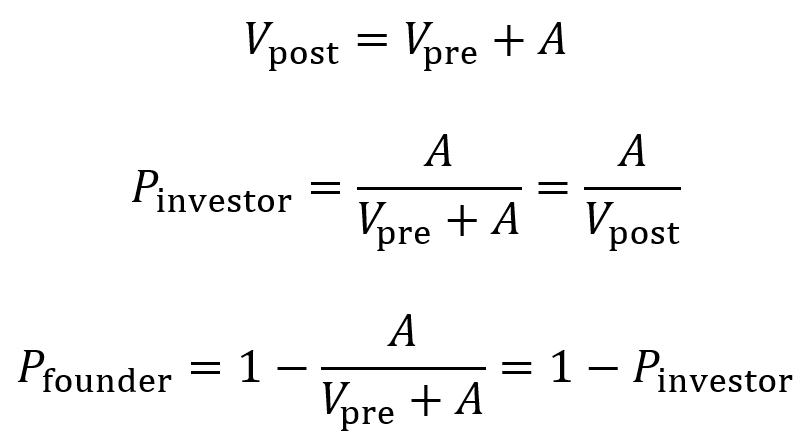
  • When raising an amount A of funds at a pre-money valuation of Vpre, the post-money valuation Vpost of the company equals Vpre + A.
  • The proportion owned by the investor Pinvestor after the round is A divided by Vpost. Multiply by 100 to obtain percentage.
  • The proportion owned by the founder Pfounder after the round is 1 – Pinvestor. Multiply by 100 to obtain percentage.

Though it can vary widely, a common dilution percentage to aim for is 20%. This allows for raising at a solid valuation while mitigating the risk of not hitting the fundraising target for the next round (and facing a “down-round”).

For a subsequent round of fundraising, the post-money valuation of its preceding round is used as a reference point for starting to evaluate the new pre-money valuation. However, it is usually not the final number. If the new pre-money valuation is higher, the round is referred to as an “up-round”. If the new pre-money valuation is the same, the round is referred to as a “flat round”. If the new pre-money valuation is lower, the round is referred to as an “down-round”.

Several factors can influence the new round’s pre-money valuation.

  • If a company hits its milestones (e.g. revenue, new data, patents, hires), this can justify a markup where the investors pay more for less dilution of the founder’s ownership.
  • If a company does not hit its milestones or grow, a flat round or down-round may be the only option to move forward.
  • Market conditions for a given industry can fluctuate and push the company’s price (pre-money valuation) up or down.
  • Other factors such as SAFEs, convertible notes, and option pool top-up can influence the company’s price.

When a company raises a priced equity round, the board and stockholders authorize the creation of shares and sell them to the investor (an issuance) if there are not enough unissued shares available. Price per share is calculated by dividing valuation V by the company’s number of shares. When new shares are issued in a round, the number of new shares is the amount A raised divided by the price per share.

Higher valuations lead to higher price per share and fewer shares issued for the same amount of investment, which means less dilution. Larger round sizes with more cash lead to more shares issued at the same price, which means more dilution.

Shares may exist as units of common stock or preferred stock. A company’s common stock is typically held by founders and employees. Unlike preferred stock, it does not come with special contractual protections. Those who hold common stock have standard voting rights for decisions like board elections, mergers, etc.

Preferred stock (usually a type called convertible preferred) is a type of equity that is typically held by investors. It comes with a number of protections for investors including liquidation preference (discussed in the next paragraph), having a separate preferred vote on major company actions, anti-dilution protections, pro rata rights (discussed in the next section), and sometimes board seats or rights to observe board meetings.

Liquidation preference describes the multiple by which the investor receives their original investment back after a liquidation event (e.g. acquisition/merger,  asset sale, winddown). Term sheets define what counts as a liquidation event. The multiple is usually 1×, but higher multiples exist (1.5×, 2×, etc.) and are not as founder-friendly.

Preferred stock can be categorized as non-participating or as participating. When a liquidation event happens for a non-participating preferred stock, the investors receive their money back as either the “preference” or the “as-converted common”. The preference is the original amount they invested multiplied by the liquidation preference factor. The as-converted is the amount of money generated from the liquidation event times the percentage of the company owned by that investor.

  • For example, consider a $12M acquisition of a company where the investor originally invested $5M at a $15M pre-money valuation ($20M post-money valuation). The investor owns 25% of the company based on these numbers.
  • So, the investor can take 25% of $12M (which is $3M) or can take their original $5M back. Because $5M is higher, they receive $5M.
  • But for an example with an acquisition of $200M, the investor would take higher value of 25% of the $200M (which is $50M) rather than the original $5M.

When a liquidation event happens for a participating preferred stock, the investor first takes the preference amount (their original investment) and then takes additional funds pro rata, which here means they take an amount equal to the remaining money from the liquidation event times their percentage ownership. (Pro rata rights are discussed more in the next section).

  • Consider again the example of a $12M acquisition of a company where the investor originally invested $5M at a $15M pre-money valuation ($20M post-money valuation) and thus owns 25%.
  • The investor first takes $5M, then additionally takes 25% of the remaining $12M – $5M = $7M, where 25% of $7M = $1.75M.
  • So, the investor takes a total of $5M + $1.75M = $6.75M.

The effects of non-participating preferred and of participating preferred are summarized by the following equations where R is the amount of money from the liquidation event (the return), A is the original amount invested and p is the percentage of the company owned by the investor (as a proportion).

Pro rata rights are a legal stipulation that gives existing investors the right (but no obligation) to buy enough shares in a future financing round to retain the same ownership percentage as their initial investment. For example, if an investor owns 20% in the seed round and has pro rata rights, then they have the right to purchase 20% of new shares issued during the series A round so that they keep the same percentage ownership. (With the board’s authorization, the corporation issues new shares so that additional investment can be taken on).

Consider an existing investor with pro rata rights and owns p% of the company before the new round. The company raises an amount of A dollars at an agreed upon post-money valuation of Vpost. For the existing investor to keep ownership of the p% of the company, they must invest an amount Apro_rata (where p is the percentage converted to a fraction).

The amount Apro_rata comes in addition to the amount invested by the new lead investor, so at least one of three items must be adjusted.

  • The round size must grow (this is most common).
  • The new lead investor’s ownership must shrink (this is rarer).
  • The valuation must increase so the lead investor still obtains their target percentage ownership.

As an example, consider a series A round (note: do not confuse “series A” with the variable A chosen to represent amount of funds invested) raised after a seed round where the seed investor was given pro rata rights.

  • In this example, let the target series A post-money valuation be $30M and new the lead investor’s target ownership be 20%.
  • Without the seed investor having pro rata rights, the lead investor would be able to invest $6M (adding to a $24M pre-money valuation) and own 20% of the company. If the seed investor’s stake is worth $4.8M (owning 20% of $24M beforehand), then the seed investor’s ownership will be diluted to 16% due to the lead investor having bought more of the company.
  • With the seed investor having pro rata, they will have the right to invest another $1.2M (buy $1.2M worth of shares) when the target post-money valuation stays at $30M, keeping them at 20% since they previously held a stake value of $4.8M (20% of $24M) and they now hold a stake value of $4.8M + $1.2M = $6M (20% of $30M).
  • With the seed investor having pro rata rights, the new lead investor will only be able to invest $4.8M (16% of $30M) assuming the post-money valuation must stay at $30M.
  • With the seed investor having pro rata rights, the lead still could invest $6M and retain 20% ownership if the post-money valuation rises to $36M or the total round amount grows to $7.2M.

An ESOP is a collection of a company’s shares that it reserves (but has not yet issued) for giving to current and future employees and advisors. It facilitates talent attraction and retention and aligns employee incentives with the company’s incentives. On cap tables, ESOP appears despite the shares not having been issued (it is labeled as “non-issued options”) and is counted when calculating ownership percentages. At the seed and series A stages, ESOPs typically occupy around 10%-15% of the cap table. Note that ESOPs are taken out of the founder’s shares and not the investor’s shares.

VCs generally require the ESOP pool to be included or “topped up” within the pre-money valuation so that dilution from the ESOP does not dilute them but instead affects the founders and earlier stakeholders.

To calculate the size of the option pool and how it affects the new investor’s shares, first find the post-money valuation Vpost from the amount invested A and the investor’s target ownership percentage.

  • For example, if the investor provides $6M and has a target ownership percentage of 20%, then the Vpost = $6M/0.2 = $30M.
  • Let x equal the number of option pool shares necessary to reach 10% at post-money valuation. Let y equal the new shares that the investor will purchase with the $6M. In this example, the number of pre-round shares will be 10M without the ESOP top-up.
  • Ownership percentages are measured after the round closes. Solving the algebraic system of equations below gives x = 1.4286M shares and y = 2.8571M shares.

  • Pre-round share count after ESOP top-up is 10M + 1.4286M = 11.4286M.
  • Number of total post-round shares is 10M + 1.4286M + 2.8571M = 14.2857M.
  • Price per share is $30M/14.2857M = $2.10.
  • Pre-money valuation is therefore 11.4286M×$2.10 = $24M.
  • The ESOP pool top-up decreases the founder’s effective pre-money valuation since the price per share falls from $24M/10M = $2.40 to $24M/11.4286M = $2.10. That is, since the founder still holds 10M shares, the founder’s stake is 10M×$2.10 = $21M (rather than $24M).

A convertible note acts as a short-term loan investors make to a startup. It is similar to debt in that it has a principal amount, interest rate, and maturity date. However, the expectation is that the note will convert into preferred equity when a later priced round is raised (e.g. a series A). Since valuation is set later, the negotiations move faster and legal fees for convertible notes remain lower.

Convertible notes come with a discount on shares for early-stage investors. (Often around 15%-25% off of the share price paid by series A investors). This rewards early investors who take a risk on the company.

Convertible notes come with a valuation cap which sets the maximum price per share once conversion to equity occurs. (For pre-clinical companies, often around $8M-20M for pre-money caps). This protects early investors if the series A price per share is high.

Convertible notes come with interest (often around 4%-8% simple interest accruing to principal) which also converts into equity upon raising a priced round. This further rewards early investors.

The accrued principal is the total amount that needs to be “paid back for the loan” (though in this case it will be paid back in equity) which consists of the principal (base loan amount of money) plus the accrued interest. Seed-stage biotech convertible notes usually use simple interest rather than compounding interest. Simple interest is calculated linearly using the equation below where r is the interest rate as a proportion (e.g. 6% interest = 0.06 = r). Number of days is counted from the issue date until the conversion trigger or the maturity date.

Convertible notes come with a maturity date (often around 18-36 months). If no priced round occurs by the maturity date, investors may (i) force conversion of their shares into common stock, (ii) extend the maturity date, or (iii) require repayment. Maturity dates should thus be chosen to give ample room to complete one’s next milestone.

The early investors purchase shares at a conversion price which is the lower of either the discounted series A price or the price implied by the cap.

  • As an example, consider a situation where one raises $1M on a convertible note with 6% interest, a 20% discount, and a $12M cap. In this example, let us say that there are 4M pre-money shares.
  • Eighteen months later, a series A of $20M in new capital is raised at $4.00 per share.
  • With the interest, the accrued principal amount is $1M(1 + 0.06×1.5 years) = $1.09M.
  • The discounted price per share is $4.00×(1 – 0.20) = $3.20
  • The capped price per share is $12M/(4M shares) = $3.00
  • So, the note converts at $3.00 per share price since that is the lower value between the discounted price and the capped price.
  • $1.09M/$3.00 = 363,333 new preferred stock shares issued to the note holder (the investors).

It is important to realize that the stockholders approve the board’s creation of new shares to pay back the convertible note. Everyone’s ownership percentage adjusts accordingly.

A SAFE or Simple Agreement for Future Equity is similar to a convertible note in that the investor gives a startup funding in exchange for the right to receive equity later. Unlike convertible notes, SAFEs do not accrue interest nor do they have a maturity date.

Conversion is triggered when the company raises a priced round (typically a series A). Conversion can also happen when a liquidity event occurs (e.g. acquisition or IPO). The amount of money provided by the SAFE then converts into equity, at which point the investor receives shares as determined by the valuation and number of shares issued. Investors only own shares once the conversion happens.

As protections for investors, SAFEs can (but do not always) include valuation cap, discount, and/or most favored nation (MFN) clause.

Valuation cap is the maximum post-money valuation at which the SAFE converts into equity. Even if the valuation of the company is later set at higher, the SAFE converts at the valuation set by the cap, leading to the investor receiving shares as if the cap were the valuation.

  • For example, consider a scenario where the SAFE investment is $100K, the cap is $4M the company raises a $5M series A round at a $10M pre-money valuation, and shares are priced at $1.00/share.
  • There are 10M shares initially from the $10M/($1.00/share). The series A investor adds $5M/($1.00/share) = 5M more shares. Still more shares (see below to find the exact number) are then added due to the SAFE.
  • The amount of shares from the SAFE can be calculated by first determining the SAFE holder’s percentage ownership. Divide their investment amount A by the post-money cap Cpost, so A/Cpost = 100K/4M = 2.5% ownership.
  • Next take the 2.5% ownership of the SAFE investor and divide by the total remaining percentage ownership (100% – 2.5% = 97.5%) and multiply by the initial number of shares (10M here), so 10M(2.5%/97.5%) = 256,410 shares.
  • 10M (founders) + 5M (series A investor) + 256,410 (SAFE investor) = 15,256,410 shares total.
  • In the end, the founders own 10M/15,256,410 = ~65.6%, the series A investor owns 5M/15,256,410 = ~32.8%, and the SAFE investor owns 100K/15,256,410 = ~1.68%.
  • Note that if there was no cap, the SAFE investor would receive $100K/($1.00/share) = 100K shares instead. This would correspond to $100K/($15M + $100K) = 0.66% ownership by the SAFE investor after the series A round (which is much less than with the cap).

As an interesting side note, valuation cap used to correspond to pre-money valuation, but this was changed by Y Combinator to post-money valuation in 2018. Now almost all SAFEs use post-money valuation for their calculations.

Discount means the investor receives a percentage discount (often ~10%-20%) on the share price in the round when the SAFE converts to equity. Note that this only occurs in the conversion round and does not persist into future rounds beyond that.

  • As an example, consider a scenario where the series A investor pays $1.00 per share and the SAFE has a 20% discount.
  • The SAFE then converts at $0.80 per share and the SAFE holder receives more shares for the same amount of money compared to the new series A investors.

Finally, an MFN clause gives the SAFE holder investors to adopt better terms if the company issues SAFEs later which have more favorable provisions. The original SAFE holder investors can then receive the more favorable provisions found in the terms of the new SAFEs.

Notes on Ultrasound Physics and Instrumentation


No Comments

PDF version: Notes on Ultrasound Physics and Instrumentation – by Logan Thrasher Collins

Fundamentals of ultrasound waves

Sound waves such as those in ultrasound are longitudinal waves where particles oscillate backwards and forwards along the wave’s direction of propagation. This forms regions of higher (compression) and lower (rarefaction) density. Sound waves occur through the exchange of kinetic energy from molecular movement with the potential energy from elastic compression and stretching of bonds.

The speed of sound c depends on the medium. For example, in air c = 330 m/s while in water c = 1480 m/s. The frequency of a sound wave depends on the source producing it. Frequency is measured in Hertz (Hz) where 1 Hz = 1 cycle/second. Sound waves with frequencies greater than or equal to 20 kHz are referred to as ultrasound. The wavelength of a sound wave is λ = c/f. It is measured in mm (or other units of length). A sound wave’s phase describes what position the wave starts at within a cycle of oscillation and is measured in degrees or radians. Phase shifts are typically measured relative to a phase of 0° (or 0 rad). A sound wave’s amplitude corresponds to its “loudness” and describes the height of the wave’s peaks (or depth of its troughs). Cosine-based or complex exponential equations can describe sound waves in a similar way as they describe electromagnetic waves. These equations include amplitude as a coefficient, frequency as a factor multiplied by time, and phase shift as a term added to time.

Ultrasound pressure, power, and intensity

A sound wave’s excess pressure is the difference between its peak amplitude and the normal ambient pressure of the medium. When a medium is compressed, the excess pressure is positive and when it is rarified, the excess pressure is negative. In practice, the ambient pressure is often quite low and can be ignored, in which case pressure is used rather than excess pressure. Excess pressure and pressure are measured in Pascals (Pa), which are equivalent to N/m2.

When an ultrasound wave passes through a medium, it deposits energy (measured in Joules) into said medium. The rate at which a source produces this energy is the power, which is measured in Watts or J/s. An ultrasound wave’s power is unevenly distributed across the beam and often is more concentrated near the beam’s center. Intensity is a measure of the power flowing through a unit area perpendicular (or normal) to the wave’s direction of propagation and is measured in W/m2 or W/cm2. Intensity is proportional to the wave’s pressure squared (I ∝ p2).

Ultrasound and its medium

As mentioned, the medium (material) an ultrasound wave passes through determines the sound’s speed of propagation. Specifically, the material’s density and stiffness determine the speed of sound propagation. Density ρ is often measured in kg/m3. For instance, bone’s density ρbone = 1850 kg/m3 and water’s density ρwater = 1000 kg/m3 (or 1 g/cm3). Stiffness k describes how much a material resists deformation by force F. It equals the amount of pressure (stress) needed to change the thickness of a material by a given fraction and is measured in Pa. The ratio of change in thickness ΔL over original thickness L0 is called tensile strain ε. The increase (or decrease) in length of a material due to applied force is denoted ΔL = L – L0. Stress σ or fractional change in thickness is given by change in thickness divided by original thickness of the sample. Stress over strain is the elastic modulus E (also called Young’s modulus). Here, A is the cross-sectional area of a sample perpendicular to the applied force. Note that these formulas apply only for tensile stress (which induces tensile strain), the type of stress where a material is compressed or elongated.

The relationship between a sound wave’s speed and the properties of density and thickness can be modeled by masses on springs where ρ = m = density (corresponding to masses in the model) and k = stiffness (corresponding to the spring stiffness in the model). The relationship between c, ρ, and k is given by the following equation.

As a result of these properties, the speed of sound varies in different tissues. A table of the approximate speeds of sound across selected tissues is provided.

Acoustic impedance z measures the response of a medium’s particles in terms of their velocity v to a sound wave of a given pressure p. Acoustic impedance can also be expressed in terms of density and stiffness or in terms of density and the sound’s speed. The latter form of definition is called the characteristic acoustic impedance of the tissue. It has units of kg m–2 s–1, also called rayl.

Ultrasound reflection and refraction

When an ultrasound wave traveling through a medium of acoustic impedance z1 encounters a new medium of different acoustic impedance z2, some of the wave is transmitted and some is reflected back. The equations in the following discussion will initially assume that the wave approaches the interface at a 90° angle (perpendicular) until stated otherwise.

To maintain continuity across the interface, the following equations must hold. Here, pi and vi are initial pressure and velocity, pr and vr are reflected pressure and velocity, and pt and vt are transmitted pressure and velocity.

Additionally, the intensity transmitted It across the interface equals the incident intensity Ii minus the reflected intensity Ir.

By using the equation for the definition of acoustic impedance z = p/v, the following two equations are true. Algebraically manipulating these equations leads to the third equation below. Rp is called the amplitude (or pressure) reflection coefficient of the interface. It is important because it decides the amplitude of the echoes produced at various interfaces within the tissue.

Note that if the acoustic impedance of the first medium is greater than the acoustic impedance of the second medium (i.e. z1 > z2), then Rp is negative and the reflected wave is inverted (across the x axis). For most interfaces between soft tissues, Rp is quite small and so most of the wave is transmitted to produce further echoes deeper within the tissue. This is useful for ultrasound imaging. Since the interface between air and soft tissue has a much larger Rp, the ultrasound source must be placed in direct contact with the patient’s skin to avoid air blocking transmission. This also means that gas-containing tissues like lungs and gut effectively block imaging beyond the region with the gas.

Another way to describe reflection is in terms of the intensity reflection coefficient RI. Since I ∝ p2, this means that RI = Rp2.

Since the incident intensity is Ii = It + Ir and the transmitted intensity is It = Ii – Ir, one can also define an intensity transmission coefficient TI as the first equation below. Since the transmitted pressure is pt = pi + pr, one can also define a pressure transmission coefficient Tp as the second equation below.

It is useful to realize that, because energy at interfaces must be conserved, the following equation holds true.

But ultrasound waves often do not approach interfaces at a 90° angle, so the equations in this section must be modified via trigonometry to account for other angles. First, note that the incident angle θi will equal the backscattered angle θr (this is true in the 90° case as well).

When a sound wave in a less dense tissue (slower sound wave) crosses into a tissue of greater density (faster sound wave), the transmitted wave bends away from the normal and thus θt > θi

Likewise, when a sound wave in a tissue of greater density (faster sound wave) crosses into a tissue of less density (slower sound wave), the transmitted wave bends towards the normal and thus θt < θi.

Ultrasound scattering

When ultrasound encounters an object which is small compared to the wavelength, it scatters in all directions, though slightly more energy is typically backscattered towards the transducer than away from it. Scattering specifics depend on the shape, size, and acoustic properties (z, k, ρ) of the object.

When many similar small objects are close together (e.g. red blood cells), constructive interference can occur, which is useful. In the case of the blood, this is the basis for Doppler ultrasound, which measures blood flow. By comparison, when many small objects are far apart, complex interference patterns occur. This leads to a phenomenon in images known as “speckle”, which is usually (but not always) considered a form of undesirable noise.

Absorption and relaxation of ultrasound

As ultrasound moves through tissue, it loses energy due to absorption, resulting in heat. There are two ways this occurs: relaxation absorption and classical absorption. The effects of relaxation absorption are typically much more dominant.

Relaxation absorption depends on the elastic properties of tissue, occurring when the tissue returns to its original state after rarefaction or compression by ultrasound. This is quantified by the relaxation time τ = 1/fr, which is how long the tissue takes to return to its original state after the ultrasound’s effect. 

Relaxation is characterized by a relaxation absorption coefficient βr which is given by the first two equations below. Here, fr is the frequency of relaxation, f is the frequency of ultrasound, and B0 is a material-specific constant. In practice, tissues contain a range of values of τ and fr, so the third equation below is a more general formula where the overall relaxation absorption coefficient is proportional to the sum of the various contributions. Higher values of βr mean more energy is absorbed into the tissue.

It is useful to note that in tissues, the relationship between the relaxation absorption coefficient βr and the frequency f is approximately linear.

Classical absorption is less important in tissues since, at clinical frequencies, the relaxation absorption is strongly dominant as mentioned. That said, overall absorption does consist of a combination of relaxation and classical absorption (though the latter may be approximated away sometimes). Classical absorption occurs because of friction between particles as they are displaced by ultrasound, causing loss of energy to heat. This loss is characterized by the classical absorption coefficient βclass ∝ f2.

Attenuation coefficients

When an ultrasound beam propagates through tissue, the sum of the absorption and scattering is described as attenuation, which causes an exponential decrease in the pressure and intensity of the ultrasound as a function of the propagation distance x through tissue.

The following equations describe the loss of ultrasound intensity and pressure as the wave moves through tissue. Here, µ is the intensity attenuation coefficient and α is the pressure attenuation coefficient. The value of µ is equal to twice the value of α (so, µ = 2α). Both have units of cm–1, though the value of µ is often given in units of decibels (dB) per cm, where the conversion factor is µ(dB cm–1) = 4.343µ(cm–1). It is useful to note that each 3 dB decrease corresponds to a decrease in intensity by a factor of 2.

Approximate frequency dependences of µ are given in the table below. As an example, in soft tissue, the value of µ = 1 dB cm–1 for 1 MHz ultrasound and µ = 2 dB cm–1 for 2 MHz ultrasound. Note that the value of µ for fat is calculated differently than the others via the equation µ(f) = 0.7f1.5 dB.

Ultrasound transducers

Ultrasound imaging is performed using ultrasound transducers. A gated frequency generator first produces short periodic voltage pulses, which are then amplified and fed into the transducer via a transmit-receive switch. Because the transducer transmits high power pulses and receives low intensity signals from the reflected ultrasound waves, the transmit and receive circuits must be isolated from each other. Amplified voltage is converted by a shaped piezoelectric material (typically lead zirconate titanate, which is abbreviated PZT) in the transducer into a mechanical pressure wave which is transmitted into the tissue. 

After reflecting and scattering from boundaries within the tissue, pressure wave signals return to the transducer and are converted back into voltages by the piezoelectric material. The voltages must pass through low-noise preamplifier before digitization. Further amplification and signal processing facilitates display of images on a computer.

When oscillating voltage is applied to one end of shaped PZT material, the thickness of the PZT element oscillates at the same frequency as the voltage. By placing this element in contact with skin, mechanical pressure waves are transmitted into tissue. The element has a resonant frequency f0 which is determined by its thickness T and the speed of the ultrasound wave in the PZT material cPZT. The value of cPZT is ~4000 m/s.

For most ultrasound devices, the transducer element’s thickness must be designed to equal one half the wavelength of ultrasound in the PZT material λPZT, so T = λPZT/2. This facilitates use of the resonant frequency.

Because of the much higher acoustic impedance of PZT material compared to skin (~18 times higher), a large amount of the energy would be reflected if the PZT was placed directly onto the skin’s surface. This would mean the mechanical wave traveling into the tissue would lose most of its energy.

To prevent this energy loss from happening, transducers possess a matching layer with a zmatching value between zskin and zPZT as given by the equation below. The thickness of the matching layer is typically made to be 1/4 of the ultrasound’s wavelength in its material T = λmatching/4. All this improves the transmission and reception efficiency. Sometimes multiple matching layers are used to further improve efficiency.

At the back of a PZT element, there is a damping layer, typically made of some backing material and epoxy. This damping layer prevents the PZT from continuing to oscillate (at a decaying rate) after each voltage pulse. This continued oscillation would blur the boundaries between the short pulses, which can decrease axial resolution (as will be described soon).

Although transducers have a central frequency f0, they typically cover a range of frequencies (e.g. a 3 MHz transducer might cover a range of 1-5 MHz). Higher mechanical damping leads to broader transducer bandwidth. Transducer bandwidth is described as the frequency range over which the sensitivity is greater than half the maximum sensitivity level. The relationship between bandwidth and f0 is often quantified by the quality factor Q, which is the ratio of f0 to the bandwidth. Low values of Q mean larger bandwidths. Note that 2f0 is the second harmonic frequency.

Beam geometry and resolution

FUS transducers produce a very complicated wave pattern close to the face of the transducer (the near-field or Fresnel zone). This complicated pattern is not usually useful since it has many parts where the intensity is zero. Beyond the near-field zone, the wave pattern is much simpler and decays exponentially with distance (the far-field or Fraunhofer zone). The boundary between the two zones is called the near-field boundary (NFB) and occurs at a distance ZNFB away from the face of the transducer. The following equation (where r is the radius of the transducer) can be used to calculate the ZNFB value.

After the NFB, the FUS beam diverges (spreads out laterally) with an angle of deviation θ which is given by the equation below.

For the far-field zone, the lateral shape of the beam approximates a Gaussian function. The full width at half maximum (FWHM) defines the lateral resolution of the beam. It is given by the equation below, where σ is the standard deviation of the Gaussian. This value is unique to each FUS beam at the specific desired depth. It can be calculated by the following equation.

Single element transducers also produce ultrasound side lobes where the first zero of the side lobe at angle φ is the same equation as the FUS beam’s divergence angle equation. In ultrasound imaging, the side lobes can cause artifacts if they are backscattered from tissue outside of the imaged region.

Axial resolution is the closest distance two boundaries can be relative to each other (in a direction parallel to the FUS beam’s propagation) while still allowing them to be resolved as two distinct features. It is given by the equation below where pd is the pulse duration and c represents the speed of the ultrasound in the tissue.

The reason that axial resolution works this way is because the echoes of beams returning from two different boundaries are distinguishable so long as these boundaries are spaced widely enough that they do not overlap in time.

Some typical values of axial resolution are 1.5 mm at a frequency (1/c) of 1 MHz or 0.3 mm at a frequency of 5 MHz. But it should be noted that attenuation of the FUS increases at higher frequencies, so there is an important tradeoff between penetration depth and axial resolution. (Very high frequencies such as 40 MHz can be used for imaging the skin at high resolution).

Single flat ultrasound transducers possess relatively poor lateral resolution. Concave curved transducers can achieve better resolutions. (It should be noted that the transducer equations above may be somewhat altered in the case of curved transducers rather than flat transducers). To make a curved transducer, one can add a curved plastic lens in front of the piezoelectric element or the piezoelectric element itself can be made in a concave curved shape.

The shape of a transducer’s curvature can be described by an “f-number”, which is a value equal to the focal distance divided by the aperture dimension where the aperture dimension is determined by the size of the transducer element.

Lateral resolution for a bowl-shaped curved (focused) transducer is calculated using the following equation below where λ is the ultrasound wavelength, F is the focal distance, and D is the diameter of the transducer. The focal distance F is where the lateral beamwidth is narrowest and is approximated as the radius of curvature (ROC) of the lens or PZT element. This approximation is valid except in the case of very high curvature.

When deciding on the focusing power of a transducer, there is a compromise between high spatial resolution and depth over which good spatial resolution is achievable. For a strongly focused transducer, locations further away from the beam’s focal plane diverge more sharply than for a weakly focused transducer. This can be quantified by the on-axis depth-of-focus (DOF) which equals the axial distance over which the beam’s intensity is at least 50% of its maximum value.

Transducer arrays

Contemporary FUS systems typically use arrays consisting of many small piezoelectric elements (rather than single-element transducers). These arrays allow 2D imaging via electronic steering of the beam through tissue while the transducer is held at a fixed position. Sophisticated electronics produce a dynamically changing focus during pulse transmission and signal reception, which maintains high resolution throughout the image. Linear and phased array transducers represent the two main types of arrays.

A linear array consists of many (often 128-512) rectangular piezoelectric elements where the space between elements is called kerf and the distance between their centers is referred to as pitch. Each element is mechanically and electrically isolated from its neighbors by filling the kerf regions with acoustically isolating material. The elements are not focused. Pitch is designed to range from λ/2 to 3λ/2 (where λ is ultrasound wavelength in tissue). Linear arrays are usually about 1 cm wide and 10-15 cm long.

Linear arrays work by using separate voltage pulses to excite a small number of elements at slightly different times where the outer elements are excited first and the inner elements are excited after a short delay. This creates an effectively curved wavefront with a focal point at a certain distance from the array. After all backscattered echoes have been received, another beam consisting of a distinct subset of elements performs the same steps. This is repeated in sequence until all of the groups of elements have completed the procedure. If even numbers of elements were used for each group, the entire process can be repeated again with odd numbers of elements to cover the focal points between those acquired before.

Linear array focusing occurs only in one dimension. By contrast, the elevation plane (the direction perpendicular to the image plane) cannot be focused unless a curved lens is included to produce focus in this dimension. Linear arrays are most often used for applications involving large fields of view and relatively low penetration depth.

Phased arrays are typically around 1-3 cm in length and 1 cm in width. They are used in applications like cardiac imaging where there is only a small region of the body through which the ultrasound can enter without running into bone or air.

As with linear arrays, phased arrays apply voltage pulses at slightly varying times to excite elements and produce an effective wavefront with a certain focal length. But phased arrays must employ beam steering to reconstruct a full 2D image. This occurs by changing the pattern of excitation to sweep the effective wavefront beam across a range of directions to cover the image plane.

Phased arrays also employ a process called dynamic focusing to optimize lateral resolution over the full depth of imaged tissue. This involves dynamically changing the number of elements used to produce a wavefront with varying focal lengths. At deeper regions in the tissue, the number of elements needed to position the focus (where optimal lateral resolution is achieved) is higher than at shallower regions in the tissue. Dynamic focusing allows high lateral resolution across the full depth of the scan. However, dynamic focusing is relatively slow since multiple scans are needed to build up a single line of the image. It should be noted that the length of each element determines the “slice thickness” for the image’s elevation dimension.

There are also multidimensional transducer arrays which include extra rows of transducer elements. These multidimensional arrays can focus in the elevation dimension without the need for curved elements or lenses (though they are more complicated devices). Multidimensional arrays with a small number of extra rows (e.g. 3-10) are referred to as 1.5 dimensional arrays. These 1.5D arrays can facilitate some level of focusing in the elevation dimension, though to a limited extent. When multidimensional arrays possess a large number of extra rows (up to the number of elements in each row), they are referred to as 2 dimensional arrays. These can acquire full 3D image data without needing to be moved from their initial position.

Annular arrays represent another class of transducer array. They are useful at very high frequencies (>20 MHz) since linear or phased arrays are quite difficult to create for these frequencies. Annular arrays consist of concentric rings of piezoelectric material alternating with rings acoustically isolating material. Beam forming is accomplished using an analogous strategy to that of phased arrays. The outermost rings are excited first and the innermost rings last, producing an effective focus. Because annular arrays require mechanical motion to sweep the beam through tissue for reconstruction of images, commercially available devices have been developed to precisely control this motion.

When transducer arrays receive signals, they pass through an amplifier to strengthen them before digitization. However, such amplifiers do not provide linear gain for signals with a dynamic range that exceeds 40-50 dB. This is an issue because very strong signals appear from tissue boundaries near the transducer while much weaker signals appear from tissue boundaries deeper in the body. Weak signals can thus be lost when attempting to receive over larger dynamic ranges. A process called time-gain compensation (TGC) is employed to circumvent this issue. TGC increases the amplification factor as a function of time after transmission of an ultrasound pulse. As a result, the weaker backscattered echoes which come later are amplified to a greater degree than the stronger backscattered echoes which come sooner. TGC is controlled by the operator of the instrument, which usually comes with a variety of preset values for clinical imaging protocols.

Parameters for focused ultrasound in practice

There is no universally accepted definition of FUS dose, so various metrics of exposure are used to quantify how much ultrasound is delivered during a therapeutic session. Examples of such metrics (which will be discussed further below) include acoustic pressure or peak negative pressure, mechanical index, frequency, pulse repetition frequency (PRF), and intensity.

Peak negative pressure is often measured in MPa and describes the degree of rarefaction caused by the ultrasound wave in tissue. For low intensity focused ultrasound (LIFU), the greatest mechanical safety risk is from cavitation (bubble formation and collapse). To measure cavitation risk, the mechanical index (MI) is used. MI can be computed using the following equation where Pn is the peak negative pressure, f0 is the fundamental frequency, and the derating constant of 0.3 adjusts for tissue attenuation (~7% loss per cm per MHz) and has units dBcm–1MHz–1. After derating, 0.3Pn has units of MPa. FDA guidelines specify that MI should not exceed 1.9. MI itself is unitless.

An ultrasound wave’s pulse’s duration (PD) is the number of cycles divided by the frequency. For instance, a pulse with 500 cycles of 500 kHz ultrasound would last for 1 ms. The pulse repetition interval (PRI) is the amount of time between the start of one pulse and the start of the next pulse (so it includes both the pulse and the pause after the pulse). Pulse repetition rate (PRR) also known as the pulse repetition frequency (PRF) equals 1/PRI. The pulse duty cycle (PDC) equals PD/PRI and is expressed as a percentage. PD typically ranges from microseconds to seconds, PRI from milliseconds to seconds, and PDC from <1% up to 70%.

One’s choice of a particular PD and PDC comes from two main factors: (i) the duty cycle can have varying neuromodulatory effects (excitatory or inhibitory) depending on its value and (ii) lower PDC values can be leveraged to limit total energy and heat deposition.

A pulse train is a series of pulses, for which the pulse train duration (PTD) equals the total number of pulses times the PRI. Typical PTDs range from less than 1 second to several minutes. The amount of time between the start of one pulse train and the start of the next is called the pulse train repetition interval (PTRI). The amount of time between pulse trains is called the interstimulus interval (ISI). The pulse train duty cycle (PTDC) equals PTD/PTRI.

It should be noted that the PTDC does not have a major influence on neuromodulatory effect, so the ratio is driven by safety such that the ISI is long enough to limit cumulative heating to reasonable levels.

Multiplying PDC by PTDC gives an overall duty cycle equal to (PD/PRI)(PTD/PTRI) which can be further multiplied by the average intensity of the pulses Iavg to obtain average temporal intensity Iavg_tp. FDA diagnostic safety guidelines state that average intensity should fall below 720 mW/cm2. So, Iavg_tp = (PD/PRI)(PTD/PTRI)Iavg generally should not exceed 720 mW/cm2.

Total ultrasound application time is the sum of the durations of all pulse trains plus ISIs. It typically ranges from less than 1 minute to over 60 minutes. Longer total ultrasound application time is thought to usually improve efficacy by depositing more energy, though this may not always be true. Energy per unit time might play a more significant role in efficacy, but this is an ongoing area of investigation.

Frequency (or fundamental frequency f0) is the primary frequency of FUS passing through the tissue. It is typically measured in kilohertz (kHz) or megahertz (MHz). In human neuromodulation applications, frequency typically ranges from 200-700 kHz (or 0.2-0.7 MHz), providing an acceptable tradeoff between amount of energy entering the brain and the size of the focal region. The reason that the upper limit of frequency for human neuromodulation is typically ~700 kHz is because FUS energy attenuation by the skull at 700 kHz is ~75% (though this varies depending on skull morphology) and keeps increasing at higher frequencies.

Recall from the equations in the earlier discussion that lateral resolution involves wavelength λ (and f = c/λ), so frequency influences the focal region’s size. Also discussed earlier, frequency influences the distance from the transducer to the near-field boundary (ZNFB). Frequency itself is generally not believed to contribute to neuromodulatory effects in a direct fashion, though this is still under investigation. So, the f0 value is usually selected to create a focal volume of a desired size at a given depth.

Intensity is defined as power per unit area (and recall the unit of power is Watts or J/s) and is the rate at which energy is transferred by the FUS wave. For ultrasound at any given point in time during the wave cycle, intensity is proportional to the square of the acoustic pressure as described by the equation below where P is the acoustic pressure, ρ is the density of the medium, and c is the ultrasound speed in the medium. Recall that ρc = z, the acoustic impedance. Acoustic intensity is usually measured in watts per square centimeter (W/cm2).

Beyond instantaneous intensity, FUS is often measured by spatial peak pulse average intensity (ISPPA) and by spatial peak temporal average intensity (ISPTA). ISPPA is the average intensity experienced during a single ultrasound pulse. Note that I does not equal Pn2/2z in the case of a ramped pulse. To determine average intensity (ISPPA) for ramped pulses, the integral of intensity across the pulse is divided by the pulse’s duration PD. Ramped pulses distribute energy more smoothly and help mitigate auditory confounds for LIFU applications.

ISPTA represents the average intensity of the FUS beam at the point where it is strongest averaged over the pulse duration while accounting for any off periods. It is described by the following equation consisting of the ISPPA multiplied by the PDC (which is the fraction of PRI that the pulse is turned on).

References:

1.      Legon, W. & Strohman, A. Low-intensity focused ultrasound for human neuromodulation. Nat. Rev. Methods Prim. 4, 91 (2024).

2.      Smith, N. B. & Webb, A. Introduction to Medical Imaging: Physics, Engineering and Clinical Applications. (Cambridge University Press, 2010).