
business

Notes on Fundraising Mechanics for Startups


No Comments

PDF version: Notes on Fundraising Mechanics for Startups by Logan Thrasher Collins

A company’s valuation is initially an estimate of how much the company is worth as set by methods such as the following.

  • Comparable transactions: looking at valuations of startups at a similar stage in the given sector.
  • Berkus method: assigning dollar values to qualitative factors such as idea, team, prototype, sales, etc. and adding them up to obtain the valuation of the company.
  • VC method: estimate the exit value of the company (value when it is sold) and divide by the firm’s desired multiple on invested capital or MOIC (e.g. 10×) to obtain the post-money valuation Vpost. Then subtract the amount invested to obtain the pre-money valuation Vpre.

Pre-money valuation is the company’s agreed-upon value before new capital is invested. It sets the price at which new shares can be sold and thus dictates how much of the company the founder gives up for the round. Post-money valuation is the pre-money valuation plus the newly invested amount of funds. It dilutes everyone’s percent ownership immediately after the round.

Dilution refers to the decrease in the percentage of the company owned by the founders. So, one might say “the round diluted us by 20%” or “we sold 20% of the company” or “the founders are at 80% ownership post-money”.

  • When raising an amount A of funds at a pre-money valuation of Vpre, the post-money valuation Vpost of the company equals Vpre + A.
  • The proportion owned by the investor Pinvestor after the round is A divided by Vpost. Multiply by 100 to obtain percentage.
  • The proportion owned by the founder Pfounder after the round is 1 – Pinvestor. Multiply by 100 to obtain percentage.
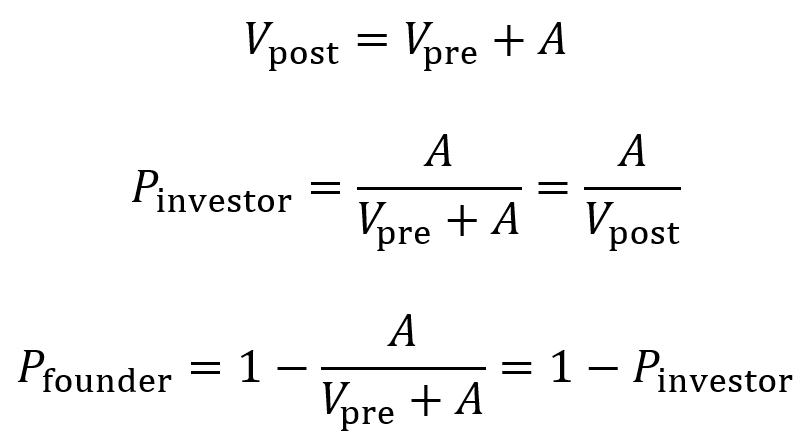
Though it can vary widely, a common dilution percentage to aim for is 20%. This allows for raising at a solid valuation while mitigating the risk of not hitting the fundraising target for the next round (and facing a “down-round”).

For a subsequent round of fundraising, the post-money valuation of its preceding round is used as a reference point for starting to evaluate the new pre-money valuation. However, it is usually not the final number. If the new pre-money valuation is higher, the round is referred to as an “up-round”. If the new pre-money valuation is the same, the round is referred to as a “flat round”. If the new pre-money valuation is lower, the round is referred to as an “down-round”.

Several factors can influence the new round’s pre-money valuation.

  • If a company hits its milestones (e.g. revenue, new data, patents, hires), this can justify a markup where the investors pay more for less dilution of the founder’s ownership.
  • If a company does not hit its milestones or grow, a flat round or down-round may be the only option to move forward.
  • Market conditions for a given industry can fluctuate and push the company’s price (pre-money valuation) up or down.
  • Other factors such as SAFEs, convertible notes, and option pool top-up can influence the company’s price.

When a company raises a priced equity round, the board and stockholders authorize the creation of shares and sell them to the investor (an issuance) if there are not enough unissued shares available. Price per share is calculated by dividing valuation V by the company’s number of shares. When new shares are issued in a round, the number of new shares is the amount A raised divided by the price per share.

Higher valuations lead to higher price per share and fewer shares issued for the same amount of investment, which means less dilution. Larger round sizes with more cash lead to more shares issued at the same price, which means more dilution.

Shares may exist as units of common stock or preferred stock. A company’s common stock is typically held by founders and employees. Unlike preferred stock, it does not come with special contractual protections. Those who hold common stock have standard voting rights for decisions like board elections, mergers, etc.

Preferred stock (usually a type called convertible preferred) is a type of equity that is typically held by investors. It comes with a number of protections for investors including liquidation preference (discussed in the next paragraph), having a separate preferred vote on major company actions, anti-dilution protections, pro rata rights (discussed in the next section), and sometimes board seats or rights to observe board meetings.

Liquidation preference describes the multiple by which the investor receives their original investment back after a liquidation event (e.g. acquisition/merger,  asset sale, winddown). Term sheets define what counts as a liquidation event. The multiple is usually 1×, but higher multiples exist (1.5×, 2×, etc.) and are not as founder-friendly.

Preferred stock can be categorized as non-participating or as participating. When a liquidation event happens for a non-participating preferred stock, the investors receive their money back as either the “preference” or the “as-converted common”. The preference is the original amount they invested multiplied by the liquidation preference factor. The as-converted is the amount of money generated from the liquidation event times the percentage of the company owned by that investor.

  • For example, consider a $12M acquisition of a company where the investor originally invested $5M at a $15M pre-money valuation ($20M post-money valuation). The investor owns 25% of the company based on these numbers.
  • So, the investor can take 25% of $12M (which is $3M) or can take their original $5M back. Because $5M is higher, they receive $5M.
  • But for an example with an acquisition of $200M, the investor would take higher value of 25% of the $200M (which is $50M) rather than the original $5M.

When a liquidation event happens for a participating preferred stock, the investor first takes the preference amount (their original investment) and then takes additional funds pro rata, which here means they take an amount equal to the remaining money from the liquidation event times their percentage ownership. (Pro rata rights are discussed more in the next section).

  • Consider again the example of a $12M acquisition of a company where the investor originally invested $5M at a $15M pre-money valuation ($20M post-money valuation) and thus owns 25%.
  • The investor first takes $5M, then additionally takes 25% of the remaining $12M – $5M = $7M, where 25% of $7M = $1.75M.
  • So, the investor takes a total of $5M + $1.75M = $6.75M.

The effects of non-participating preferred and of participating preferred are summarized by the following equations where R is the amount of money from the liquidation event (the return), A is the original amount invested and p is the percentage of the company owned by the investor (as a proportion).

Pro rata rights are a legal stipulation that gives existing investors the right (but no obligation) to buy enough shares in a future financing round to retain the same ownership percentage as their initial investment. For example, if an investor owns 20% in the seed round and has pro rata rights, then they have the right to purchase 20% of new shares issued during the series A round so that they keep the same percentage ownership. (With the board’s authorization, the corporation issues new shares so that additional investment can be taken on).

Consider an existing investor with pro rata rights and owns p% of the company before the new round. The company raises an amount of A dollars at an agreed upon post-money valuation of Vpost. For the existing investor to keep ownership of the p% of the company, they must invest an amount Apro_rata (where p is the percentage converted to a fraction).

The amount Apro_rata comes in addition to the amount invested by the new lead investor, so at least one of three items must be adjusted.

  • The round size must grow (this is most common).
  • The new lead investor’s ownership must shrink (this is rarer).
  • The valuation must increase so the lead investor still obtains their target percentage ownership.

As an example, consider a series A round (note: do not confuse “series A” with the variable A chosen to represent amount of funds invested) raised after a seed round where the seed investor was given pro rata rights.

  • In this example, let the target series A post-money valuation be $30M and new the lead investor’s target ownership be 20%.
  • Without the seed investor having pro rata rights, the lead investor would be able to invest $6M (adding to a $24M pre-money valuation) and own 20% of the company. If the seed investor’s stake is worth $4.8M (owning 20% of $24M beforehand), then the seed investor’s ownership will be diluted to 16% due to the lead investor having bought more of the company.
  • With the seed investor having pro rata, they will have the right to invest another $1.2M (buy $1.2M worth of shares) when the target post-money valuation stays at $30M, keeping them at 20% since they previously held a stake value of $4.8M (20% of $24M) and they now hold a stake value of $4.8M + $1.2M = $6M (20% of $30M).
  • With the seed investor having pro rata rights, the new lead investor will only be able to invest $4.8M (16% of $30M) assuming the post-money valuation must stay at $30M.
  • With the seed investor having pro rata rights, the lead still could invest $6M and retain 20% ownership if the post-money valuation rises to $36M or the total round amount grows to $7.2M.

An ESOP is a collection of a company’s shares that it reserves (but has not yet issued) for giving to current and future employees and advisors. It facilitates talent attraction and retention and aligns employee incentives with the company’s incentives. On cap tables, ESOP appears despite the shares not having been issued (it is labeled as “non-issued options”) and is counted when calculating ownership percentages. At the seed and series A stages, ESOPs typically occupy around 10%-15% of the cap table. Note that ESOPs are taken out of the founder’s shares and not the investor’s shares.

VCs generally require the ESOP pool to be included or “topped up” within the pre-money valuation so that dilution from the ESOP does not dilute them but instead affects the founders and earlier stakeholders.

To calculate the size of the option pool and how it affects the new investor’s shares, first find the post-money valuation Vpost from the amount invested A and the investor’s target ownership percentage.

  • For example, if the investor provides $6M and has a target ownership percentage of 20%, then the Vpost = $6M/0.2 = $30M.
  • Let x equal the number of option pool shares necessary to reach 10% at post-money valuation. Let y equal the new shares that the investor will purchase with the $6M. In this example, the number of pre-round shares will be 10M without the ESOP top-up.
  • Ownership percentages are measured after the round closes. Solving the algebraic system of equations below gives x = 1.4286M shares and y = 2.8571M shares.

  • Pre-round share count after ESOP top-up is 10M + 1.4286M = 11.4286M.
  • Number of total post-round shares is 10M + 1.4286M + 2.8571M = 14.2857M.
  • Price per share is $30M/14.2857M = $2.10.
  • Pre-money valuation is therefore 11.4286M×$2.10 = $24M.
  • The ESOP pool top-up decreases the founder’s effective pre-money valuation since the price per share falls from $24M/10M = $2.40 to $24M/11.4286M = $2.10. That is, since the founder still holds 10M shares, the founder’s stake is 10M×$2.10 = $21M (rather than $24M).

A convertible note acts as a short-term loan investors make to a startup. It is similar to debt in that it has a principal amount, interest rate, and maturity date. However, the expectation is that the note will convert into preferred equity when a later priced round is raised (e.g. a series A). Since valuation is set later, the negotiations move faster and legal fees for convertible notes remain lower.

Convertible notes come with a discount on shares for early-stage investors. (Often around 15%-25% off of the share price paid by series A investors). This rewards early investors who take a risk on the company.

Convertible notes come with a valuation cap which sets the maximum price per share once conversion to equity occurs. (For pre-clinical companies, often around $8M-20M for pre-money caps). This protects early investors if the series A price per share is high.

Convertible notes come with interest (often around 4%-8% simple interest accruing to principal) which also converts into equity upon raising a priced round. This further rewards early investors.

The accrued principal is the total amount that needs to be “paid back for the loan” (though in this case it will be paid back in equity) which consists of the principal (base loan amount of money) plus the accrued interest. Seed-stage biotech convertible notes usually use simple interest rather than compounding interest. Simple interest is calculated linearly using the equation below where r is the interest rate as a proportion (e.g. 6% interest = 0.06 = r). Number of days is counted from the issue date until the conversion trigger or the maturity date.

Convertible notes come with a maturity date (often around 18-36 months). If no priced round occurs by the maturity date, investors may (i) force conversion of their shares into common stock, (ii) extend the maturity date, or (iii) require repayment. Maturity dates should thus be chosen to give ample room to complete one’s next milestone.

The early investors purchase shares at a conversion price which is the lower of either the discounted series A price or the price implied by the cap.

  • As an example, consider a situation where one raises $1M on a convertible note with 6% interest, a 20% discount, and a $12M cap. In this example, let us say that there are 4M pre-money shares.
  • Eighteen months later, a series A of $20M in new capital is raised at $4.00 per share.
  • With the interest, the accrued principal amount is $1M(1 + 0.06×1.5 years) = $1.09M.
  • The discounted price per share is $4.00×(1 – 0.20) = $3.20
  • The capped price per share is $12M/(4M shares) = $3.00
  • So, the note converts at $3.00 per share price since that is the lower value between the discounted price and the capped price.
  • $1.09M/$3.00 = 363,333 new preferred stock shares issued to the note holder (the investors).

It is important to realize that the stockholders approve the board’s creation of new shares to pay back the convertible note. Everyone’s ownership percentage adjusts accordingly.

A SAFE or Simple Agreement for Future Equity is similar to a convertible note in that the investor gives a startup funding in exchange for the right to receive equity later. Unlike convertible notes, SAFEs do not accrue interest nor do they have a maturity date.

Conversion is triggered when the company raises a priced round (typically a series A). Conversion can also happen when a liquidity event occurs (e.g. acquisition or IPO). The amount of money provided by the SAFE then converts into equity, at which point the investor receives shares as determined by the valuation and number of shares issued. Investors only own shares once the conversion happens.

As protections for investors, SAFEs can (but do not always) include valuation cap, discount, and/or most favored nation (MFN) clause.

Valuation cap is the maximum post-money valuation at which the SAFE converts into equity. Even if the valuation of the company is later set at higher, the SAFE converts at the valuation set by the cap, leading to the investor receiving shares as if the cap were the valuation.

  • For example, consider a scenario where the SAFE investment is $100K, the cap is $4M the company raises a $5M series A round at a $10M pre-money valuation, and shares are priced at $1.00/share.
  • There are 10M shares initially from the $10M/($1.00/share). The series A investor adds $5M/($1.00/share) = 5M more shares. Still more shares (see below to find the exact number) are then added due to the SAFE.
  • The amount of shares from the SAFE can be calculated by first determining the SAFE holder’s percentage ownership. Divide their investment amount A by the post-money cap Cpost, so A/Cpost = 100K/4M = 2.5% ownership.
  • Next take the 2.5% ownership of the SAFE investor and divide by the total remaining percentage ownership (100% – 2.5% = 97.5%) and multiply by the initial number of shares (10M here), so 10M(2.5%/97.5%) = 256,410 shares.
  • 10M (founders) + 5M (series A investor) + 256,410 (SAFE investor) = 15,256,410 shares total.
  • In the end, the founders own 10M/15,256,410 = ~65.6%, the series A investor owns 5M/15,256,410 = ~32.8%, and the SAFE investor owns 100K/15,256,410 = ~1.68%.
  • Note that if there was no cap, the SAFE investor would receive $100K/($1.00/share) = 100K shares instead. This would correspond to $100K/($15M + $100K) = 0.66% ownership by the SAFE investor after the series A round (which is much less than with the cap).

As an interesting side note, valuation cap used to correspond to pre-money valuation, but this was changed by Y Combinator to post-money valuation in 2018. Now almost all SAFEs use post-money valuation for their calculations.

Discount means the investor receives a percentage discount (often ~10%-20%) on the share price in the round when the SAFE converts to equity. Note that this only occurs in the conversion round and does not persist into future rounds beyond that.

  • As an example, consider a scenario where the series A investor pays $1.00 per share and the SAFE has a 20% discount.
  • The SAFE then converts at $0.80 per share and the SAFE holder receives more shares for the same amount of money compared to the new series A investors.

Finally, an MFN clause gives the SAFE holder investors to adopt better terms if the company issues SAFEs later which have more favorable provisions. The original SAFE holder investors can then receive the more favorable provisions found in the terms of the new SAFEs.

Logan’s List of Entrepreneurship Resources


2 Comments

PDF version: Logan’s List of Entrepreneurship Resources

I have compiled this list to help myself and others learn about the entrepreneurial landscape and find opportunities for funding. Although experience is the best teacher, these resources can act as a foundation for exploring further avenues of learning. I should note that many (but not all) of these resources are aimed at academic researchers seeking to spin off companies based on new biotechnology inventions. The resources are listed in alphabetical order.

Academic Entrepreneurship How to Bring Your Scientific Discovery to a Successful Commercial Product: book aimed at educating academic entrepreneurs which details important topics like IP, funding, market research, and more. “The pathway to bringing laboratory discoveries to market is poorly understood and generally new to many academics. This book serves as an easy-to-read roadmap for translating technology to a product launch – guiding university faculty and graduate students on launching a start-up company”.

Activate Fellowship: a 2-year fellowship program (full time) for scientists working on startups. Provides guidance on business development, networking, $100K in funding for R&D, $100K per year living stiped, and technical support. “Activate transforms scientists and engineers into founders, empowering them to reinvent the world by bringing their research to market. The two-year Activate Fellowship provides early-stage science entrepreneurs with funding, technical resources, and unparalleled support from a network of scientists, engineers, investors, commercial partners, and fellow entrepreneurs”.

America’s Seed Fund: official website of the U.S. government’s SBIR (Small Business Innovation Research) and STTR (Small Business Technology Transfer) grants. Directs to many more specific resources on how to apply for these grants, what governmental agencies offer them, etc. “America’s Seed Fund awards non-dilutive funding to develop your technology and chart a path toward commercialization. The federal government invests in your solution and gives you the freedom to run your business according to your vision”.

NIH SEED: official website of the NIH’s SBIR and STTR programs which offers resources on funding opportunities, how to apply, entrepreneurial training, etc. “SBIR and STTR grant funding opportunities offer small business entrepreneurs a chance to obtain non-dilutive funding for early-stage research and development. Applications are accepted three times a year… NIH advertises the availability of grant support through notices of funding opportunities (NOFOs), previously referred to as funding opportunity announcements (FOAs)… Researcher-initiated ideas are proposed via the SBIR and STTR Omnibus grant solicitations. These funding opportunities do not specify a topic, though they link to identified topics of interest for each participating awarding component. Most small business applications to NIH are submitted to the Omnibus solicitations”.

Arch Grants: a source of up to $100,000 of funding for St. Louis startup companies which is awarded through an annual startup competition. Improved access to an ecosystem of resources for business development is also provided to winners. “Through our unique and groundbreaking annual Startup Competition model, we provide up to $100,000 in equity-free grants and access to an ecosystem of resources, helping early-stage startups grow and scale”.

WashU Venture Network Follow-on Investments: a funding program of up to $150,000 for companies with ties to Washington University in St. Louis that are also previous Arch Grants winners. “The WashU Venture Network Follow-on Investments is a joint effort between WashU’s Skandalaris Center for Interdisciplinary Innovation and Entrepreneurship and the ‘In St. Louis, For St. Louis’ initiative. It will award up to $150,000 each year to companies with WashU ties that previously have been awarded funding through Arch Grants, the local nonprofit that awards equity-free grants to startups”.

Cake Equity SAFE Notes: a guide from Cake Equity on what a SAFE (Simple Agreement for Future Equity) is and how it works. “What is a SAFE note agreement, how does it work, how is it different from convertible notes, and how to leverage it to raise funds for your startup”.

Charles River: a high-end contract research organization which provides a wide array of services for biotechnology R&D. “Charles River provides essential products and services to help pharmaceutical and biotechnology companies, government agencies, and leading academic institutions around the globe accelerate their research and drug development efforts. We deliver what our clients need to improve and expedite the discovery, early-stage development, and safe manufacture of new therapies for patients who need them”.

Charles River AAV Testing: a part of Charles River’s contract research organization which provides GMP characterization and in vitro AAV testing services for gene therapy R&D. “Adeno-associated virus (AAV) is one of the most widely used vectors in gene therapy. Our extensive, in-house AAV testing experience with rigorous characterization and biosafety testing will help ensure that your gene therapy is safe, effective, and regulatory-compliant from preclinical stages to commercialization”.

Charles River Cell Banking: a part of Charles River’s contract research organization which provides cell banking, which can facilitate consistent production biologics for clinical applications. “Cell banking is the foundation of biologics and therapeutics. With decades of experience and over 2,000 cell and/or viral banks successfully produced, our fully integrated CGMP cell bank production, storage, and characterization services will help support your product’s success from R&D through commercial manufacturing”.

Charles River CRADL Vivarium Lab Space: a part of Charles River’s contract research organization which provides animal testing services for biomedical R&D. “Charles River’s Accelerator and Development Lab, provides contract vivarium lab space with built-in animal husbandry, veterinary care, operations management, and IACUC protocol support to give you greater speed, flexibility, and control over your mice and rat in vivo pharmacology studies”.

Charles River GMP AAV Production Service: a part of Charles River’s contract research organization which provides GMP-grade AAV manufacturing services. “As a trusted CDMO partner for AAV production services, our multi-disciplinary teams provide the experience and dedication to quality that you need to scale up your AAV gene therapy project into a patient-ready product. Leverage the nAAVigation® AAV manufacturing platform to bolster your program with all-important predictability, guidance, and reduced time to clinic”.

Cooley GO: a website with articles about business concepts for entrepreneurs at various stages of developing startups. “At Cooley, we want to give you the information you need to build a great company – easily accessible and from the most trusted source”.

Cooley GO: What You Should Know About SAFEs: an article from Cooley GO on the SAFE (Simple Agreement for Future Equity) investment mechanism. “A SAFE is an investment instrument that converts the holder’s value into equity of the issuer upon certain triggering events”.

Curie.Bio: a therapeutics-focused VC firm that provides funding at the seed and series A stages as well as extensive guidance and assistance to scientific founders building biomedical companies. They offer a ‘co-pilot’ program to guide founders towards optimal therapeutic targets, a network of CROs, and more. Has a low acceptance rate (~1%) for funding. “We built Curie.Bio to free the founders. Curie.Bio significantly improves your ability to create impactful medicines while minimizing long-term dilution. Our unparalleled team and capital-efficient model provide you with immediate access to the industry’s top drug hunters, operators, and R&D services from day one”.

Emergent Ventures Grant: a philanthropic funding opportunity offered to highly motivated entrepreneurs (and others) with scalable project ideas for meaningfully improving society. Most awardees receive around $10K-$20K, but there are rumors that larger awards have been issued as well. Has a simple online application process centering on a 1500-word proposal. “Launched in 2018, Emergent Ventures is a low-overhead fellowship and grant program that supports entrepreneurs and brilliant minds with highly scalable, ‘zero to one’ ideas for meaningfully improving society. Mercatus Center faculty director Tyler Cowen administers the program”.

Experiment: a crowdfunding organization that provides small grants to scientific projects if donations meet a user-defined goal amount. “Experiment is an online platform for discovering, funding, and sharing scientific research… Creators never give up any ownership of their work to Experiment or backers. You keep 100% ownership and control over your work”.

Fifty Years: a VC firm focused on funding early-stage deep tech companies with technical founders. They also provide guidance to help technical/scientific founders build companies. “Fifty Years is a pre-seed and seed focused VC firm. We back founders using technology to solve the world’s biggest problems. We also help start companies. 50Y founders are building massive businesses while solving the world’s most important problems: the climate crisis, disease, connectivity, malnutrition, and more”.

Spinout Playbook: a guide from Fifty Years which provides advice for spinning companies out from inventions in academic laboratories. “We’ve seen negotiations with tech transfer offices (TTOs) take so long that founders burned out, teams lost momentum, and investors walked away. We’ve seen TTOs introduce terms that hurt the startup’s ability to raise capital. We’ve seen so many exotic term combinations that we wondered: how are founders supposed to make sense of it all? So we made this Spinout Paybook to help aspiring scientist founders make sense of the process”.

Manifest Grants: a fast grants program run by Fifty Years which offers pre-seed funding to scientists working on translational ideas. Applications are closed as of 2/2/2025 but may reopen at some point. “Manifest Grants is a fast grants program that awards $25K – $100K to scientists to accelerate their most ambitious ideas to solve the world’s biggest problems. We focus on translational research. The applications are max 2 pages and you get a decision within 21 days. No IP is taken. Are you an academic scientist working on a translational research idea for solving a big problem? Follow us on X (Twitter) to keep an eye out for updates on our grants programs. Applications are closed at the moment”.

Hevolution Foundation: a Saudi Arabian organization with a mission to treat aging and improve healthspan. It has an annual budget of $1B and provides a variety of grants and opportunities (for both translationally minded academics and companies). “Hevolution Foundation is the first non-profit to pursue age-related therapeutic breakthroughs with a commitment to funding global scientific discovery, and investing in private companies and entrepreneurs who are dedicated to advancing aging science. Through the acceleration of science, we can decelerate aging and its consequences”.

How to Start a Life Science Company: A Comprehensive Guide for First-Time Entrepreneurs: a book which provides a helpful primer on important steps for forming, growing, and running life sciences companies. “This comprehensive guide takes first-time entrepreneurs through every step of founding a life science company. It covers all the business basics that we aren’t taught in science and engineering courses”.

How to Build a Biotech: part of Celine Halioua’s blog where she provides educational writeups on a variety of topics for biotechnology entrepreneurship. “The Summer of 2019, I (Celine) gave a series of lectures to Longevity Fund’s Venture Fellows on the basics of building a biotechnology company. This is the write up of those lectures, with some additions by Laura Deming & myself (Celine)”.

Basics of Life Science Patents: great educational blog post by Celine Halioua providing an introduction to what one should know about IP protection for biotechnology. “There are three broad categories of patents: utility, plant, and design patents. Generally, biotech patents are utility patents, like the vast majority (>90%) of patents. Utility patents are enforceable for 20 years, beginning from date of earliest filing. This ticker starts when you file a provisional patent, despite the fact that the patent may not be granted for years after this filing”.

Venture Capital for Bio 101: excellent educational blog post by Laura Deming and Celine Halioua which explains the process, challenges, and strategies of seeking VC funding for biotechnology startups. “Venture capitalists are investors who specifically invest in high risk, high reward companies. Venture capitalists invest capital in your company in exchange for equity, in the hope that the equity is worth significantly more in the future. This post will cover how to find and convince such a person to swap money for equity in your new company”.

Investopedia: an online encyclopedia with numerous detailed articles covering topics in business, entrepreneurship, and investing. “Investopedia was founded in 1999 with the mission of helping people improve their financial outcomes”.

Common Stock: What It Is, Different Types, vs. Preferred Stock (Investopedia article): an article on Investopedia that discusses the concepts of common stock and preferred stock. “Common stock is not just a piece of paper—or, these days, a digital entry—but a ticket to ownership in a company. When you hold common stock, you get to weigh in on corporate decisions by voting for the board of directors and corporate policies”.

Par Value of Stocks and Bonds Explained (Investopedia article): an article on Investopedia that discusses the concept of par value for stocks and bonds. “Par value, also known as nominal or original value, is the face value of a bond or the value of a stock certificate, as stated in the corporate charter. Par value is required for a bond or a fixed-income instrument and shows its maturity value and the dollar value of the coupon, or interest, payments due to the bondholder”.

J.P. Morgan Healthcare Conference: an important event where biomedical entrepreneurs network, negotiate, and make deals with investors as well as form other kinds of partnerships. “This premier conference is the largest and most informative health care investment symposium in the industry which connects global industry leaders, emerging fast-growth companies, innovative technology creators and members of the investment community”.

LegalZoom: offers services to help handle the legal paperwork associated with starting and maintaining a business. “A tech company dedicated to making legal help accessible to all… launched 10 online services, focusing on estate planning, business formation, and intellectual property protection… easier, and less expensive way to get legal help… an independent network of attorneys so our customers could get personalized legal advice – without having to leave home”.

Business formation: offers packages for helping to incorporate businesses and work through the legal process of doing so. “Choose your business type… Answer a few questions… We’ll complete and file your paperwork”.

List of Biotechnology Companies to Watch: my own list of innovative biotechnology companies that are making an impact. Includes links to the company websites as well as key facts about each. May be useful for exploring landscapes of competitors and potential partners. “I created this list of organizations… to serve as a resource to help people learn about and keep track of key biotechnology companies. Some of these are emerging startups, some are established giants, and some provide useful services. Some notable nonprofit organizations are included as well”.

LongeVC Venture Fellowship Program: a remote 6-month program that guides ambitious graduate students and postdocs through learning about business strategy. “This program offers a unique opportunity to collaborate closely with our investment team, assisting in evaluating potential investments, participating in company pitches, and developing strategic initiatives. Fellows will also have the chance to network with industry experts and gain exposure to cutting-edge fields such as drug discovery and development, computational and synthetic biology, and genomic medicine. This is a part-time, remote, 6-month paid fellowship, with the potential for extension based on performance and mutual interest”.

NSF I-Corps: a program from the U.S. government that helps guide small businesses and make them more successful. Teams can apply for the program and then will be taken through an intensive experiential learning program to develop their company. “Launched to support NSF’s mission through experiential learning using the customer discovery process – allowing teams to quickly assess their inventions’ market potential. I-Corps prepares scientists and engineers to extend their focus beyond the laboratory to increase the economic and societal impact of NSF-funded and other basic research projects”.

I-Corps hubs: a program wherein I-Corps provides local training at certain locations and in partnership with certain institutions to help new startup teams learn about entrepreneurship. “Bring together institutions of higher education within a distinct geographical region to collaborate and deliver a standardized curriculum. The curriculum explores the commercial potential of deep technologies with members of the scientific community and other interested parties in the Hub’s region”.

I-Corps teams: the program that I-Corps uses to guide early startup teams through the process of developing their business. “Supports teams of scientists and engineers to explore the commercial potential of technologies developed in university laboratories through a standardized entrepreneurial training program”.

Nucleate: a student-led organization which identifies, educates, connects, and empowers academic biotechnology entrepreneurs to create and run startups. George Church, Tom Kalil, and Pamela Silver are some of the advisors. “Nucleate is a student-led organization that represents the largest global community of bio-innovators”.

Nucleate Activator: a six-month entrepreneurship program that equips academic biotechnology founders with the skills and connections for successful business development. “Activator is a six-month, equity-free cohort program designed for academic biotech founders. Its curriculum has served more than 100 life sciences ventures that have raised over $190 million in venture funding. Participating teams refine their scientific discoveries into biotech venture theses and train under Nucleate’s unparalleled network, rigorous curriculum, funded fellowships, legal support, and highly subsidized perks. Activator culminates in a final pitch showcase before world-renowned judges”.

Nucleate Operationalizing Your Therapeutics Spinout Playbook: an educational booklet which provides guidelines for academic biotechnology entrepreneurs on how to create and operate startup companies. “Successfully transitioning academic research to real world applications is a significant challenge for life science entrepreneurs. The goal of this playbook is to provide a comprehensive guide for academic founders, covering essential aspects of company creation and operational strategies. In partnership with Alexandria LaunchLabs and Curie.Bio”.

Petri: a Boston venture firm which provides mentorship, resources, and funding for biotechnology founders. “Petri is co-founded by a group of leaders who have deep experience building ideas into iconic companies, and academics who are driving foundational science in bioengineering. We believe the future of biotech lies in supporting the next-generation of founders who will lead us there. Petri surrounds founders with the support they need to build world-class teams, grow as leaders, develop intellectual property, find customers, and raise capital”.

O’Shaughnessy Fellowship: a remote program that offers $100K to ten researchers, builders, and creatives to work on boldly innovative projects (it appears early-stage companies might be eligible, although the fellowship is primarily aimed at individuals). Also offers $10K plus networking opportunities via the O’Shaughnessy grants program to twenty more people working on exciting projects. “This is the O’Shaughnessy Fellowships & Grants. A one-year program that unites the world’s most bold and undiscovered researchers, builders and creatives to find, build and spread new ideas. In just two years, we’ve scoured over 140 countries to find and fund 55 extraordinary innovators, leading to six companies & non-profits, five documentaries, >2.2 billion views on YouTube, and the blossoming of numerous scientific, creative, and technological projects”.

O’Shaughnessy Infinite Adventures: the investment arm of O’Shaughnessy Ventures which offers funding, networking, and support. They are mostly looking for investment opportunities of $1M+, but they sometimes invest <$1M. “Conventional VC firms often only provide funding and some advice. We are a multidimensional investment company that not only offers capital, but also amplifies your story through our ever-growing media network”.

Pillar VC: a VC firm that focuses on backing transformative technology company founders at early stages. They have a particular focus on academic spinoff companies. Has a team of experienced CEOs to provide guidance to new founders. “The term VC itself evokes an evil empire — the dark side — a painful lack of alignment between investors and entrepreneurs. In a business where trust is paramount, the dark side created a world that put us at odds with those we needed to trust most. Pillar is fixing that”.

Pillar VC Moonshot: a startup competition for academic spinoffs which awards at least two winners $250K SAFEs and one winner a $1M SAFE. “At least one member of your Founding Team must be a university undergraduate, grad student, postdoc or faculty member. Whether you have an idea for an industry-leading company or a groundbreaking technology, all ideas are open for consideration”.

SciFounders: an investment group that funds founders who have technical backgrounds. Offers a fellowship that provides up to $1M as well as mentorship to technical founders working on innovative early-stage startups. “We back strong technical leaders who work on world-changing technologies from pre-seed to series A. We also run SciFounder Fellowship which comes with up to $1MM to get started and hands-on mentorship from us”.

Soma Capital: a non-traditional VC firm with a focus on disruptive technologies and highly driven founders, aims to be more founder friendly than other such firms. “Soma Capital invests in brilliant, fearless teams building Category Kings. We focus on software to automate the world, across any sector and geography that can touch billions of people and push humanity forward”.

Project 31: a non-dilutive pre-seed funding opportunity that Soma Capital offers to help kick off the beginnings of new startups. “An initiative by Soma Capital to empower today’s pioneers with $11,111, a vast network of mentors, and the infrastructure you need to materialize ambitions”.

Soma Fellows: a program that provides funding, mentorship, and network connections for driven entrepreneurs starting disruptive new tech companies. “Teams have the opportunity to receive $100k to 1m in funding from Soma Capital at the most founder-friendly terms possible. Soma Cap has the firepower to keep supporting you across the full path to IPO and the early stages are just the beginning for us… The program spans several weeks, offering sessions that guide you through the early stages of your entrepreneurial journey and help you build a foundation for scaling lasting companies. The Soma team, leveraging years of experience with top companies of our generation, will become your closest allies in establishing your company’s core and creating a product that impacts billions. The program culminates in a demo day, where founders showcase their products to potential customers, investors, and the community”.

So You Want to Start a Biotech Company: an article published in Nature Biotechnology which provides an overview of some of the key steps, challenges, and strategies needed for starting a biotechnology company. “Commercializing research is fraught with pitfalls, but a thoughtful checklist can ensure you set off on the right path and give your fledgling business the best chance of success”.

Thrive Capital: an investment firm focusing on technology companies including some biotechnology companies (esp. AI for biology). “Thrive Capital is an investment firm that builds and invests in internet, software, and technology-enabled companies”.

Trailblazer List: a resource which lists a variety of highly impactful companies across different fields. May be useful for exploring landscapes of competitors and potential partners. “There are endless meaningful problems. Join a team building the future. Make science-fiction real. Explore something different. Discover deep-tech companies”.

Veterinary Innovation Program (FDA): an FDA-hosted program that offers regulatory guidance (as well as enhanced review efficiency) to companies developing genetically engineered animal, tissue, or cell products. “The FDA Center for Veterinary Medicine’s (CVM) Veterinary Innovation Program (VIP) is for certain intentional genomic alterations (IGA) in animals and animal cells, tissues, and cell- or tissue-based products (ACTPs). The goal of the VIP is to facilitate advancements in development of innovative animal products by providing greater certainty in the regulatory process, encouraging development and research, and supporting an efficient and predictable pathway to market for ACTPs and IGAs in animals”.

Y Combinator Guide to Seed Fundraising: a publicly available set of recommendations from Y Combinator on concepts, terminology, and best practices for startup seed round fundraising from VCs, angel investors, etc. “This brief guide is a summary of what startup founders need to know about raising the seed funds critical to getting their company off the ground”.

Y Combinator SAFE documents: publicly available legal SAFE (Simple Agreement for Future Equity) documents used by Y Combinator. Several versions with different conditions are available. “Y Combinator introduced the safe (simple agreement for future equity) in late 2013, and since then, it has been used by almost all YC startups and countless non-YC startups as the main instrument for early-stage fundraising”.

Z Fellows: a startup fellowship which offers $10K at a $1B valuation cap (or participation without the money), mentorship and guidance, connections, and a 1-week workshop at the end of the program. Does not require fellows to relocate. “Z Fellows are technical builders of all ages working on side projects and startups. We are your first believer. We’ve worked with high school dropouts, college students, and people with full-time jobs across a variety of industries, including consumer, social, enterprise, defense, healthcare, edtech, fintech, gaming, cloud infrastructure, cybersecurity, crypto, AI, ML, climate, biotech, and more. Z Fellows is a one-week startup program. But it really doesn’t end after one week. We continue to help you for the life of your company, and beyond — and so does the ZF alumni community”.

50 Biotech Seed & Angel Investors to Check Out in 2024: an article listing 50 groups/organizations that invest in early-stage biotechnology companies and providing some information about each. “In this blog post, we’ll explore the landscape of biotech seed and angel investors in 2024, highlighting key players who are shaping the future of this dynamic industry”.

100 Plus Capital: an investment group that focuses on funding companies that could improve human longevity. “100 Plus Capital invests in companies positively impacting human longevity. This can be directly targeted (for example, anti-aging companies) or broader reaching (clean food and water companies). If you are working on extending human healthspan, we are interested in hearing your ideas”.

1517 Fund: a venture capital group that provides very early-stage funding to highly motivated and rebellious outside-the-box entrepreneurs, particularly young dropouts and sci-fi scientists working at the cutting edge of technology. “1517 is a venture capital fund and community supporting college dropouts solving hard problems and deep tech scientists with investment at the earliest stages of their companies. Founded by the cofounders of the Thiel Fellowship, it supports founders across software, hardware, and deep tech verticals and also provides a community to hackers, makers, and scientists from across the world”.

6 Steps to Incorporating Your Business: a simple webpage published by the U.S. Chamber of Commerce that provides an overview of the business incorporation process and options. “If you are considering incorporating your business, it simply means you are creating an entity that is legally separate from you. A corporation can own property and sign contracts, it can be sold and carry on without your involvement, and, if it goes bankrupt, you are not held personally liable. While every state handles the process a bit differently, there are six basic steps you should keep in mind”.