technology

Resource: List of Biotechnology Companies to Watch


5 Comments

PDF version: List of Biotechnology Companies to Watch – by Logan Thrasher Collins

I created this list of organizations (162 total to date) to serve as a resource to help people learn about and keep track of key biotechnology companies. Some of these are emerging startups, some are established giants, and some provide useful services. Some notable nonprofit research organizations are included as well. Though this list is far from comprehensive, I have tried to cover as many of the key players as possible. It is also important to realize that this landscape is constantly changing, so some of the information on this list will eventually transition into antiquity. The list was originally started over the course of 2021, updated during the summer of 2022, updated during the summer of 2024, updated in January 2025, and updated in September-October 2025. I hope you enjoy delving into the exciting world of biotechnology!

CompanyCategoryDescription and Key Facts
Ablynx
ServicesNanobodies as therapeutics and as laboratory reagents.
Aera Therapeutics
BiomedDeveloping protein nanoparticle delivery vehicles (originally the “selective endogenous encapsidation for cellular delivery” or SEND platform) for gene therapy which are based on proteins from endogenous virus-like particles encoded by the human genome.
Also developing proprietary gene editing proteins of compact size to overcome packaging limits.
Co-founded by Feng Zhang.
Raised $193M in a February 2023 funding round.
AgeX Therapeutics
BiomedTreating aging using stem cell therapies, induced tissue regeneration, related methods.
Aldevron
ServicesProvides manufacturing and development services such as large-scale plasmid DNA synthesis, mRNA production, gene editing production, and antibody manufacturing.
In 2025, worked with Integrated DNA Technologies to manufacture a personalized (N of 1) gene editing therapy for an infant with (otherwise untreatable) urea cycle disorder consisting of a lipid nanoparticle, custom gRNA, and an mRNA encoding a base editor. Manufacturing took 6 months, three times faster than the standard timeline. As of May 2025, the treatment was successful.
Allonnia
EcotechEngineering microorganisms and enzymes to degrade environmental pollutants.
Funded by the Ferment Consortium of Ginkgo Bioworks.
Alora
EcotechEngineering salt-tolerant rice via CRISPR for ocean agriculture to feed the world.
Formerly known as Agrisea.
Early stage: raised a $1.4M seed round as of September 2022.
Altos Labs
BiomedDeveloping cellular rejuvenation technologies to reverse age-related diseases and aging.
Has raised over $3B from funders such as Jeff Bezos, Yuri Milner, and others (the most funding of any biotechnology company as of June 2024).
Steve Horvath is one of the principal investigators working at Altos Labs.
Main scientific advisor is Nobel Laureate Shinya Yamanaka.
Apertura Therapeutics
BiomedHas developed TfR1-binding AAV capsids which efficiently cross the blood-brain-barrier while avoiding excessive liver transduction. Based on research published in Science by Huang et al. wherein mice expressing humanized TfR1 were used.
Has engineered CD59-binding AAV which can cross the blood-brain-barrier, target brain tissue, and target muscle tissue.
Founded by Ben Deverman, director of vector engineering at the Broad Institute.
Leveraging cutting-edge machine learning tools to engineer AAV capsids simultaneously optimized for immune evasion, manufacturability, and tissue targeting.
Collaborating with Dr. Sonia Vallabh at the Broad Institute to support her efforts to cure the prion disease fatal familial insomnia (which she herself will probably develop due to family genetics).
Announced licensing deal with the Rett Syndrome Research Trust (RSRT) towards developing AAV-based treatments for Rett syndrome.
Announced licensing deals with Galibra Neuroscience (for treating GABA-imbalance disorders) and Emugen Therapeutics (for treating neurodegenerative disorders) in August 2025.
Launched with a $67M series A during 2022.
Aptah Biosciences
BiomedDeveloping a rationally designed single-stranded DNA (lead compound APT20TTMG) that crosses the blood-brain-barrier, restores cellular RNA integrity, and corrects multiple proteins to facilitate brain rejuvenation and combat aging.
APT20TTMG binds to pre-mRNA and facilitates proper U1 snRNP assembly to globally decrease cleavage of pre-mRNAs, decrease abnormal RNA splicing, decrease expression of inappropriately truncated proteins, and restore functionality of regulatory miRNAs.
George Church and Aubrey de Grey are on the scientific advisory board.
Arena Bioworks
BiomedEnded its operations as of November 2025 and is now defunct.
Not a company but a biomedical research institute that employs principal investigators to lead basic research into the mechanisms of human disease, to develop therapies, and then to create spinoff companies that can translate those therapies to the clinic.
Emphasizes translation by providing its investigators with the support and infrastructure to do so.
Relies solely on private funding, thus its investigators do not need to apply for grants and can focus on the research.
CRISPR pioneer Keith Joung is one of the first principal investigators at Arena.
Co-founder and CEO is Stuart Schreiber, who also co-founded the Broad Institute.
Launched with $500M in private funding.
Located in Cambridge near MIT and Harvard.
Asimov
BiotechDeveloping computer aided design tools for synthetic biology, making host cell lines for viral vector and biologics manufacturing, constructing genetic parts database.
One of the co-founders is Christopher Voigt.
James Collins is on the scientific advisory board.
Atomic AI
Bio-AIHas developed AI tools for RNA 3D structure prediction as well as wet lab assays for evaluation.
Their large language model ATOM-1 uses chemical mapping data to improve RNA optimization, predicting structural and functional properties of RNAs.
Their foundational RNA structural prediction technology was published in Science during 2021.
Leveraging their tools to develop therapeutic RNA-targeted small molecules and RNA-based medicines such as mRNA vaccines, siRNAs, and circular RNAs.
Aukera
BiomedDeveloping protein vault delivery vectors for delivery of peptides, small molecules, and possibly nucleic acids.
Their vault formulation is reportedly stable for years at room temperature.
Beam Therapeutics
BiomedDeveloping base editor technologies towards therapeutic applications.
David Liu and Feng Zhang are among the co-founders.
Bexorg
NeurotechHas developed instrumentation for maintaining the cellular functions (but not the consciousness) of whole human brains from deceased donors. Their machinery perfuses the brains with an artificial blood-like substance and continuously measures substances going into and out of the brains. This allows automatic adjustment of oxygen and nutrient levels as well as measurement of the responses of the brains to potential therapies.
To prevent consciousness, the brains are kept in a low-energy state where the neurons do not exhibit electrical activity. As an additional measure of caution, anesthetics are included in the perfusate.
They collect -omics data from experiments on the brains, using these data to create a map of how the brains respond to potential therapeutics over time.
Their data are fed into AI software to create predictive models for how therapies interact with human brains.
Aims to improve success rates in CNS clinical trials through their data and models of human brain responses.
Spun out from Nenad Sestan’s laboratory at Yale University.
Has raised $42.5M as of October 2025.
BigHat Biosciences
Bio-AIHas developed a high-speed closed-loop pipeline (known as Milliner) for antibody discovery, development, and optimization which leverages wet lab automation, advanced machine learning techniques, and synthetic biology.
Milliner starts with preexisting antibodies, phage display, or generative AI to discover initial hits. It then rapidly produces antibodies and comprehensively characterizes them to obtain training data, before updating them with AI models that optimize the design. This cycle repeats in a loop until high-quality antibodies with desired characteristics are created.
Also develops AI-optimized VHHs, camelids, BiTEs, scFvs, and fusions of different antibody-related components.
In 2022, made strategic partnerships with Merck and Amgen as well as acquired a cell-free protein synthesis company called Frugi Biotechnology.
Has several preclinical therapeutic programs in development (one of which is at IND-enabling stage) as of September 2025.
Has raised over $100M in total as of September 2025.
Bioasis
BiomedHas developed a peptide called xB3 that facilitates transcytosis across the blood-brain barrier.
Working towards applications in glioblastomas, brain metastases, and neurodegenerative diseases.
Biogen
BiomedLarge pharmaceutical company focusing on developing treatments for neurological diseases.
Has made moves towards developing gene therapy pipelines for treating neurological diseases, though the company has experienced some setbacks in this space (i.e. failed clinical trials).
BioMarin Pharmaceutical
BiomedEnzyme replacement therapies for rare diseases.
During April 2021, announced a collaboration with the Allen Institute to develop AAV gene therapies for rare diseases of the brain.
Bionaut Labs
BiomedMicrorobotics as a new paradigm for drug delivery.
BioViva
BiomedDeveloping gene therapies to treat aging, offers tests for determining biological age.
Elizabeth Parrish (the company’s CEO) tested an experimental gene therapy on herself and reports positive results, though she did not intend for this information to go public.
George Church and Aubrey de Grey are on the scientific advisory board.
Anders Sandberg is the company’s ethics advisor.
Blackrock Neurotech
NeurotechOwns commercial rights to the Utah Array, one of the best known and most widely used neural electrode array technologies.
The Utah Array was first implanted in humans during 2004 and has been used in clinical studies since then.
Licenses the Utah Array to academics, companies, and clinicians.
Developing brain-computer interfaces for control of prosthetic limbs, control of computer functions, writing text via computer, and restoration of senses (touch, vision, and hearing).
Sells devices for human studies, non-human primate research, and rodent research.
Has restored sensory or motor function to over 40 human patients through their studies.
Their devices have remained functioning in patients for a total of 30,000+ days (adding up how long in each patient).
In 2021, received FDA Breakthrough Device Designation for their MoveAgain medical device, which facilitates control of cursors and keyboards, mobile devices, wheelchairs and prosthetic devices.
During 2024, received a large infusion of funding in the form of $200M worth of cryptocurrency cash (before that, they had only taken on about $10M in funding despite their longevity as a company).
Is not at all affiliated with the well-known finance company Blackrock investments.
Calico Life Sciences
BiomedA subsidiary of Alphabet Inc. (Google) which focuses on studying and treating aging.
Partnered with Abbvie to develop drugs for age-related diseases.
Has also established partnerships with the Broad Institute of MIT and Harvard and with the Buck Institute for Research on Aging, has published numerous peer-reviewed papers on the biology of aging.
Capsida Biotherapeutics
BiomedDeveloping targeted AAV gene therapies for a variety of brain diseases.
Has made blood-brain barrier crossing AAVs that are liver untargeted and brain targeted.
Founded by Viviana Gradinaru.
Capsigen
BiomedEngineering superior AAV gene therapy vectors through a proprietary method called Transcription-Dependent Directed Evolution (TRADETM).
Have developed greatly improved neurotrophic AAVs.
Entered into a partnership with Biogen during May of 2021 to develop AAV gene therapies that treat various brain and neuromuscular disorders.
Caribou Biosciences
BiomedDeveloping allogenic CAR-T and CAR-NK therapies using a Cas12a chRDNA (CRISPR hybrid RNA-DNA) genome-editing technology which enables multiplex gene edits, higher specificity, and less off-target editing.
As of June 2023, has two CAR-T therapies for hematologic diseases in phase I clinical trials as well as a portfolio of other therapies at earlier stages of development.
Jennifer Doudna is a co-founder and is on the scientific advisory board.
As of June 2023, has raised $167.7M in funding.
Cathedral Therapeutics
BiomedEncapsulating AAVs inside of protein vaults as a way of shielding from preexisting anti-AAV immunity found in up to 60% of patients, a platform technology to increase access to gene therapy and improve the efficacy of genetic treatments.
Based on early data, vaultAAVs might also enhance AAV transduction efficiency by about 5-fold, which could enable treatments at lower doses and thus make AAV gene therapy safer and less expensive.
My company, which I co-founded with David Curiel.
CATALOG
BiotechBuilding a DNA-based platform for massive digital data storage and computation.
Celero Systems
BiomedDeveloping ingestible pills which can diagnose, monitor, and treat diseases by sending data to external devices (e.g. cell phones).
Their HEALTH-DxTM pill can monitor respiratory and cardiac rhythms to diagnose sleep apnea.
Their RESCUE-RxTM pill can automatically administer rescue medication in the case of an opioid overdose.
Robert Langer is an advisor and one of the co-founders.
Cirsium Biosciences
BiomanufacturingDeveloping a platform for manufacturing clinical-grade AAVs at higher yields which uses plants.
They deliver plant-specific helper plasmids into producer plants using a vector (possibly A. tumefaciens), produce the AAVs inside the plant tissues, and purify the AAVs.
Have demonstrated 70% reduction in manufacturing lead times compared to traditional methods.
Produces up to 1015 vg/kg AAVs and is highly scalable, lowering costs compared to traditional methods.
Safer than traditional methods since they leverage plants designed for resistance to contamination with human pathogens.
Received (up to) $61M in ARPA-H funding as of October 2024.
Coastal Carbon
EcotechAggregating massive amounts of satellite imagery data as well as non-intrusive underwater sensors to train foundation models and measure seaweed biomass, facilitating access to blue carbon for seaweed farmers.
This strategy could accelerate the development of seaweed farming towards carbon capture.
As of September 2023, raised $1.6M to develop the non-intrusive underwater sensors that can capture data to enhance the accuracy of their models.
Code Biotherapeutics
BiomedHas developed 3DNA, a multivalent DNA nanostructure (not DNA origami) which both carries therapeutic transgenes and can be linked to antibodies or peptides to facilitate cell-targeted delivery of said transgenes.
Focusing on Duchenne Muscular Dystrophy while also in very early stages of exploring lung, pancreas, and liver diseases.
Has raised $85M as of June 2023.
Cognito Therapeutics
NeurotechDeveloping a noninvasive wearable visual and audio stimulation device to evoke gamma waves in the brain, slowing cognitive decline of Alzheimer’s patients.
Based on studies from Ed Boyden’s and Li-Huei Tsai’s labs at MIT.
Co-founded by Ed Boyden and Li-Huei Tsai.
As of September 2024, has completed a phase II clinical trial and demonstrated up to 77% reduction in cognitive decline over a period of 6 months with patients using the device.
Cognigenics
BiomedDeveloping inhalable AAVs to deliver CRISPR gene therapy for treating anxiety, depression, and mental impairment.
Has demonstrated successes in mouse models for treating anxiety as of June 2023.
Plans to start clinical trials in 2024 and claims that they may bring the product to market as early as 2025.
Leveraging contract research organizations (CROs) and contract manufacturing organizations (CMOs) to accelerate their research and development.
First raised initial funding in 2020 for early preclinical work from early angel investors and then received $950K during 2022 from Fifth Set Ventures and Lionheart Ventures for further preclinical studies and beyond.
Constellation Bio
BiomedDeveloping molecularly precise probiotics that actually work.
First target is to develop precision medicine probiotics for lowering cholesterol.
Pre-seed stage as of October 2025, funded by angel investors.
As of October 2025, the company is collecting fecal samples along with some data about cardiovascular health from volunteers as part of their R&D.
Leveraging observational human research to bypass much of the red tape often associated with early-stage therapeutic products.
Founded by Stephen Skolnick, who announced the company in a Substack post.
Colossal
EcotechCentered on moonshot projects that are using advanced CRISPR methods to bring back the Wooly Mammoth, the Thylacine (Tazmanian Tiger), and other extinct animals.
Aims to reintroduce lost biodiversity and thus repair ecosystems.
Will develop biomedical technologies such as artificial wombs in conjunction with its de-extinction research, providing additional benefits to humanity and acting as a way to bring in funding.
Cofounded by George Church, Ben Lamm, and Andrew Busey.
As of January 2025, received a $200M series C funding round (for a total of $435M funds raised) at a $10.2B valuation.
Composite Programmable Therapeutics

BiomedHas developed DNA origami shells to multivalently capture viruses and trigger their clearance by the immune system.
Co-founded by Hendrik Dietz.
As of June 2023, also planning to develop new gene therapy vectors based on DNA origami as well as a biomanufacturing platform for producing large quantities of ssDNA.
Has raised $29M as of September 2024.
Concerto Biosciences
BiotechHas developed a high-throughput assay device (kChip) which displays millions of microbial communities with different combinations of microorganisms. Across these microbial communities, pathogen suppression, metabolite production or degradation, robustness to environment, and other metrics are tracked.
Data from kChip assays are used to train kAI to predict microbial behavior in different community contexts, which allows identification of combinations of microorganisms that work together to achieve useful functions.
They are leveraging kChip and kAI to develop multistrain probiotics for dermatology applications including treatment of vaginal yeast infections, general skin health, and treatment of atopic dermatitis.
As of this writing (October 2025), a phase 1b clinical trial has been completed for the probiotic formulation aimed at treating atopic dermatitis.
Has raised $25.5M as of October 2025.
Convergent Research
ServicesNot a company but a nonprofit organization which incubates, finds philanthropic donors for, and supports Focused Research Organizations (FROs).
For more information on FROs, see this open access article in Nature.
Adam Marblestone is CEO and a co-founder.
Cortical Labs
NeurotechDeveloping hybrid bioelectronic devices which incorporate cultured biological neurons to perform computational tasks. These devices are power efficient, scalable, robust to physical damage, and have the potential for fluid adaptation to many different computational problems.
Cradle
NeurotechAiming to develop reversible whole-body cryopreservation for humans.
They have so far shown that electrophysiological activity can be restored in a cryopreserved and rewarmed slice of rat cerebellar tissue.
Has raised $48M as of June 2024.
Laura Deming and Hunter Davis are the co-founders.
Creative Biolabs
ServicesCustom services for antibody engineering, membrane protein production and characterization, bioconjugation, gene therapy development, viral vector engineering, cell therapy development, molecular dynamics simulations, drug development consulting, and more.
Cultivarium
BiotechDeveloping molecular techniques, hardware platforms, and software tools to accelerate adoption of non-model microorganisms for biotechnology.
Cultivarium is a focused research organization (FRO), so it possesses a distinct funding approach and different goals compared to traditional startups. For more information, see this open access article describing FROs in Nature.
Dalan Animal Health
EcotechHas developed the world’s first bee vaccine (made using inactivated bacteria), which protects hives against American Foulbrood disease, a devastating infection caused by the bacterium Paenibacillus larvae that spreads rapidly and leaves persistent spores.
Sells their vaccine for beekeepers to mix with queen candy or in the form of vaccinated queens.
American Foulbrood disease harms ecosystems and costs the U.S. food industry over $400M in lost revenue.
Antibiotics used to control American Foulbrood disease can lead to resistance and can negatively affect the health of the bees; the vaccine does not lead to antibiotic resistance or harm the bees.
Also developing a number of other vaccines for various honeybee infectious diseases (e.g. a vaccine against deformed wing virus is in clinical development as of December 2024) as well as one for diseases in shrimp.
Raised about $10M in total funding as of June 2023.
Deep
EcotechDeveloping modular undersea habitats that scientists will live inside of for extended periods of time during marine research missions.
Also offers advanced manufacturing services for customers seeking large metal parts.
Funded with £100M+ by a mysterious anonymous donor (as of September 2025).
UK-based company.
DoriVac
BiomedDeveloping DNA origami cancer vaccines which facilitate cross presentation of antigens and are also applicable to infectious diseases.
Raised $100K by winning the 2022 Alnylam BioVenture Challenge.
Early stage as of June 2023.
Their technology was developed by William Shih and Yang Zeng at the Wyss Institute.
Dyno Therapeutics
BiomedUsing deep learning to improve properties of AAV capsids as a platform technology for gene therapy.
George Church is one of the co-founders.
E11 Bio
NeurotechBuilding moonshot technologies involving superior molecular barcoding, spatial -omics, and viral circuit tracing to help neuroscientists map the brain. Has a long-term goal of mapping brains at the one-hundred billion neuron scale.
E11 Bio is a focused research organization (FRO), so it possesses a distinct funding approach and different goals compared to traditional startups. For more information, see this open access article describing FROs in Nature.
Editas Medicine
BiomedCRISPR-based gene therapy.
George Church, David Liu, Jennifer Doudna, Feng Zhang, and J. Keith Joung are the co-founders.
eGenesis
BiomedDeveloping safer xenotransplants by using multiplexed CRISPR gene editing to inactivate all of the porcine endogenous retroviruses and to address the numerous mechanisms of immune-mediated rejection.
Working on gene edited porcine kidneys, livers, and hearts for xenotransplantation.
George Church is a co-founder.
Has raised a total of $481M in funding as of September 2024.
Eikon Therapeutics
BiomedSuperior drug discovery platform which leverages high-throughput automated super-resolution microscopy for tracking single protein movements in living cells.
Eric Betzig is one of the advisors.
Emerald Cloud Lab
ServicesRemote automated laboratory as a service for researchers.
Has a large array of automated equipment for synthetic biology and genetic engineering, physical and biophysical chemistry, structural biology, biochemistry, analytical chemistry, etc.
Provides a software interface for users to instruct the automated equipment.
Entos
BiomedDeveloping lipid nanoparticles with transmembrane fusogenic proteins to facilitate delivery of DNA, RNA, and CRISPR cargos.
Neutral lipid formulation (not ionizable) gives lower toxicity while the fusogenic proteins facilitate delivery efficacy.
As of June 2024, Entos is involved in oncology therapeutics, antivirals, gene editing therapies, immunotherapies, DNA vaccines, and senolytics.
Has partnered with Oisin Biotechnologies (see later in this list) to develop a new senolytic therapy.
Eve Bio
BiomedMapping the “pharmome” with the goal of identifying all of the off-target effects of clinically approved small-molecule drugs.
Leveraging high-throughput screening assays with 2,000 FDA-approved drugs on reporter cells, measuring the effects on up to 1,000 gene products per drug.
Many of their assays use reporter cell lines engineered to emit a quantifiable optical signal when a test drug stimulates a specific gene product (a different cell line for each gene product).
Releasing their data and assay designs to the public to support pharmacological safety profiling, drug repurposing, biomedical AI training, polypharmacology (finding drugs that act at multiple targets), chemical toxicology profiling, and future automated laboratory processes.
Eve Bio is a focused research organization (FRO), so it possesses a distinct funding approach and different goals compared to traditional startups. For more information, see this open access article describing FROs in Nature.
EvolutionaryScale
Bio-AIHas developed an open-source AI frontier model for biology (called ESM3) which can create a wide variety of proteins with desired functions through natural language prompting.
ESM3 can create new proteins that diverge greatly from naturally occurring proteins including a variant of GFP with only 58% sequence similarity to the closest known naturally occurring type of GFP (calculated as the equivalent of simulating 500 million years of evolution).
Has plans to develop plastic-degrading and carbon capture proteins using their models.
An enormous amount of compute was used to train ESM3, it has 98 billion parameters, and it can be fine tuned by experimental results in a fashion analogous to RLHF (reinforcement learning with human feedback).
ESM3 can reason across protein sequence, structure, and function, making it extremely generalizable.
Even more compute resources and data for training could create new models with even greater generative capabilities and new models that operate across biological scales from individual molecules to whole cells.
Patrick Hsu is one of their investors and is listed as an author on the ESM3 paper in the journal Science.
Led by CEO Alexander Rives, former head of Meta’s AI protein team.
Raised a seed round of $142M as of June 2024.
Evox Therapeutics
BiomedDeveloping exosomes loaded with AAV as a delivery system for gene therapy, shielding AAVs from immune factors and targeting them to specific tissues.
Also exploring other exosome cargos such as RNAs, CRISPR-Cas proteins, and therapeutic proteins.
Preclinical stage as of June 2023.
Fauna Bio
BiomedHas developed a platform called ConvergenceTM AI which uses data from the Zoonomia Consortium, including genome alignments and protein-coding alignments of hundreds of mammalian species.
ConvergenceTM AI identifies protective genomic signatures in disease-resilient mammals such as hibernators (e.g. 13-lined ground squirrels) and maps these results to human cell models so that validation experiments can be performed. It also predicts compounds which can mimic the protective genomic phenotypes upon application to human cells.
Working on preclinical development of drugs for cardiopulmonary and retinal indications as of October 2025.
In January 2020, announced a collaboration with Novo Nordisk to discover new treatments for obesity.
In December 2023, announced a partnership with Eli Lilly for preclinical drug discovery in obesity. This partnership renders Fauna Bio eligible to receive up to $494 million in preclinical, clinical, and commercial milestone payments as well as royalties on potential product sales.
In addition to past funding, has raised a $40M series A as of March 2025.
Fieldstone Bio
EcotechDeveloping microbial biosensors which synthesize hyperspectral reporter molecules through engineered metabolism in response to desired signals on the ground (e.g. contaminants in soil).
The hyperspectral reporters can be imaged from above using flying drones equipped with special cameras, enabling rapid surveying of chemical properties across large amounts of land.
Applying AI software to automate analysis of images taken by drones.
Application areas include contaminant detection, agriculture, national security, and mining.
Their foundational technology is based on published research by Chemla and Levin et al. from Christopher Voigt’s laboratory at MIT.
Forest Neurotech
NeurotechDeveloping a minimally invasive ultrasonic brain-computer interface implant that can access any part of the brain to understand and treat a wide range of neurological disorders.
Will employ both ultrasonic neuroimaging and neuromodulation using Ultrasound-on-Chip technology from their partner Butterfly Network.
Sumner Norman is CEO and a co-founder.
Launched in 2023 with $14M in philanthropic funding from Convergent Research, has since raised additional funding.
Has signed $20M contract to pay Butterfly Network for facilitating partnership and licensing of the Ultrasound-on-Chip technology.
Forest Neurotech is a focused research organization (FRO), so it possesses a distinct funding approach and different goals compared to traditional startups. For more information, see this open access article describing FROs in Nature.
Form Bio
ServicesDeveloping AI-powered computational services for characterization and prediction of the properties of engineered AAVs (e.g. simulation and analysis of bioreactor setups for AAV production, prediction of mRNA expression, immunotoxicity prediction, generative in silico AAV candidate optimization) as well as for analyzing data from AAV production.
Spun off by another startup company (see earlier in this list) called Colossal.
Some of its advisors include George Church, Christopher Mason, and Peter Diamandis.
Frontier Bio
BiotechHas developed tissue engineered systems including Blood Vessel Mimics (already in use for medical device testing, a neurovascular-unit-on-a-chip for studying the blood-brain-barrier in health and disease, and vascularized organoids for aiding drug development and disease modeling.
Has raised $1.1M from investors and an SBIR grant as of July 2023.
Future House

Bio-AINot a company but a research nonprofit organization funded through philanthropist Eric Schmidt, also seeking other funding.
They plan to spend $20M ramping up during 2024.
Has a 10-year mission to create “AI scientists”, semiautonomous AI systems that may dramatically accelerate the pace of biological research through not only laboratory automation, but also through cognitive automation of literature research, protocol writing, generating hypotheses, discerning patterns in data, etc.
Founder and CEO is Sam Rodriques, a principal investigator at the Crick Institute.
Gameto
BiomedDeveloping women’s reproductive health technologies, starting with Fertilo.
Fertilo consists of lines of ovarian support cells that secrete hormones to mature eggs in a dish, replacing hormonal injections and shortening the IVF process from 14 days to 3 days.
Eggs can be frozen or fertilized after Fertilo is used.
Raised $73M in total funding as of December 2024.
In December 2024, announced birth of first human baby who came from eggs matured using the Fertilo technology.
GATTAquant
ServicesDNA origami imaging probes, fluorescence microscopy reagents.
First commercial application of DNA origami.
Generate Biomedicines
Bio-AIGenerative artificial intelligence to create novel de novo protein therapeutics with desired protein-protein interactions, enhanced enzymatic activities, and invisibility to the immune system.
Frances Arnold is on the board of directors.
Has raised $420M as of July 2023.
Generation Bio
BiomedDeveloping gene therapies for rare and prevalent genetic diseases using close-ended DNA and cell-targeted lipid nanoparticle platform using a scalable enzymatic synthesis strategy to produce the DNA in large quantities.
Preclinical stage as of June 2023.
Has raised over $536M as of June 2023.
Established a strategic partnership with Moderna in March 2023.
Gensaic
BiomedDeveloping M13 phage-derived particles displaying targeting molecules as a novel gene therapy vector, utilizing a high-throughput directed evolution platform to improve these phage-derived particles.
Redosable since M13 phages are a part of the human virome.
Tissue targets for their phage-derived particles include liver, lung, and central nervous system.
As of June 2023, has raised $3.5M (grant from Cystic Fibrosis Foundation).
GenScript
ServicesServices in artificial DNA synthesis, synthetic biology, antibodies, cell therapies, enzyme engineering, etc.
Ginkgo Bioworks
ServicesSynthetic biology, biomanufacturing, microorganism design, enzyme engineering, etc.
Acquired Gen9 in 2017.
Grove Biopharma

BiomedHas developed proteomimetic peptide brush polymers (“bionic biologics” as they call the molecules) which act as therapeutics targeting protein-protein interactions.
Their peptide brush polymers are designed to penetrate cell membranes and thus can work on intracellular targets.
Their peptide brush polymers have longer half lives in vivo than traditional peptides.
Has demonstrated the utility of peptide brush polymers against several different cancer and neurodegenerative disease targets in preclinical models.
Raised a $30M series A as of April 2025.
HelixNano
BiomedDeveloping an mRNA-based SARS-CoV-2 vaccine which might protect from all possible variants of the virus.
Pivoted from original plan of developing cancer vaccines using the same technology.
Co-founded by Hannu Rajaniemi, who is also a successful science fiction author.
George Church is an advisor.
Humble Bee Bio
EcotechIdentified a species of solitary bee which produces bioplastic to protect their nests and has leveraged the genetic blueprint from this bee to develop an environmentally friendly alternative to traditional plastics.
ImmuneAge Bio
BiomedDeveloping ways of regenerating hematopoietic stem cells (HSCs) to treat the aging immune system and thus prevent ailments like cancer, brain aging, infections, and cardiovascular disease.
Has developed a way of expanding numbers of human HSCs 1000-fold, which allows them to run high-throughput combinatorial drug screening assays for in vivo and ex vivo HSC rejuvenation.
As of January 2025, working on an orally available small molecule (IA-101) which acts on mitophagy and mitochondrial biogenesis and has top indications of vaccine response, preventing respiratory infections, and mitigating post-chemotherapy immunosenescence.
Immunai
Bio-AICombining multi-omic single cell profiling technologies and machine learning to comprehensively map the immune system and thereby enable greatly improved immunotherapies as well as accelerate clinical trials and avoid costly failures.
Impossible Foods
EcotechUses synthetic biology and biochemical engineering to develop plant-based substitutes for meat products.
Their signature product is the Impossible Burger. They also make a product which mimics sausages.
One notable strategy employed by Impossible Foods is production of leghemoglobin in yeast. This compound gives a meaty flavor when added to their food products. They also add other plant-based compounds to mimic the fats found in animal meat.
Imprint
BiotechDeveloping experimental and computational tools to decode immunological memory in B and T cells with the aim of uncovering the causes of chronic diseases such as autoimmune conditions, long COVID, psychiatric disorders, and dementias.
Hopes to pave the way for new treatments and diagnostics by uncovering the mechanisms of chronic diseases.
Imprint a focused research organization (FRO), so it possesses a distinct funding approach and different goals compared to traditional startups. For more information, see this open access article describing FROs in Nature.
Inait
Bio-AIAiming to develop AGI by building on work from the Blue Brain Project and Human Brain Project.
Founded by Henry Markram, the pioneer behind the European Union’s (somewhat controversial) Blue Brain Project and Human Brain Project.
Combines biomimetic spiking neural net (SNN) AI architectures, a brain-like learning rule discovered during Henry Markram’s studies on SNNs, and contemporary AI technologies like LLMs, CNNs, and GNNs.
Goal is to use biomimetic approaches to overcome limitations found in traditional advanced AI systems,
Working on architectures which possess sensory-like systems to learn from complex digital environments and to adapt and function intelligently within said environments.
Has partnered with Microsoft as of March 2025.
Has raised $300M according to its website.
Insilico Medicine
Bio-AILeveraging artificial intelligence to facilitate every step of pharmaceutical development.
Has developed software to discover and prioritize novel drug targets, generate novel molecules, and design and predict clinical trials.
Alex Zhavoronkov is CEO, Executive Director, and Chairman of the Board.
One of the company’s lead pharmaceuticals (TNIK) represents the first AI-designed drug to reach phase II clinical trials.
Has raised over $400M in funding as of June 2024.
Intellia Therapeutics
BiomedDeveloping therapies which employ CRISPR gene editing technology.
Has conducted some successful clinical trials using CRISPR gene therapy to treat transthyretin amyloidosis (as of February 2022, this is not yet FDA approved though).
Also working on CRISPR therapeutics for engineering T cells towards targeting acute myeloid leukemia.
Partnered with Regeneron, Novartis, and others.
Jennifer Doudna was one of the co-founders.
Kernel
NeurotechNeurotechnology, noninvasive brain-computer interfaces, invasive neural prostheses.
Some noninvasive products anticipated to be released during 2021.
Founded by Bryan Johnson who personally invested $54M.
Raised an additional $53M from outside investors.
Early goal is to help treat brain disease, has ambitions to enable human enhancement.
Landmark Bio
ServicesProvides services for clients in cell and gene therapy development including therapeutic discovery research, process development, analytical development, quality control, GMP manufacturing, and consulting.
Emerged from a public-private partnership founded by MIT, Harvard, FUJIFILM Diosynth Biotechnologies, Cytiva, and Alexandria Real Estate Equities.
Their mission is to accelerate biomanufacturing of cell and gene therapies as well as to serve as a forum for biomanufacturing workforce development in Massachusetts and beyond.
Laronde
BiomedDeveloping therapies which utilize circular RNAs (Laronde calls these “endless RNAs”) as expression vehicles for proteins. Such circular RNAs are much more stable and less immunogenic than linear RNAs.
Ligandal
BiomedPeptide nanoparticles for targeted CRISPR-Cas gene therapy delivery, immunotherapy, hematological gene therapy, aging treatments.
Founded by Andre Watson.
Living Carbon
EcotechDeveloping genetically modified plants (including trees) with enhanced growth, carbon capture efficiency, and bioremediation properties.
Has raised over $36M and has planted over 170,000 genetically modified trees as of August 2023.
Loyal
BiomedDeveloping anti-aging therapeutics for dogs including LOY-001, LOY-002, and LOY-003.
LOY-001 and LOY-002 corrects for the overexpression of insulin-like growth factor 1 (IGF-1) and growth hormone (GH) found post-maturity in large dogs, they are expected to be available in 2027.
LOY-002 corrects metabolic dysfunction in senior dogs, is expected to be available in 2025.
As of December 2024, working on a clinical trial for LOY-002 with over 1000 senior dogs enrolled across the USA.
Founder and CEO is Celine Halioua.
Has raised over $125M total funding as of March 2024.
Loyal’s research may pave the way for human anti-aging therapies in the future.
LyGenesis
BiomedAllogenic cell therapy that uses host lymph nodes as bioreactors to grow ectopic replacement organs.
Has developed a method for generating ectopic livers via patient lymph nodes that is in early clinical trials as of September 2022.
Mammoth Biosciences
BiomedCRISPR-based diagnostics.
Jennifer Doudna is one of the co-founders.
ManifoldBio
Bio-AISystem for barcoding protein therapeutics to enable high-throughput design and testing in complex environments, machine learning to optimize drug design.
George Church is one of the co-founders.
Marblis
EcotechSustainable biomaterials company with flagship product Marblis UrchiniteTM, a marble-like material made from purple sea urchins, a highly overpopulated species off the coast of California which has taken over due to rising ocean temperatures and loss of predators.
Marblis UrchiniteTMcan be used as a building material for countertops, wall coverings, furniture, decor, flooring, etc.
Partners with marine conservation organizations, researches ways to alleviate plastic pollution, to restore kelp ecosystems, and to leverage market-driven solutions as well as runs educational initiatives on sustainable ocean innovation.
Has a biomaterials laboratory called Primitives which offers custom biomaterials R&D services and has already developed Marblis UrchiniteTM as well as seaweed-based biosensors and compostable packaging materials.
Markov Biosciences
Bio-AIDeveloping deep learning tools that learn the dynamics of cellular systems by taking in a vast amount of data from genomics, transcriptomics, and more.
Leveraging cutting-edge mechanistic interpretability tools to find mechanistic insights from their AI-derived simulations of cellular processes.
Their mechanistic interpretability system is implemented by probing the simulations with questions in natural language, facilitating actionable insights from in silico experiments.
Medtronic

BiomedWorld’s largest medical device company by revenue as of 2024 rankings, employs over 90,000 people.
An American-Irish company with legal and executive headquarters in Ireland and operational headquarters in Minnesota. Operates primarily in the USA, but has some level of operation in over 150 countries.
Has developed wearable and implantable pacemakers, the implantable cardioverter defibrillator, the world’s smallest pacemaker, and the world’s smallest spinal cord stimulator, an automated insulin pump, implantable drug delivery systems, and more.
Microdrop Technologies
ServicesSells instruments that can rapidly and accurately dispense liquid droplets in amounts as small as 20 picoliters using piezo-driven inkjet printing technology, also sells accurate nanoliter to microliter dispensing systems as well as instruments to automate the dispensing systems.
Micro-X
BiomedSmall, light, and fast proprietary x-ray imaging technology based on novel electronically controlled carbon nanotube emitters.
Products are applied in portable medical imaging and in security.
There are over 380 of their medical x-ray devices used across 35 countries.
Their medical x-ray products have been used extensively in the field on Ukraine’s frontlines in the ongoing Ukraine-Russia war.
Moderna
BiomedBiomedical technologies which utilize mRNA inside of lipid nanoparticles; application areas include drug discovery, drug development, and vaccines.
Major player in COVID-19 pandemic since it was one of the first companies which developed and distributed SARS-CoV-2 vaccines to the world.
Motif Neurotech
NeurotechDeveloping a small device implanted in skull bone which can perform transcranial magnetic stimulation (TMS) to treat depression and other mental health disorders, users wear a baseball cap with coils to activate the device.
Unlike traditional TMS, this device does not require numerous visits to a clinic with access to bulky equipment, vastly improving accessibility.
Has raised $100K as of June 2023.
Jacob Robinson from Rice University is co-founder.
Nanite BioBio-AIEmploying a high-throughput AI platform to predict properties of polymers and to design nanomaterials which serve as efficacious gene delivery vehicles, synthesizes and tests in vitro thousands of distinct polymer nanoparticles over a few days, uses multiplexed in vivo screening to test many polymer nanoparticles at once in animal models.
Has raised $8M in funding as of June 2023.
Nautilus Biotechnology
ServicesDeveloping a high-throughput single-molecule proteomics platform which integrates many novel techniques to decipher protein networks and thereby help accelerate basic science, new therapeutics, and new diagnostics.
Neurable
NeurotechDeveloping a non-invasive brain-computer interface based on headphones that use electroencephalography to record brain signals, allowing people to control devices like phones with their minds.
As of September 2022, the company appears fairly far along in its product development process and is likely to release their headphones within a year or so.
Neuralink
NeurotechHigh-bandwidth brain-machine interfaces, surgical robots which implant the interfaces in a manner resembling a sewing machine.
Early goal is to help treat brain disease, has ambitions to enable human enhancement.
Founded by Elon Musk and others, highly publicized by Elon Musk.
Has done testing on rats, pigs, monkeys, and other animals as of April 2021.
NewLimit
BiomedExtending human longevity through epigenetic reprogramming, starting with restoring youthful function in the liver and the immune system.
Has raised $40M as of May 2023.
Co-founded by Coinbase CEO Brian Armstrong.
Nudge
NeurotechDeveloping whole-brain focused ultrasound devices which achieve millimeter precision.
Has already developed a helmet-like phased array device which can be used along with an MRI machine, allowing visualization of the effects of the ultrasound.
Also has developed an MRI-based acoustic radiation force imaging technique to visualize the ultrasound focus in the brain.
Has developed powerful simulation and imaging algorithm software to provide control over their device’s interactions with the brain.
Running studies on patients with essential tremor, tinnitus, substance use disorders, and chronic pain (though as of September 2025, these studies are aimed at device feasibility rather than treatment).
Will run studies on healthy volunteers in the future to study ways that ultrasound can influence the brain.
Announced a $100M series A led by Thrive Capital and Greenoaks in July 2025.
Nvelop Therapeutics
BiomedDeveloping delivery vehicles for tissue-specific targeting and gene editing; based on lentivirus-like particles with fused gene editing proteins instead of DNA inside of the envelope (as seen in publications from David Liu’s academic laboratory).
Co-founded by David Liu and Keith Joung.
Launched with $100M of funding as of April 2024.
Oisin Biotechnologies
BiomedDeveloping senolytics which target senescent cells by triggering apoptosis only when certain genes are expressed.
Has received investment from the SENS Research Foundation, the Methuselah Foundation, and the Methuselah Fund.
Olden Labs
ServicesDeveloping technologies to automate mouse research, has released their first product: DOME cages, which use AI on 24/7 video of housed mice to track the movement of multiple mice with 99% accuracy over long time periods.
DOME cages also automatically feed mice, calculate numerous behavioral metrics (e.g. total distance traveled, sleep time, average acceleration, food and water intake, number of aggressions, etc.), evaluate behavior-based health metrics, provide automated emergency alerts when problems arise, and are compatible with existing rack systems.
Michael Florea is CEO and one of the co-founders.
Openwater
NeurotechPortable medical imaging technologies which employ novel optoelectronics, lasers, and holographic systems.
Wearable imaging technologies which could be 1,000x cheaper than MRI and achieve similar or better results.
Has speculated that their technology might eventually allow telepathic communication.
Founded by Mary Lou Jepsen.
Orchid Health
BiomedPerforms whole-genome sequencing on embryos to screen for neurodevelopmental disorders, birth defects, and chromosomal abnormalities as well as for genetic predispositions to cancers and ailments of the brain, heart, and more.
Helps patients ensure that their children have a healthy future and gives them the option to not move forward with the pregnancy if the embryo may lead to an unhealthy person.
Organovo
Biomed3D tissue bioprinting for in vivo clinical applications, in vitro tissue models for disease modeling and toxicology.
Long-term goal is to print entire human organs for transplants.
Oviva Therapeutics
BiomedTherapies for ovarian aging to aiming extend women’s healthspan and longevity.
Developing a treatment to improve ovarian longevity that uses recombinant Anti-Müllerian Hormone (AMH), a first-in-class therapeutic which may delay menopause and thus exert beneficial effects on health.
Daisy Robinton is a co-founder and the CEO.
Raised a $11.5M seed round in May 2022.
Oxford Nanopore Technologies
BiotechPortable nanopore sequencing devices, high-throughput desktop nanopore sequencing devices, sample preparation kits.
The company states that they have the first and only nanopore DNA and RNA sequencing platform as of May 2021.
Oxgene
BiomanufacturingProvides AAV manufacturing kits and services leveraging tetracycline enabled self-silencing adenovirus (TESSATM) technology to greatly enhance yields.
The TESSA technique increases AAV yields by around 40-fold relative to traditional methods, increases overall infectivity of the virus particles, and is well-suited to GMP-quality production.
Provides self-inactivating (SIN) lentiviral plasmids for lentivirus production with optimized safety and translation efficiency; this can increase viral yields by up to 10-fold compared to traditional methods.
Provides stable lentiviral packaging and producer cell lines (based on HEK293) which facilitate consistent production of high-titer lentivirus after transfection of a viral genomic plasmid carrying a gene of interest or after stable integration of a gene of interest respectively.
The lentiviral packaging and producer cell lines can be grown without animal serum in the media.
Oxitec
EcotechGenetically modified male insects which curb the reproduction of populations of their species in the wild, acting as a precise and environmentally friendly way of controlling dangerous pests that spread disease or destroy crops.
After years of battles with activists and regulatory bodies, the company will release 750 million genetically modified mosquitos in the Florida Keys (the first time this has been done in the U.S.) with the goal of reducing rates of illnesses such as yellow fever and dengue. 
Panacea Longevity
BiomedEnhancing longevity and health using a fasting-mimetic metabolite supplementation.
Early stage as of May 2021.
Panluminate
ServicesOffers expansion microscopy (ExM) as a service as well as related tissue labeling (e.g. Unclearing, chromatin labels for ExM, etc.) and imaging services, can expand tissues up to 25x using their pan-ExM technology.
CEO Ons M’Saad developed pan-ExM and some of Panluminate’s related technologies while working in Joerg Bewersdorf’s laboratory at Yale.
Paradromics
NeurotechDeveloping surgically implanted brain-computer interface called Connexus which uses hairlike intracortical electrodes to record from 1684 channels, aims to restore communication abilities to people with severe motor impairments (e.g. amyotrophic lateral sclerosis).
Interface is scalable to possibly add even more channels for future applications.
Has raised a total of $88.7M as of December 2024.
Pioneer Labs
EcotechNot a startup company but a nonprofit research organization with a startup-like approach.
Developing engineered microorganisms that may be able to grow on Mars with the future goal of terraforming, combining various types of extremophiles that individually have some of the abilities necessary for survival on Mars.
Shorter term goal of green manufacturing in resource-constrained environments.
CEO is Erika DeBenedictis, formerly a principal investigator at the Crick Institute.
Funded by the Astera Institute as well as supported by another nonprofit founded by Erika DeBenedictis called Align to Innovate.
Precision Neuroscience
NeurotechDeveloping a thin-film microelectrode array (called the “Layer 7 Cortical Interface”) which conforms to the surface of the brain and collects high-resolution data from 1024 microelectrodes.
Layer 7 Cortical interface can be implanted with minimally invasive and reversible surgery, facilitates recording and stimulation, and is designed to allow paralyzed people to control computers with their thoughts.
Aiming to treat conditions such as spinal cord injury, stroke, ALS, and traumatic brain injury
Started clinical trials in 2023 and has (as of April 2025) tested the device in 37 patients, for which it was implanted temporarily to aid in situations like surgical removal of brain tumors.
One of the co-founders is Benjamin Rapoport, who previously was part of the founding team at Neuralink.
Has raised $155M as of December 2024, including series A, B, and C rounds.
Prime Medicine
BiomedDeveloping CRISPR Prime editing technology as a novel therapeutic modality.
David Liu and Andrew Anzalone are co-founders.
Profluent BioBio-AIAI platform for designing de novo proteins such as enzymes, gene editors, antibodies, and more.
Has released the first freely available AI-generated gene editor called OpenCRISPR-1, which has similar structure to Cas proteins, yet its sequence differs by over 400 mutations compared to Cas9 and over 200 mutations compared to any known Cas protein.
Has raised a total of $44M in funding as of March 2024.
Proteinea
EcotechMass-produced insect larvae as an affordable way of manufacturing recombinant proteins.
Early stage as of May 2021.
ReCode Therapeutics

BiomedHas developed selective organ targeting (SORT) lipid nanoparticles, which include the four components of traditional lipid nanoparticles plus a fifth biochemically distinct lipid to facilitate bypassing of the liver and targeting of other organs such as lung and spleen.
As of July 2023, has reached early-stage clinical trials for treating primary ciliary dyskinesia with inhalable SORT lipid nanoparticles that carry mRNA, is just starting early-stage clinical trials for treating cystic fibrosis with inhalable SORT lipid nanoparticles that carry mRNA, and has begun discovery-stage work on several other treatments.
Has raised a total of $422M as of July 2023.
Co-founded by Daniel Siegwart, a professor at the University of Texas.
Recursion Pharmaceuticals
Bio-AIHigh-throughput platform for drug discovery which leverages AI and multimodal automated screening tools to achieve a cycle of homing in on useful drug molecules, narrowing the search space recursively.
Has found some molecules which are now in clinical trials as of June 2023.
Rejuvenate Bio
BiomedDeveloping anti-aging gene therapy using liver-directed AAVs encoding FGF21, a protein facilitates global regulation of a network of genes and helps reverse multiple conditions such as age-related obesity, diabetes, heart failure, and renal failure.
Lead indication (desmoplakin arrhythmogenic cardiomyopathy) is at IND-enabling study stage as of January 2025, also at preclinical stage for other indications.
Running a clinical trial for cardioprotective gene therapy to treat dogs with mitral valve disease as of January 2025.
George Church is a co-founder.
Has raised over $14M in funding as of January 2025.
Renewal Bio
BiomedDeveloping a method that acts as an artificial womb and facilitates ex vivo production of human embryos similar to those found in a pregnancy around day 40 to 50.
Have demonstrated successful proof-of-principle for making human embryos ex vivo.
Aims to use the embryos as “3D bioprinters” to make tissues and organs for transplantation.
The embryos may produce immune cells that could be transplanted into an older person to rejuvenate her/his immune system and facilitate longevity.
The embryos may produce gonad tissues that could be transplanted into women to restore fertility and improve health.
Strictly not aiming to create embryos that could develop further due to ethical issues.
Likely will be able to genetically engineer the embryos to prevent formation of a head, mitigating ethical concerns.
Based in Israel.
Has published several high-profile scientific papers (two in Nature and one in Cell).
Repair Biotechnologies
BiomedDeveloping a cholesterol degrading platform therapy which can reverse atherosclerosis.
The CEO, who is known as Reason, is outspoken about the need to combat aging.
Has preclinical proof-of-concept as of May 2021.
Resilience
BiomanufacturingNew manufacturing platforms to service partners for development and scaling of gene therapies, cell therapies, vaccines, protein therapies, and more.
Received $800M in funding during 2020.
Retro Biosciences
BiomedLongevity company with the goal of adding 10 years to the healthy human lifespan.
Developing treatments for aging in the areas of hematopoietic stem cell reprogramming, autophagy enhancement, microglia therapeutics, tissue reprogramming, and T cell reprogramming.
Sam Altman invested $180M into Retro Biosciences in 2023.
Ring Therapeutics
BiomedDeveloping anellovirus as a minimally toxic and redosable alternative to existing gene therapy viral vectors.
Anellovirus is a commensal human virus.
Employing a platform called Anelloscope for screening of anellovirus sequences from human tissue, this then leads into to design of improved anellovirus variants.
Sanmai
NeurotechDeveloping transcranial focused ultrasound devices (noninvasive) for neuromodulation to treat mental illnesses.
Has published a pilot study (2023) showing that 60% of people with treatment-resistant anxiety experienced a statistically significant reduction in their feelings of anxiety.
Has published a pilot study (2020) showing that 70% of people with treatment-resistant depression experienced a statistically significant improvement in certain forms of mood.
As of 2025, in the process of performing a clinical trial with Acacia Mental Health clinic to determine if multiple sessions extend anxiety reduction effect.
Raised a $12M series A in June 2025 from Reid Hoffman (LinkedIn co-founder and wealthy individual).
Sarepta Therapeutics

BiomedA large medical biotechnology company with 4 FDA-approved therapies and 40 investigational therapies under-development (as of September 2025).
Their FDA-approved therapies include three antisense oligonucleotides (made with phosphorodiamidate morpholino oligomer backbones) as well as the AAV gene therapy Elevidys, all medicines for treating Duchenne muscular dystrophy.
The investigational therapies are aimed at treating Duchenne muscular dystrophy, limb-girdle muscular dystrophies, Charcot-Marie-Tooth disease, and some CNS-related disorders.
The cost of Elevidys is $3.2M per patient (one-time treatment).
Elevidys has endured significant public controversy due to several patient deaths (acute liver failure) in 2025, which led to a hold on the therapy as requested by the FDA. The hold on Elevidys was lifted by the FDA in July 2025, but concerns remain. Additionally, the European Medicines Agency has recommended against marketing Elevidys in the European Union.
Science
NeurotechDeveloping a device-therapy combination to restore sight in people who have lost photoreceptors but retain retinal ganglion cells.
Leveraging optogenetic gene therapy to give retinal ganglion cells the ability to respond to light as well as an implantable device that fits over the retina and stimulates the modified retinal ganglion cells with appropriate wavelengths to reproduce vision.
Has an in-house foundry which can provide custom electronics fabrication as a service to interested parties.
Also developing a new type of brain-computer interface which uses an external device containing living neurons that interface with the brain tissue, are activated via optogenetic stimulation in the external device, and are recorded by electrodes in the external device.
Sherlock Biosciences
BiomedCRISPR-based diagnostics.
Feng Zhang is one of the co-founders.
Siren Biotechnology
BiomedDeveloping AAVs encoding cytokines to induce the immune system to attack solid tumors.
Planning a first clinical program which will use cytokine-encoding AAVs to treat gliomas via local delivery, taking advantage of the brain’s immune-privileged status to avoid anti-AAV immunity.
A low dose of AAVs is injected directly into tumors, expresses cytokines which kill the cancer cells as well as attract the innate immune system (e.g. macrophages, natural killer cells) to further eradicate the cancer.
Nicole Paulk (formerly a UCSF professor) is the CEO, founder, and president.
Has raised $25.6M as of January 2025.
Somalogic
BiotechProteomics platform called SomaScan for protein biomarker discovery which aids researchers in the development of new diagnostics.
SomaScan is an aptamer-based platform which can simultaneously measure 7,000 protein biomarkers.
Founded by Larry Gold, who is the inventor of SELEX.
SpiNNcloud
Bio-AIDeveloping neuromorphic supercomputers so that AI can take advantage of biologically-inspired hardware architectures.
Has built SpiNNaker and SpiNNaker2 high-performance computing clusters using their neuromorphic chips; these systems are highly scalable and energy efficient.
The original SpiNNaker system was developed as part of the Human Brain Project; both systems are well-suited to running biologically realistic neuroscience simulations in real time.
SpyBiotech
BiomedDeveloping a vaccine against human cytomegalovirus using virus-like particles equipped with their SpyTag-SpyCatcher molecular glue technology.
As of June 2024, is in the process of a phase I clinical trial for their vaccine against human cytomegalovirus.
Has licensed the SpyTag-SpyCatcher technology to a variety of research groups working on vaccines for cancer, chronic diseases, viral diseases, bacterial diseases, parasite diseases, and veterinary diseases.
Mark Howarth, who originally developed the SpyTag-SpyCatcher technology in his academic lab, is a co-founder.
Strateos
ServicesOffers R&D services through remotely controlled automated laboratories.
Has extensive automated equipment for research in drug discovery, synthetic biology, imaging, cell and gene therapy, etc.
Synchron
NeurotechEndovascular brain-computer interfaces as a minimally invasive approach for neural prosthetics, neuromodulation, and neurodiagnostics.
Has developed the strentrode, an endovascular electrode array that can record or stimulate neurons from within blood vessels.
As of September 2022, a technology called brain.io (that employs stentrodes) is in early clinical trials and gives paralyzed patients the ability to control digital devices.
Synthego
ServicesCRISPR genome engineering services, custom cell lines, custom screening libraries, CRISPR reagents and kits, aiding both academic researchers and clinical drug developers.
Systemic Bio
BiotechDevelops vascularized organ models in hydrogels as tools for accelerating and improving preclinical drug testing.
Syzygy Plasmonics
EcotechDeveloping a photocatalytic reactor system which leverages a nanoparticle-based plasmonic photocatalyst. The photocatalyst consists of a larger light-harvesting plasmonic nanoparticle decorated with smaller catalytic nanoparticles. Their first product will be a clean hydrogen fuel production system which does not rely on petroleum.
More of a chemical engineering company than a biotechnology company, but their technology may eventually have applications in biology.
Tahoe Therapeutics
Bio-AIDeveloping AI virtual cell models to help find drugs for treating cancer.
Working with data from perturbative interactions between single cells and drugs as well as data from drug-patient interactions.
Has built an open-source foundation model (Tahoe-100M) which was trained using 100M single cell data points and 60,000 drug-patient interactions.
Working on larger models to continue towards the goal of finding clinical leads to translate.
Has raised a $30M series A (as of August 2025) to build a model mapping between 1B single-cell datapoints and 1M drug-patient interactions.
Tektonyx Bio
BiotechDeveloping new protein therapeutics using genetically recoded bacteria with expanded genetic alphabets which include noncanonical amino acids.
Has several journal publications from 2015 to 2021.
Tessera Therapeutics
BiomedDeveloping gene writing technology for therapeutics.
Characterizing a database of over 100,000 candidate mobile genetic elements to use in their technologies; using these to develop a toolkit for single nucleotide edits, correcting pathogenic alleles, replacing whole exons, and introducing whole genes.
Leveraging target primed reverse transcription (TPRT) to engineer the genome, this is done with an RNA template and a gene writer protein, these components come from retrotransposon systems.
TPRT gene writers bind and nick DNA before using reverse transcription to write into the genome (no double strand breaks).
Also developing DNA gene writers for stably integrating large pieces of DNA into the genome; these can be delivered with lower doses of AAVs compared to traditional gene therapies.
Has developed proprietary lipid nanoparticles for delivery of template RNAs along with RNAs encoding the gene writers to the liver, hematopoietic stem cells, and T cells.
Seeking to address monogenic diseases, provide genetic treatments for prevalent diseases, and develop both in vivo and ex vivo cancer treatments.
Has raised over $500M in total funding as of April 2022, more recently (December 2024) completed an agreement with the Bill and Melinda Gates Foundation to receive an additional amount of up to $50M.
Terrain Biosciences
ServicesLeverages next-generation AI to design libraries of optimal RNA sequences (improved manufacturability, stability, expression quality, immunogenicity, durability, and targetability) for customers, has a rapid manufacturing pipeline to produce the RNAs.
Aids customers in designing lead RNAs at early stages of development, helps via high-quality manufacturing for later (clinical) development.
Co-founded by Patrick Hsu, Jonathan Gootenberg, and Omar Abudayyeh.
Raised $9M in seed funding as of February 2025.
The Far Out Initiative
BiotechPublic benefit corporation developing technologies to mitigate biological suffering as inspired by philosopher David Pearce’s Hedonistic Imperative manifesto.
Investigating cases of pain insensitivity where people experience very little or no pain while still having an instinctive capacity to avoid actions which may cause bodily harm; aiming to use the genetics of such people to develop a gene therapy that confers similar benefits.
Working on germline engineering of farm animals and feed animals to minimize their capacity for suffering.
Carefully evaluates the ethics of its proposed technologies and similar emerging technologies in order to hopefully move the world towards less suffering overall without accidentally exacerbating mistreatment of animals, etc.
Early stage as of January 2025.
Tidal
EcotechProvides autonomous underwater robotic camera system equipped with AI computer vision technology along with environmental sensors which help fish farmers keep track of the growth, behaviors, and health of their fish and to monitor the water’s salinity, temperature, etc.
The systems can furthermore facilitate real-time biomass monitoring, sea lice detection, autonomous feeding, and thus inform the decision making of fish farmers.
Much of the data collected by the computer vision system occurs on timescales of milliseconds, faster than the human eye can track.
Has expanded use of their technology beyond Norway to customers across the globe.
Also working to leverage its systems towards ways of protecting the Earth’s oceans.
Started out as a project at Alphabet’s X Moonshot Factory.
Tilibit Nanosystems
ServicesService which gives researchers predesigned and custom DNA origami nanostructures, including ones with chemical modifications.
Founded by Hendrik Dietz, who was CEO from 2012-2014. He is now a scientific advisor.
Topas Therapeutics
BiomedDeveloping Topas Particle Conjugates (TPCs), which consist of nanoparticles linked to immunogenic epitopes involved in selected autoimmune diseases; TPCs target liver sinusoidal endothelial cells (LSECs) and induce antigen-specific immune tolerance, thus treating specific autoimmune conditions.
Targeting LSECs with TPCs results in antigen-specific tolerance via induction of regulatory T cells.
As of January 2025, has shown positive results from a phase 2a trial for treating celiac disease.
Has also advanced a treatment for the rare disease pemphigus vulgaris to phase 2 clinical trials.
Has raised a total of $70M as of January 2025.
TreeCo
EcotechDeveloping CRISPR gene editing technology to create enhanced trees with improved characteristics for applications in timber, pulp and paper, and biofuels as well as for sustainability.
For the sustainability applications, they are working on improved frost tolerance, drought tolerance, and disease resistance.
Turbine AI
Bio-AIPredictive computational models of cancer cells, the “Simulated CellTM” platform, performing in silico experiments to test millions of drugs.
Has partnered with Bayer, AstraZeneca, and others for drug development efforts.
Twist Bioscience
BiomanufacturingArtificial DNA synthesis services. Synthetic biology towards insulin manufacturing in yeast, scalable spider silk manufacturing, combating malaria, and DNA data storage.
Emily Leproust is a co-founder.
Vault Pharma
BiomedProtein vault nanocompartments as a drug delivery platform to treat cancers and other diseases, protein vaults as a vaccine platform.
Co-founded by Leonard Rome.
VectorBuilder
ServicesServices in vector cloning, virus packaging, library construction, cell lines, etc.
Verve Therapeutics
BiomedDeveloping CRISPR base editing therapies to turn off key genes (e.g. PCSK9 and ANGPTL3) involved in atherosclerotic plaque formation and thus to combat cardiovascular disease.
The delivery mechanism involves lipid nanoparticles carrying gRNA and mRNA encoding a base editor protein.
Has potential to save tens of millions of lives due to the status of heart disease as one of the most common causes of death.
Early clinical trials began in July 2022.
Virica Biotech
BiomanufacturingHelps in biomanufacturing of viral vectors through utilizing Viral Sensitizers, a library of small molecules which inhibit cellular antiviral defenses and thus increase yields of viruses from producer cells by around 5-10x.
Provides custom services in aiding client biomanufacturing process development by incorporating Viral Sensitizers.
Has raised $1.1M as of July 2023.
Xaira Therapeutics
Bio-AILeveraging machine learning data generation to develop a drug discovery platform and therapeutic products.
Has received $1B of funding as of April 2024, though was recently announced and is still ramping up.
David Baker is a co-founder.
Led by Marc Tessier-Lavigne, former CSO of Genentech.
Staff includes the scientists who developed RFdiffusion and RFantibody in David Baker’s lab.
YourChoice Therapeutics
BiomedDeveloping a daily non-hormonal male birth control pill which is thus far (i) 99% effective and 100% reversible in mice and (ii) after 2 weeks decreases sperm count in primates to a level below fertility threshold as defined by NIH Contraceptive Development Program chief.
Has completed a phase 1a clinical trial in human patients to evaluate safety and pharmacokinetics as reported by a 2025 publication.
Their drug blocks spermatogenesis by inhibiting sperm progenitor cell division and by inhibiting release of mature sperm from the seminiferous tubules.
Raised a $15M series A as of July 2022.
Zetta.ai
NeurotechAdvancing connectomics via computational reconstructions of neuronal wiring diagrams from image data.
Offers a wide variety of automatic image reconstruction services to neuroscience laboratories.
Created the automated AI reconstruction software behind reconstruction of the cubic millimeter of mouse cortex from MICrONS as well as reconstruction of the adult Drosophila brain from FlyWire.
Working closely with BRAIN CONNECTs, a ten-year effort with the US BRAIN Initiative aiming to map a whole mouse brain.
Zymergen
EcotechSynthetic biology, metabolic engineering, biomanufacturing of materials and compounds as a substitute for chemical engineering practices.
4D Molecular Therapeutics
BiomedUsing high-throughput screening and recombination methods to develop novel AAV serotypes that evade immune responses and that target and transduce specific organs.
Clinical trials for several new AAV vectors that treat pulmonary, cardiac, and eye diseases are ongoing as of September 2022
10x Genomics
ServicesSpatial transcriptomics, genomics, proteomics, immune cell profiling, etc.
Acquired ReadCoor and Cartana in 2020.
64x Bio
BiotechHigh-throughput screening and computational design of new mammalian cell lines for manufacturing gene and cell therapies.
George Church and Pamela Silver are among the co-founders.

Notes on x-ray physics


1 Comment

PDF version: Notes on x-ray physics – Logan Thrasher Collins

Thomson scattering and Compton scattering

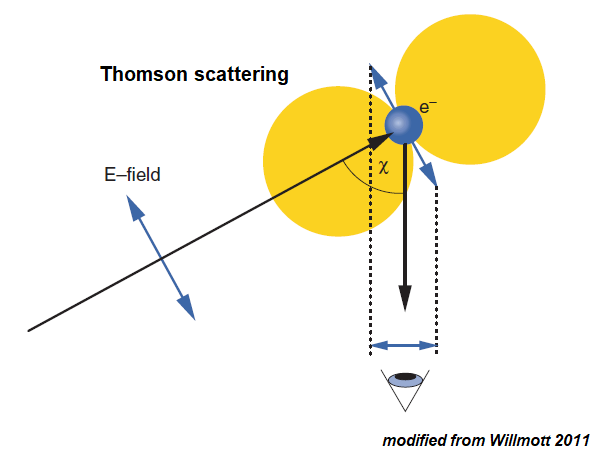
  • Electrons are the main type of particle that can scatter x-rays. Elastic or Thomson scattering occurs when a non-relativistic electron is accelerated by the electrical component of an incoming electromagnetic field from an x-ray. The accelerated electron then reradiates light at the same frequency. Since the frequency of the input light and output light are the same, this is an elastic process.
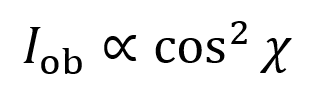
  • The intensity of the re-emitted radiation at an observer’s location depends on the angle Χ between the incident light and the observer. Because of the sinusoidal wave character of light, the scattered intensity at the observer’s location is given by the proportionality equation below.

Eq.1

  • Light that encounters the electron is scattered if it is incident on the region defined by the electron’s classical radius. This region is called the Thomson scattering length r0. For a free electron, r0 = 2.82×10⁻⁵ Å.

Fig.1

  • Compton scattering occurs when an electron scatters a photon and the scattered photon has a lower energy than the incident photon (an inelastic process). For Compton scattering, a fraction of the incident photon’s energy is transferred to the electron.

Fig.2

  • The amount of energy lost via Compton scattering where the incident photon has energy E0 = hc/λ0 and the scattered photon has energy E1 = hc/λ1 is described by the following equation. Here, ψ represents the angle between the paths of the incident photon and the scattered photon.

Eq.2

Scattering from atoms

  • X-rays are scattered throughout the volumes of atomic electron clouds. For x-rays that scattered in the same direction as the incident x-rays, the strength of scattering is proportional to the atom’s Z-number. In the case of an ionic atom, this value is adjusted to equal the atom’s number of electrons. Note that this assumes free electron movement within the cloud.
  • By contrast, x-rays that are scattered at some angle 2θ relative to the incident x-rays exhibit lower scattering magnitudes. Each of the x-rays scattered at angle 2θ will possess different magnitudes and phases depending on where they were scattered from within the atomic cloud. As a result, the scattering amplitude for the x-rays at angle 2θ will be a vector sum of these waves with distinct magnitudes and phases.

Fig.3

  • A wavevector k is a vector with magnitude 2π/λ that points in the direction of a wave’s propagation. The difference between the wavevector of the incident wave k0 and the wavevector of the scattered wave k1 is equal to a scattering vector Q (that is, Q = k0k1). The magnitude of Q is given by the following equation.

Eq.3

  • The atomic scattering factor f describes the total scattering amplitude for an atom as a function of sin(θ)/λ. By assuming that the atom is spherically symmetric, f will depend only on the magnitude of Q and not on its orientation relative to the atom. Values for f can be found in the International Tables for Crystallography or computed using nine known coefficients a1,2,3,4, b1,2,3,4, and c (which can also be looked up) and the following expression. The coefficients vary depending on the atom and ionic state. The units of f are the scattering amplitude that would be produced by a single electron.

Eq.4

  • If the incident x-ray has an energy that is much less than that of an atom’s bound electrons, the response of the electrons will be damped due to their association with the atom. (This no longer assumes free electron movement within the cloud). As a result, f will be decreased by some value fa. The value fa increases when the incoming x-ray’s energy is close to the energy level of the electron and decreases when the incoming x-ray’s energy is far above the energy levels of the electrons.
  • When the incident x-ray’s energy is close to an electron’s energy level (called an absorption edge), the x-ray is partially absorbed. With this process of partial absorption, some of the radiation is still directly scattered and another part of the radiation is re-emitted after a delay. This re-emitted radiation interferes with the directly scattered radiation. To mathematically describe the effect of the re-emitted radiation’s phase shift and interference, f is adjusted by a second term fb (which is an imaginary value). Far from absorption edges, fb has a much weaker effect (it decays by E-2). The total atomic scattering factor is then given by the following complex-valued equation.

Eq.5

Refraction, reflection, and absorption

  • A material’s index of refraction can be expressed as a complex quantity nc = nRe + inIm. The real part represents the rate at which the wave propagates through the material and the imaginary part describes the degree of attenuation that the wave experiences as it passes through the material.
  • The reason that a material can possess a complex refractive index involves the complex plane wave equation. The wavenumber k = 2π/λ0 is the spatial frequency in wavelengths per unit distance and it is a constant within the complex plane wave equation (λ0 is the wave’s vacuum wavelength). The complex wavenumber kc = knc is the wavenumber multiplied by the complex refractive index. As such, the complex refractive index can be related to the complex wavenumber via kc = 2πnc0 where λ0 is the vacuum wavelength of the wave. After inserting 2π(nRe + inIm)/λ0 into the complex plane wave equation, a decaying exponential can be simplified out as a coefficient for the rest of the equation. The decaying exponential represents the attenuation of the wave in the material. Once this simplification is performed, the equation’s complex wavenumber is converted to a real-valued wavenumber.

Eq.6

  • For x-rays, a material’s complex refractive index for wavelength λ is related to the atomic scattering factors of atoms in the material using the following equation. Ni represents the number of atoms of type j per unit volume and fj(0) is the atomic scattering factor in the forward direction (angle of zero) for atoms of type j. Recall that r0 is the Thomson scattering length.

Eq.7

  • The refractive index is a function of the wavelength. For most optical situations, as the absorption maximum of a material is approached from lower frequencies, the refractive index increases. But when the radiation’s frequency is high enough that it passes the absorption maximum, the refractive index decreases to a value of less than one.
  • The refractive index is defined by n = c/v, where v is the wave’s phase velocity. Phase velocity is the rate at which a wave’s phase propagates (i.e. how rapidly one of the wave’s peaks moves through space). Rearranging the equation, v = c/n is obtained. When the refractive index is less than one, the phase velocity is greater than the speed of light. However, this does not violate relativity because the group velocity (not the phase velocity) carries the wave’s energy and information. For comparison, group velocity is the rate at which a change in amplitude of an oscillation propagates.
  • Anomalous dispersion occurs when the radiation’s frequency is high enough that the refractive index of a material is less than one. As a result, x-rays entering a material from vacuum are refracted away from the normal of the refracting surface. This is in contrast to the typical case where the radiation would be refracted toward the normal of the refracting surface. In addition, the refracted wave is phase shifted by π radians.
  • The complex refractive index is often expressed using the equation below. Here, δ is called the refractive index decrement and β is called the absorption index. Note that nRe = 1 – δ and nIm = β (as a comparison to the previously used notation). Recall that nIm = β describes the degree of a wave’s attenuation as it moves through a material.

Eq.8

  • The refractive index decrement can be approximately computed using the average density of electrons ρ, the Thomson scattering length r0, and the wavenumber k = 2π/λ0. Note that this approximation is better for x-rays that are far from an absorption edge.

Eq.10

  • With most materials, the resulting real part of the index of refraction is only slightly less than one when dealing with x-rays. For example, a typical electron density of one electron per cubic Angstrom yields a δ value of about 5×10⁻⁶.
  • Snell’s law applies to the index of refraction for x-rays and is given as follows.

Eq.11

  • Because the index of refraction for x-rays is slightly less than one, total external reflection can occur when x-rays are incident on a surface at angles less than the critical angle θcritical. This stands in contrast with the total internal reflection that commonly occurs with visible light.

Eq.12

  • The critical angle can be approximated with a high level of accuracy using the following equation (derived from the Taylor expansion of the cosine function). With typical values of δ on the order of 10-5, θcritical is often equal to just a few milliradians (or a few tenths of a degree). These small angles relative to the surface are called grazing angles.

Eq.13

  • Because grazing incident angles facilitate x-ray reflection, special curved mirrors can be used to focus x-rays. The curvature of these mirrors must be small enough that the steepest incident angle is less than θcritical. It should be noted that, even when undergoing total external reflection, x-rays do penetrate the reflecting material to a depth of a few nanometers via an evanescent wave.

Fig.4

  • The absorption index β is related to the value fb using the following equation where r0 is the Thomson scattering length. Recall that fb represents the effects of scattering from absorption and remission of x-rays with energies that are close to the absorption edges of a material.

Eq.14

  • Using the process explained earlier for computing the decaying exponential exp(-2πnImx/λ0) that represents the attenuation of a wave’s amplitude as it travels through a material, the decay of a wave’s intensity as it travels through a material can also be found. Recall that λ0 is the wavelength in a vacuum. Because intensity is proportional to the square of the amplitude, the equation below describes the exponential decay of a wave’s intensity in a material. (This decaying exponential function is multiplied by the equation of the wave). Here, μ is called the absorption coefficient and is defined as the reciprocal of the thickness of a material required to decrease a wave’s intensity by a factor of 1/e. The absorption coefficient is a rough indication of a material’s electron density and electron binding energy.

Eq.15

  • The correspondences between the atomic configurations associated with an x-ray absorption edge and the commonly used name for said absorption edge are given in the following table. The subscripts used with the configurations represent the total angular momenta.

Table1

X-ray fluorescence and Auger emission

  • Materials fluoresce after bombardment with x-rays or high-energy electrons. If electrons are used, the emitted light consists of Bremsstrahlung radiation (which comes from the deacceleration of the electrons) and fluorescence lines. The Bremsstrahlung radiation includes a broad spectrum of wavelengths and has low intensity while the fluorescence lines are sharp peaks and exhibit high intensity. If x-rays are used to bombard a material, there is no Bremsstrahlung radiation, but fluorescence lines occur.
  • Different materials exhibit different characteristic fluorescence lines. These x-ray fluorescence lines are caused by outer-shell electrons relaxing to fill the holes left after the ejection of photoelectrons. However, not all electronic transitions are allowed, only those which follow the selection rules for electric dipoles. These selection rules are given below. J is the total angular momentum and can be computed from the sum of the Azimuthal quantum number L (which determines the type of atomic orbital) and the spin quantum number S (which determines the direction of an electron’s spin).

Eq.16

  • The nomenclature for x-ray fluorescence lines is based on the shell to which an electron relaxes. If an excited electron relaxes to the 1s shell state, then the fluorescence line is part of the K series. For an excited electron that relaxes to the 2s or 2p state, the fluorescence line is part of the L series. The M series includes relaxations to 3s, 3p, and 3d. The N series includes relaxations to 5s, 5p, 5d, and 5f. As such, the Azimuthal quantum number determines if the fluorescence line falls into the K, L, M, or N series (there are some series beyond these as well which follow the same pattern). The transition within each series that exhibits the smallest energy difference is labeled with α (i.e. Kα), the transition with the next smallest energy difference is labeled with β, and so on. It should be noted that the fluorescence lines are further split by the effects of electron spin and angular momentum and so are labeled with suffixes of 1, 2, etc.
  • Auger emission is the process where a photoelectron is ejected, an outer shell electron relaxes to fill the hole, and the released energy causes ejection another electron instead of emitting a photon. The energies of emitted Auger electrons are independent of the energies of the incident photons.
  • The excess energy released by the relaxation of the outer shell electron is equal to |Ecore – Eouter|. In order for the last electron ejection to occur, the electron must have a binding energy that is less than the excess released energy from the relaxation. The kinetic energy of the ejected Auger electron is |Ecore – Eouter – Ebinding|. Note that Ebinding is the binding energy of the Auger electron in the ionized atom (which is different from the binding energy in the neutral form of the atom).
  • Auger emission and x-ray fluorescence are competitive with each other. Fluorescence is stronger for heavier atoms (higher Z-number) since they exhibit larger energy differences between adjacent shells as well as binding electrons more tightly. For the same reasons, Auger emission is stronger from atoms with lower Z-numbers.

Fig.5


Reference: Willmott, P. (2011). An Introduction to Synchrotron Radiation: Techniques and Applications. Wiley.

Cover image courtesy of: Asia Times


Global Highlights in Neuroengineering 2005-2018


No Comments

PDF version: global highlights in neuroengineering 2005-2018 – logan thrasher collins

Optogenetic stimulation using ChR2

(Boyden, Zhang, Bamberg, Nagel, & Deisseroth, 2005)

  • Ed Boyden, Karl Deisseroth, and colleagues developed optogenetics, a revolutionary technique for stimulating neural activity.
  • Optogenetics involves engineering neurons to express light-gated ion channels. The first channel used for this purpose was ChR2 (a protein originally found in bacteria which responds to blue light). In this way, a neuron exposed to an appropriate wavelength of light will be stimulated.
  • Over time, optogenetics has gained a place as an essential experimental tool for neuroscientists across the world. It has been expanded upon and improved in numerous ways and has even allowed control of animal behavior via implanted fiber optics and other light sources. Optogenetics may eventually be used in the development of improved brain-computer interfaces.

optogenetics

Blue Brain Project cortical column simulation

(Markram, 2006)

  • In the early stages of the Blue Brain Project, neuronal cell types from the layers of the rat neocortex were reconstructed. Furthermore, their electrophysiology was experimentally characterized.
  • Next, a virtual neocortical column with about 10,000 multicompartmental Hodgkin-Huxley-type neurons and over ten million synapses was built. Its connectivity was defined according the patterns of connectivity found in biological rats, (though this involved the numbers of inputs and outputs quantified for given cell types rather than explicit wiring). In addition, the spatial distributions of boutons forming synaptic terminals upon target cells reflected biological data.
  • The cortical column was emulated using the Blue Gene/L supercomputer and the dynamics of the emulation reflected its biological counterpart.
cortical column

Optogenetic silencing using halorhodopsin

(Han & Boyden, 2007)

  • Ed Boyden continued developing optogenetic tools to manipulate neural activity. Along with Xue Han, he expressed a codon-optimized version of a bacterial halorhodopsin (along with the ChR2 protein) in neurons.
  • Upon exposure to yellow light, halorhodopsin pumps chloride ions into the cell, hyperpolarizing the membrane and inhibiting neural activity.
  • Using halorhodopsin and ChR2, neurons could be easily activated and inhibited using yellow and blue light respectively.
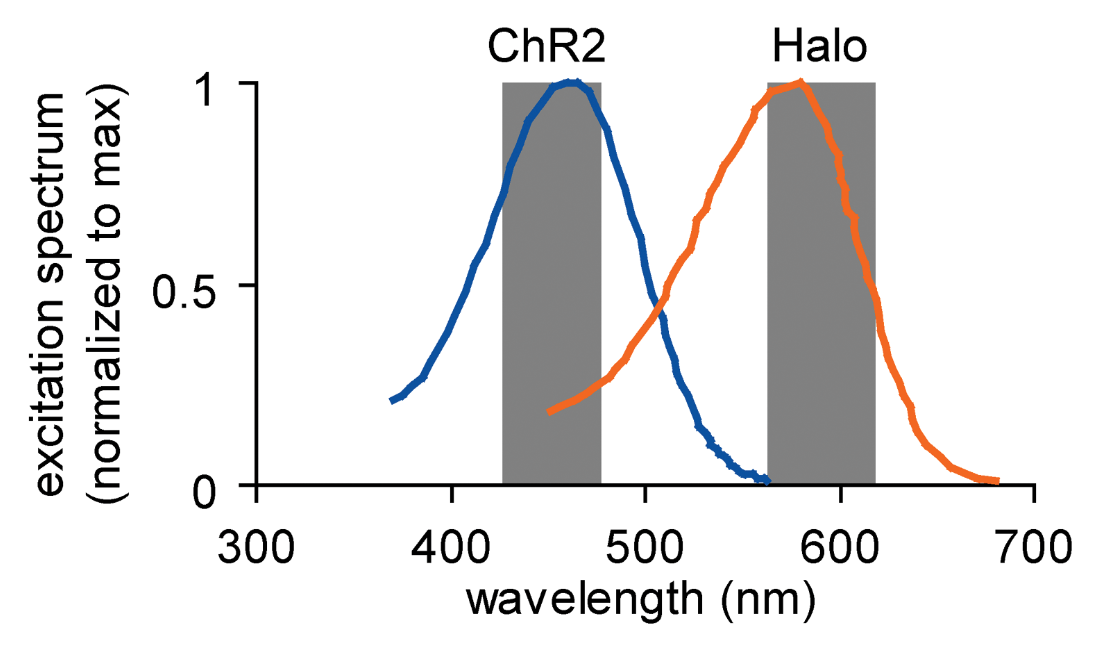
halorhodopsin and chr2 wavelengths

Brainbow

(Livet et al., 2007)

  • Lichtman and colleagues used Cre/Lox recombination tools to create genes which express a randomized set of three or more differently-colored fluorescent proteins (XFPs) in a given neuron, labeling the neuron with a unique combination of colors. About ninety distinct colors were emitted across a population of genetically modified neurons.
  • The detailed structures within neural tissue equipped with the Brainbow system can be imaged much more easily since neurons can be distinguished via color contrast.
  • As a proof-of-concept, hundreds of synaptic contacts and axonal processes were reconstructed in a selected volume of the cerebellum. Several other neural structures were also imaged using Brainbow.
  • The fluorescent proteins expressed by the Brainbow system are usable in vivo.
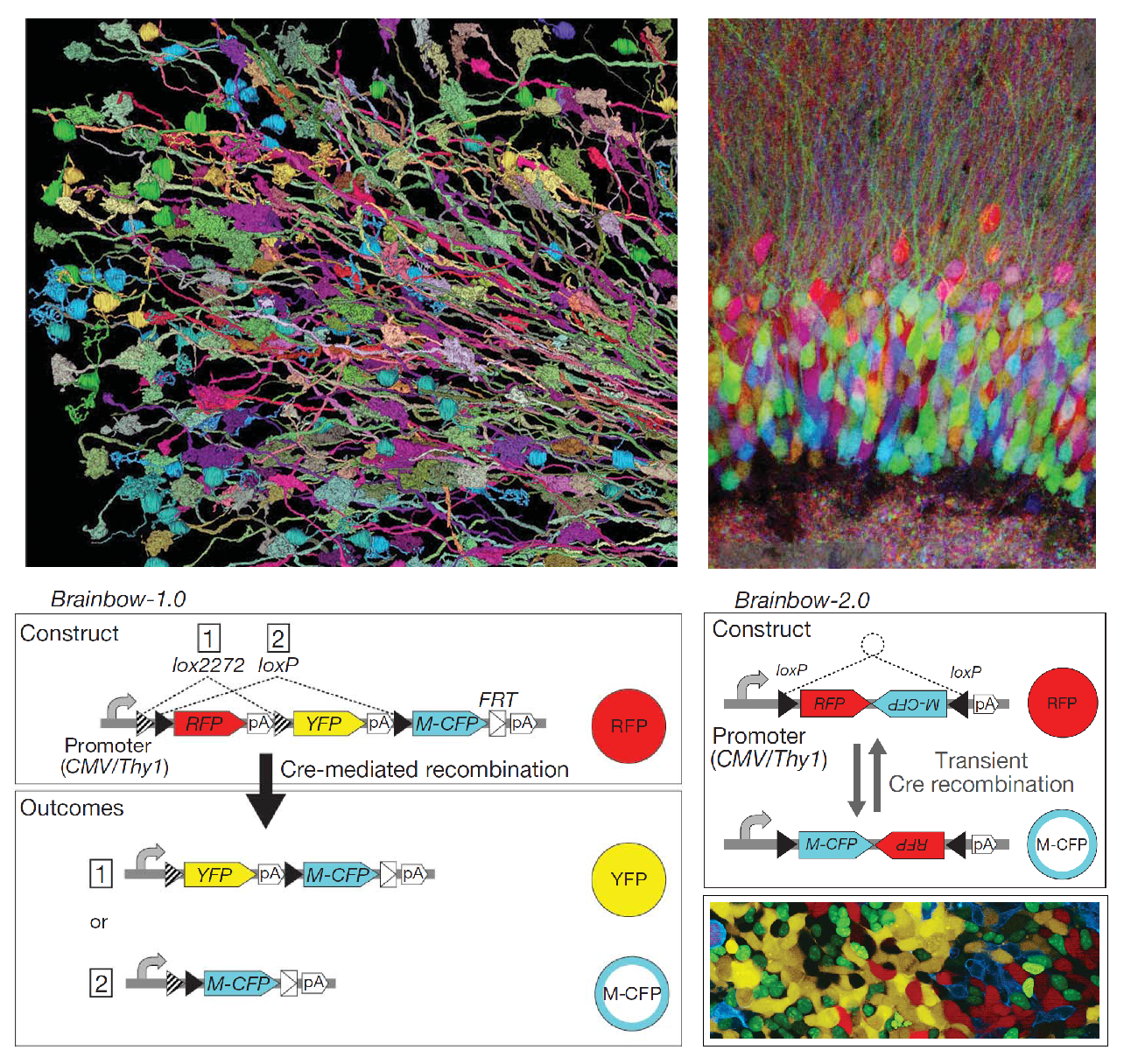
brainbow

High temporal precision optogenetics

(Gunaydin et al., 2010)

  • Karl Deisseroth, Peter Hegemann, and colleagues used protein engineering to improve the temporal resolution of optogenetic stimulation.
  • Glutamic acid at position 123 in ChR2 was mutated to threonine, producing a new ion channel protein (dubbed ChETA).
  • The ChETA protein allows for induction of spike trains with frequencies up to 200 Hz and greatly decreases the incidence of unintended spikes. Furthermore, ChETA eliminates plateau potentials (a phenomenon which interferes with precise control of neural activity).
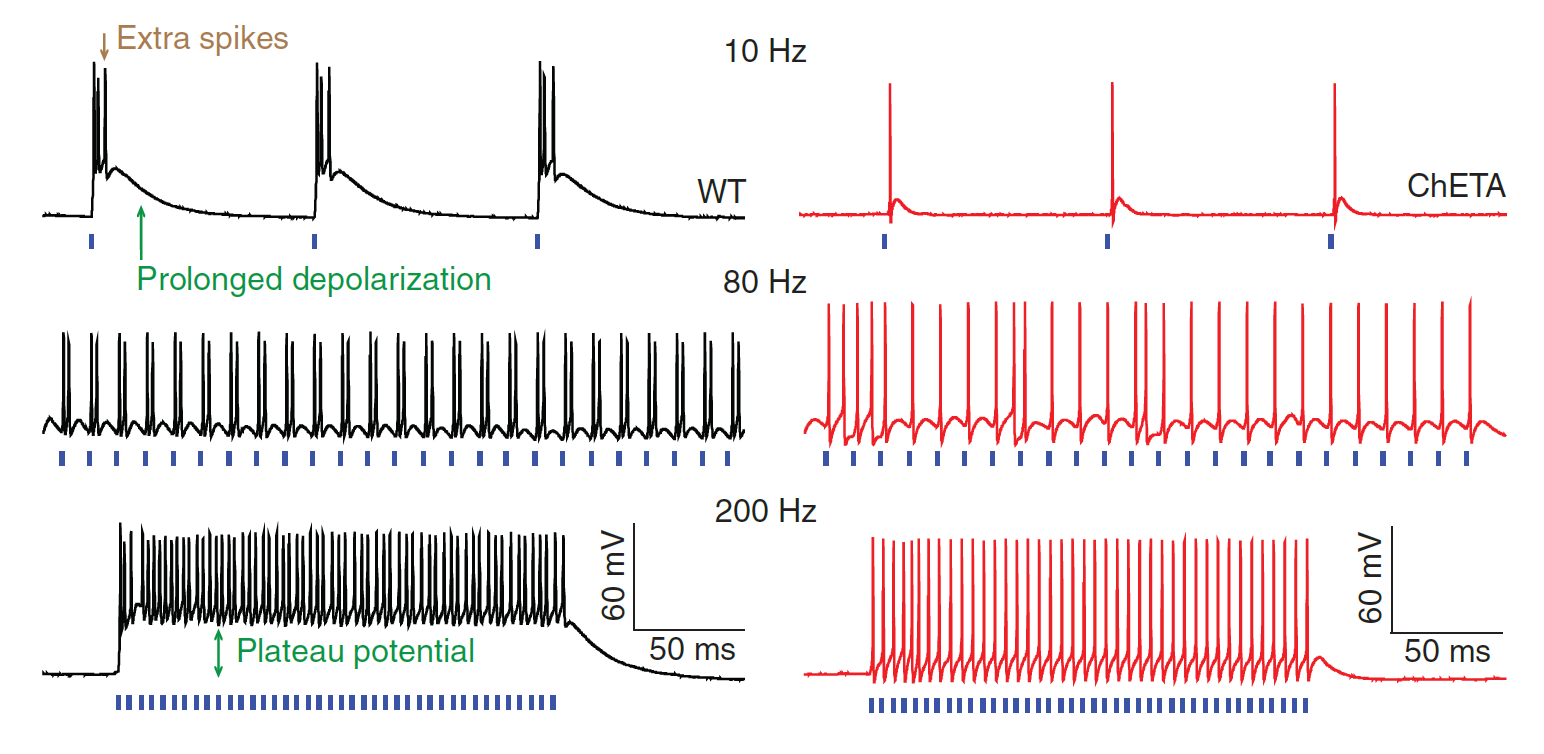
ultrafast optogenetics

Hippocampal prosthesis in rats

(Berger et al., 2012)

  • Theodore Berger and his team developed an artificial replacement for neurons which transmit information from the CA3 region to the CA1 region of the hippocampus.
  • This cognitive prosthesis employs recording and stimulation electrodes along with a multi-input multi-output (MIMO) model to encode the information in CA3 and transfer it to CA1.
  • The hippocampal prosthesis was shown to restore and enhance memory in rats as evaluated by behavioral testing and brain imaging.

In vivo superresolution microscopy for neuroimaging

(Berning, Willig, Steffens, Dibaj, & Hell, 2012)

  • Stefan Hell (2014 Nobel laureate in chemistry) developed stimulated emission depletion microscopy (STED), a type of superresolution fluorescence microscopy which allows imaging of synapses and dendritic spines.
  • STED microscopy uses a torus-shaped de-excitation laser that interferes with the excitation laser to deplete fluorescence except in a very small spot. In this way, the diffraction limit is surpassed since the resulting light illuminates extremely small regions of the sample.
  • Neurons in transgenic mice (equipped with glass-sealed holes in their skulls) were imaged using STED. Synapses and dendritic spines were observed up to fifteen nanometers below the surface of the brain tissue.
superresolution microscopy in vivo

In vivo three-photon microscopy

(Horton et al., 2013)

  • Multi-photon excitation uses pulsed lasers to excite fluorophores with two or more photons of light with long wavelengths. During the excitation, the photons undergo a nonlinear recombination process, yielding a single emitted photon with a much shorter wavelength. Because the excitation photons possess long wavelengths, they can penetrate tissue much more deeply than traditional microscopy allows.
  • Horton and colleagues developed a three-photon excitation method to facilitate even deeper tissue penetration than the commonly used two-photon microscopic techniques.
  • Since three photons were involved per excitation event, even longer excitation wavelengths (about 1,700 nm) were usable, allowing the construction of a 3-dimensional image stack that reached a depth of up to 1.4 mm within the living mouse brain.
  • Blood vessels and RFP-labeled neurons were imaged using this approach. Furthermore, the depth was sufficient to enable imaging of neurons within the mouse hippocampus.

3-photon microscopy

Whole-brain functional recording from larval zebrafish

(Ahrens, Orger, Robson, Li, & Keller, 2013)

  • Laser-scanning light-sheet microscopy was used to volumetrically image the entire brains of larval zebrafish (an optically transparent organism).
  • The genetically encoded calcium sensor GCaMP5G facilitated functional recording at single-cell resolution from about 80% of the total neurons in the larval zebrafish brains. Computational methods were used to distinguish between individual neurons.
  • Populations of neurons that underwent correlated activity patterns were identifiedto show the technique’s utility for uncovering the dynamics of neural circuits. These populations included hindbrain neurons that were functionally linked to neural activity in the spinal cord and a population of neurons which showed coupled oscillations on the left and right halves.
whole-brain recording from larval zebrafish

Eyewire: crowdsourcing method for retina mapping

(Marx, 2013)

  • The Eyewire project was created by Sebastian Seung’s research group. It is a crowdsourcing initiative for connectomic mapping within the retina towards uncovering neural circuits involved in visual processing.
  • Laboratories first collect data via serial electron microscopy as well as functional data from two-photon microscopy.
  • In the Eyewire game, images of tissue slices are provided to players who then help reconstruct neural morphologies and circuits by “coloring in” the parts of the images which correspond to cells and stacking many images on top of each other to generate 3D maps. Artificial intelligence tools help provide initial “best guesses” and guide the players, but the people ultimately perform the task of reconstruction.
  • By November 2013, around 82,000 participants had played the game. Its popularity continues to grow.

eyewire

The BRAIN Initiative

(“Fact Sheet: BRAIN Initiative,” 2013)

  • The BRAIN Initiative (Brain Research through Advancing Innovative Technologies) provided neuroscientists with $110 million in governmental funding and $122 million in funding from private sources such as the Howard Hughes Medical Institute and the Allen Institute for Brain Science.
  • The BRAIN Initiative focused on funding research which develops and utilizes new technologies for functional connectomics. It helped to accelerate research on tools for decoding the mechanisms of neural circuits in order to understand and treat mental illness, neurodegenerative diseases, and traumatic brain injury.
  • The BRAIN Initiative emphasized collaboration between neuroscientists and physicists. It also pushed forward nanotechnology-based methods to image neural tissue, record from neurons, and otherwise collect neurobiological data.

The CLARITY method for making brains translucent

(Chung & Deisseroth, 2013)

  • Karl Deisseroth and colleagues developed a method called CLARITY to make samples of neural tissue optically translucent without damaging the fine cellular structures in the tissue. Using CLARITY, entire mouse brains have been turned transparent.
  • Mouse brains were infused with hydrogel monomers (acrylamide and bisacrylamide) as well as formaldehyde and some other compounds for facilitating crosslinking. Next, the hydrogel monomers were crosslinked by incubating the brains at 37°C. Lipids in the hydrogel-stabilized mouse brains were extracted using hydrophobic organic solvents and electrophoresis.
  • CLARITY allows antibody labeling, fluorescence microscopy, and other optically-dependent techniques to be used for imaging entire brains. In addition, it renders the tissue permeable to macromolecules, which broadens the types of experimental techniques that these samples can undergo (i.e. macromolecule-based stains, etc.)

clarity imaging technique

X-ray microtomography used to reconstruct Drosophila brain hemisphere

(Mizutani, Saiga, Takeuchi, Uesugi, & Suzuki, 2013)

  • Mizutani and colleagues stained Drosophila brains with silver nitrate and tetrachloroaurate (a gold-containing compound), facilitating 3-dimensional imaging using X-ray microtomography at a voxel size of 220 × 328 × 314 nm.
  • To generate the X-rays, a synchrotron source was used. It should be noted that synchrotron sources require large facilities to operate.
  • Neuronal tracing was performed manually on the 3-dimensional X-ray images of the fly brain, a process which took about 1,700 person-hours. Some neuronal processes were too dense to be resolved, so they were “fused” into unified structures. Furthermore, some neuronal traces were fragmented and most of the cell bodies were not considered. This decreased the number of traces to one third of the estimated number of actual processes in the hemisphere.
  • Mizutani’s investigation represents an early effort at large-scale connectomics that sets the stage for further initiatives as neuronal tracing, sample preparation, and X-ray microtomography technologies continue to improve.

traced drosophila brain hemisphere

Telepathic rats engineered using hippocampal prosthesis

(S. Deadwyler et al., 2013)

  • Berger’s hippocampal prosthesis was implanted in pairs of rats. When “donor” rats were trained to perform a task, they developed neural representations (memories) which were recorded by their hippocampal prostheses.
  • The donor rat memories were run through the MIMO model and transmitted to the stimulation electrodes of the hippocampal prostheses implanted in untrained “recipient” rats. After receiving the memories, the recipient rats showed significant improvements on the task that they had not been trained to perform.

rat telepathy

Integrated Information Theory 3.0

(Oizumi, Albantakis, & Tononi, 2014)

  • Integrated information theory (IIT) was originally proposed by Giulio Tononi in 2004. IIT is a quantitative theory of consciousness which may help explain the hard problem of consciousness.
  • IIT begins by assuming the following phenomenological axioms; each experience is characterized by how it differs from other experiences, an experience cannot be reduced to interdependent parts, and the boundaries which distinguish individual experiences are describable as having defined “spatiotemporal grains.”
  • From these phenomenological axioms and the assumption of causality, IIT identifies maximally irreducible conceptual structures (MICS) associated with individual experiences. MICS represent particular patterns of qualia that form unified percepts.
  • IIT also outlines a mathematical measure of an experience’s quantity. This measure is called integrated information or ϕ.

Openworm

(Szigeti et al., 2014)

  • The anatomical elegans connectome was originally mapped in 1976 by Albertson and Thomson. More data has since been collected on neurotransmitters, electrophysiology, cell morphology, and other characteristics.
  • Szigeti, Larson, and their colleagues made an online platform for crowdsourcing research on elegans computational neuroscience, with the goal of completing an entire “simulated worm.”
  • The group also released software called Geppetto, a program that allows users to manipulate both multicompartmental Hodgkin-Huxley models and highly efficient soft-body physics simulations (for modeling the worm’s electrophysiology and anatomy).
c. elegans connectome

Expansion microscopy

(F. Chen, Tillberg, & Boyden, 2015)

  • The Boyden group developed expansion microscopy, a method which enlarges neural tissue samples (including entire brains) with minimal structural distortions and so facilitates superior optical visualization of the scaled-up neural microanatomy. Furthermore, expansion microscopy greatly increases the optical translucency of treated samples.
  • Expansion microscopy operates by infusing a swellable polymer network into brain tissue samples along with several chemical treatments to facilitate polymerization and crosslinking and then triggering expansion via dialysis in water. With 4.5-fold enlargement, expansion microscopy only distorts the tissue by about 1% (computed using a comparison between control superresolution microscopy of easily-resolvable cellular features and the expanded version).
  • Before expansion, samples can express various fluorescent proteins to facilitate superresolution microscopy of the enlarged tissue once the process is complete. Furthermore, expanded tissue is highly amenable to fluorescent stains and antibody-based labels.

expansion microscopy

Japan’s Brain/MINDS project

(Okano, Miyawaki, & Kasai, 2015)

  • In 2014, the Brain/MINDS (Brain Mapping by Integrated Neurotechnologies for Disease Studies) project was initiated to further neuroscientific understanding of the brain. This project received nearly $30 million in funding for its first year alone.
  • Brain/MINDS focuses on studying the brain of the common marmoset (a non-human primate abundant in Japan), developing new technologies for brain mapping, and understanding the human brain with the goal of finding new treatments for brain diseases.

The TrueNorth chip from DARPA and IBM

(Akopyan et al., 2015)

  • The TrueNorth neuromorphic computing chip was constructed and validated by DARPA and IBM. TrueNorth uses circuit modules which mimic neurons. Inputs to these fundamental circuit modules must overcome a threshold in order to trigger “firing.”
  • The chip can emulate up to a million neurons with over 250 million synapses while requiring far less power than traditional computing devices.

Human Brain Project cortical mesocircuit reconstruction and simulation

(Markram et al., 2015)

  • The Human Brain Project reconstructed a 0.29 mm3 region of rat cortical tissue including about 31,000 neurons and 37 million synapses based on morphological data, statistical connectivity rules (rather than exact connectivity), and other datasets. The cortical mesocircuit was emulated using the Blue Gene/Q supercomputer.
  • This emulation was sufficiently accurate to reproduce emergent neurological processes and yield insights on the mechanisms of their computations.

cortical mesocircuit

Recording from C. elegans neurons reveals motor operations

(Kato et al., 2015)

  • Live elegans worms were immobilized in microfluidic devices and the neurons in their head ganglia as well as some of their motor systems were imaged and recorded from using the calcium indicator GCaMP. As the C. elegans connectome is well-characterized, Kato and colleagues were able to determine the identities of most of the cells that underwent imaging (with the help of computational segmentation techniques).
  • Principal component analysis was used to reduce the dimensionality of the neural activity datasets since over 100 neurons per worm were recorded from simultaneously.
  • Next, phase space analysis was utilized to visualize the patterns formed by the recording data. Motor behaviors including dorsal turns, ventral turns, forward movements, and backward movements were found to correspond to specific sequences of neural events as uncovered by examining the patterns found in the phase plots. Further analyses revealed various insights about these brain dynamics and their relationship to motor actions.

c. elegans brain dynamics

Neural lace

(Liu et al., 2015)

  • Charles Lieber’s group developed a syringe-injectable electronic mesh made of submicrometer-thick wiring for neural interfacing.
  • The meshes were constructed using novel soft electronics for biocompatibility. Upon injection, the neural lace expands to cover and record from centimeter-scale regions of tissue.
  • Neural lace may allow for “invasive” brain-computer interfaces to circumvent the need for surgical implantation. Lieber has continued to develop this technology towards clinical application.

neural lace

BigNeuron initiative towards standardized neuronal morphology acquisition

(Peng et al., 2015)

  • Because of the inconsistencies between neuronal reconstruction methods and lack of standardization found in neuronal morphology databases, BigNeuron was established as a community effort to improve the situation.
  • BigNeuron tests as many automated neuronal reconstruction algorithms as possible using large-scale microscopy datasets (from several types of light microscopy). It uses the Vaa3D neuronal reconstruction software as a central platform. Reconstruction algorithms are added to Vaa3D as plugins. These computational tests are performed on supercomputers.
  • BigNeuron aims to create a superior community-oriented neuronal morphology database, a set of greatly improved tools for neuronal reconstruction, a standardized protocol for future neuronal reconstructions, and a library of morphological feature definitions to facilitate classification.

Human telepathy during a 20 questions game

(Stocco et al., 2015)

  • Using an interactive question-and-answer setup, Stocco and colleagues demonstrated real-time telepathic communication between pairs of individuals via EEG and transcranial magnetic stimulation. Five pairs of participants played games of 20 questions and attempted to identify unknown objects.
  • EEG data were recorded from the respondent, computationally processed, and transmitted as transcranial magnetic stimulation signals into the mind (occipital lobe stimulation) of a respondent. The respondent’s answers were translated into higher-intensity transcranial magnetic stimulation pulses corresponding to “yes” answers or lower-intensity transcranial magnetic stimulation pulses corresponding to “no” answers.
  • When compared to control trials in which sham interfaces were used, the people using the brain-brain interfaces were significantly more successful at playing 20 questions games.

Expansion FISH

(F. Chen et al., 2016)

  • Boyden, Chen, Marblestone, Church, and colleagues combined fluorescent in situ hybridization (FISH) with expansion microscopy to image the spatial localization of RNA in neural tissue.
  • The group developed a chemical linker to covalently attach intracellular RNA to the infused polymer network used in expansion microscopy. This allowed for RNAs to maintain their relative spatial locations within each cell post-expansion.
  • After the tissue was enlarged, FISH was used to fluorescently label targeted RNA molecules. In this way, RNA localization was more effectively resolved.
  • As a proof-of-concept, expansion FISH was used to reveal the nanoscale distribution of long noncoding RNAs in nuclei as well as the locations of RNAs within dendritic spines.

expansion fish

Neural dust

(Seo et al., 2016)

  • Michel Maharbiz’s group invented implantable, ~ 1 mm biosensors for wireless neural recording and tested them in rats.
  • This neural dust could be miniaturized to less than 0.5 mm or even to microscale dimensions using customized electronic components.
  • Neural dust motes consist of two recording electrodes, a transistor, and a piezoelectric crystal.
  • The neural dust received external power from ultrasound. Neural signals were recorded by measuring disruptions to the piezoelectric crystal’s reflection of the ultrasound waves. Signal processing mathematics allowed precise detection of activity.
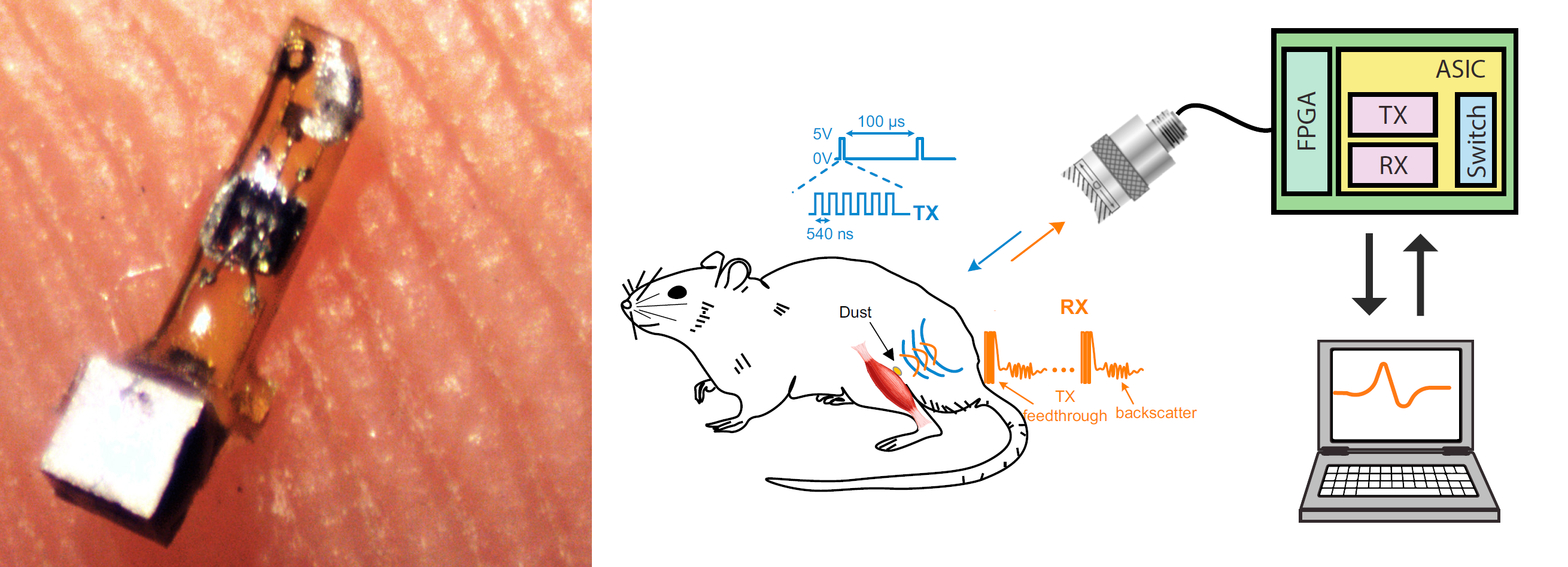
neural dust

The China Brain Project

(Poo et al., 2016)

  • The China Brain Project was launched to help understand the neural mechanisms of cognition, develop brain research technology platforms, develop preventative and diagnostic interventions for brain disorders, and to improve brain-inspired artificial intelligence technologies.
  • This project will be take place from 2016 until 2030 with the goal of completing mesoscopic brain circuit maps.
  • China’s population of non-human primates and preexisting non-human primate research facilities give the China Brain Project an advantage. The project will focus on studying rhesus macaques.

Somatosensory cortex stimulation for spinal cord injuries

(Flesher et al., 2016)

  • Gaunt, Flesher, and colleagues found that microstimulation of the primary somatosensory cortex (S1) partially restored tactile sensations to a patient with a spinal cord injury.
  • Electrode arrays were implanted into the S1 regions of a patient with a spinal cord injury. The array performed intracortical microstimulation over a period of six months.
  • The patient reported locations and perceptual qualities of the sensations elicited by microstimulation. The patient did not experience pain or “pins and needles” from any of the stimulus trains. Overall, 93% of the stimulus trains were reported as “possibly natural.”
  • Results from this study might be used to engineer upper-limb neuroprostheses which provide somatosensory feedback.

somatosensory stimulation

Simulation of rat CA1 region

(Bezaire, Raikov, Burk, Vyas, & Soltesz, 2016)

  • Detailed computational models of 338,740 neurons (including pyramidal cells and various types of interneurons) were equipped with connectivity patterns based on data from the biological CA1 region. External inputs were also estimated using biological data and incorporated into the simulation. It is important to note that these connectivity patterns described the typical convergence and divergence of neurites to and from particular cell types rather than explicitly representing the exact connections found in the biological rat.
  • Each neuron was simulated using a multicompartmental Hodgkin-Huxley-type model with its morphological structure based on biological data from the given cell type. Furthermore, different cell types received different numbers of presynaptic terminals at specified distances from the soma. In total, over five billion synapses were present within the CA1 model.
  • The simulation was implemented on several different supercomputers. Due to the model’s complexity, a four second simulation took about four hours to complete.
  • As with the biological CA1 region, the simulation gave rise to gamma oscillations and theta oscillations as well as other biologically consistent phenomena. In addition, parvalbumin-expressing interneurons and neurogliaform cells were identified as drivers of the theta oscillations, demonstrating the utility of detailed neuronal simulations for uncovering biological insights.

ca1 simulation

UltraTracer enhances existing neuronal tracing software

(Peng et al., 2017)

  • UltraTracer is an algorithm that can improve the efficiency of existing neuronal tracing software for handling large datasets while maintaining accuracy.
  • Datasets with hundreds of billions of voxels were utilized to test UltraTracer. Ten existing tracing algorithms were augmented.
  • For most of the existing algorithms, the performance improvements were around 3-6 times, though a few showed improvements of 10-30 times. Even when using computers with smaller memory, UltraTracer was consistently able to enhance conventional software.
  • UltraTracer was made opensource and is available as a plugin for the Vaa3D tracing software suite.

Whole-brain electron microscopy in larval zebrafish

(Hildebrand et al., 2017)

  • Serial electron microscopy facilitated imaging of the entire brain of a larval zebrafish at 5.5 days post-fertilization.
  • Neuronal tracing software (a modified version of the CATMAID software) was used to reconstruct all the myelinated axons found in the larval zebrafish brain.
  • The reconstructed dataset included 2,589 myelinated axon segments along with some of the associated soma and dendrites. It should be noted that only 834 of the myelinated axons were successfully traced back to their cell bodies.

ssem of larval zebrafish brain

Hippocampal prosthesis in monkeys

(S. A. Deadwyler et al., 2017)

  • Theodore Berger continued developing his cognitive prosthesis and tested it in Rhesus Macaques.
  • As with the rats, monkeys with the implant showed substantially improved performance on memory tasks.

The $100 billion Softbank Vision Fund

(Lomas, 2017)

  • Masayoshi Son, the CEO of Softbank (a Japanese telecommunications corporation), announced a plan to raise $100 billion in venture capital to invest in artificial intelligence. This plan involved partnering with multiple large companies in order to raise this enormous amount of capital.
  • By the end of 2017, the Vision Fund successfully reached its $100 billion goal. Masayoshi Son has since announced further plans to continue raising money with a new goal of over $800 billion.
  • Masayoshi Son’s reason for these massive investments is the Technological Singularity. He agrees with Kurzweil that the Singularity will likely occur at around 2045 and he hopes to help bring the Singularity to fruition. Though Son is aware of the risks posed by artificial superintelligence, he feels that superintelligent AI’s potential to tackle some of humanity’s greatest challenges (such as climate change and the threat of nuclear war) outweighs those risks.

Bryan Johnson launches Kernel

(Regalado, 2017)

  • Entrepreneur Bryan Johnson invested $100 million to start Kernel, a neurotechnology company.
  • Kernel plans to develop implants that allow for recording and stimulation of large numbers of neurons at once. The company’s initial goal is to develop treatments for mental illnesses and neurodegenerative diseases. Its long-term goal is to enhance human intelligence.
  • Kernel originally partnered with Theodore Berger and intended to utilize his hippocampal prosthesis. Unfortunately, Berger and Kernel parted ways after about six months because Berger’s vision was reportedly too long-range to support a financially viable company (at least for now).
  • Kernel was originally a company called Kendall Research Systems. This company was started by a former member of the Boyden lab. In total, four members of Kernel’s team are former Boyden lab members.

Elon Musk launches NeuraLink

(Etherington, 2017)

  • Elon Musk (CEO of Tesla, SpaceX, and a number of other successful companies) initiated a neuroengineering venture called NeuraLink.
  • NeuraLink will begin by developing brain-computer interfaces (BCIs) for clinical applications, but the ultimate goal of the company is to enhance human cognitive abilities in order to keep up with artificial intelligence.
  • Though many of the details around NeuraLink’s research are not yet open to the public, it has been rumored that injectable electronics similar to Lieber’s neural lace might be involved.

Facebook announces effort to build brain-computer interfaces

(Constine, 2017)

  • Facebook revealed research on constructing non-invasive brain-computer interfaces (BCIs) at a company-run conference in 2017. The initiative is run by Regina Dugan, Facebook’s head of R&D at division building 8.
  • Facebook’s researchers are working on a non-invasive BCI which may eventually enable users to type one hundred words per minute with their thoughts alone. This effort builds on past investigations which have been used to help paralyzed patients.
  • The building 8 group is also developing a wearable device for “skin hearing.” Using just a series of vibrating actuators which mimic the cochlea, test subjects have so far been able to recognize up to nine words. Facebook intends to vastly expand this device’s capabilities.

DARPA funds research to develop improved brain-computer interfaces

(Hatmaker, 2017)

  • The U.S. government agency DARPA awarded $65 million in total funding to six research groups.
  • The recipients of this grant included five academic laboratories (headed by Arto Nurmikko, Ken Shepard, Jose-Alain Sahel and Serge Picaud, Vicent Pieribone, and Ehud Isacoff) and one small company called Paradromics Inc.
  • DARPA’s goal for this initiative is to develop a nickel-sized bidirectional brain-computer interface (BCI) which can record from and stimulate up to one million individual neurons at once.

Human Brain Project analyzes brain computations using algebraic topology

(Reimann et al., 2017)

  • Investigators at the Human Brain Project utilized algebraic topology to analyze the reconstructed ~ 31,000 neuron cortical microcircuit from their earlier work.
  • The analysis involved representing the cortical network as a digraph, finding directed cliques (complete directed subgraphs belonging to a digraph), and determining the net directionality of information flow (by computing the sum of the squares of the differences between in-degree and out-degree for all the neurons in a clique). In algebraic topology, directed cliques of n neurons are called directed simplices of dimension n-1.
  • Vast numbers of high-dimensional directed cliques were found in the cortical microcircuit (as compared to null models and other controls). Spike correlations between pairs of neurons within a clique were found to increase with the clique’s dimension and with the proximity of the neurons to the clique’s sink. Furthermore, topological metrics allowed insights into the flow of neural information among multiple cliques.
  • Experimental patch-clamp data supported the significance of the findings. In addition, similar patterns were found within the elegans connectome, suggesting that the results may generalize to nervous systems across species.

hbp algebraic topology

Early testing of hippocampal prosthesis algorithm in humans

(Song, She, Hampson, Deadwyler, & Berger, 2017)

  • Dong Song (who was working alongside Berger) tested the MIMO algorithm on human epilepsy patients using implanted recording and stimulation electrodes. The full hippocampal prosthesis was not implanted, but the electrodes acted similarly, though in a temporary capacity. Although only two patients were tested in this study, many trials were performed to compensate for the small sample size.
  • Hippocampal spike trains from individual cells in CA1 and CA3 were recorded from the patients during a delayed match-to-sample task. The patients were shown various images while neural activity data were recorded by the electrodes and processed by the MIMO model. The patients were then asked to recall which image they had been shown previously by picking it from a group of “distractor” images. Memories encoded by the MIMO model were used to stimulate hippocampal cells during the recall phase.
  • In comparison to controls in which the same two epilepsy patients were not assisted by the algorithm and stimulation, the experimental trials demonstrated a significant increase in successful pattern matching.

Brain imaging factory in China

(Cyranoski, 2017)

  • Qingming Luo started the HUST-Suzhou Institute for Brainsmatics, a brain imaging “factory.” Each of the numerous machines in Luo’s facility performs automated processing and imaging of tissue samples. The devices make ultrathin slices of brain tissue using diamond blades, treat the samples with fluorescent stains or other contrast-enhancing chemicals, and image then using fluorescence microscopy.
  • The institute has already demonstrated its potential by mapping the morphology of a previously unknown neuron which “wraps around” the entire mouse brain.

china brain mapping image

Automated patch-clamp robot for in vivo neural recording

(Suk et al., 2017)

  • Ed Boyden and colleagues developed a robotic system to automate patch-clamp recordings from individual neurons. The robot was tested in vivo using mice and achieved a data collection yield similar to that of skilled human experimenters.
  • By continuously imaging neural tissue using two-photon microscopy, the robot can adapt to a target cell’s movement and shift the pipette to compensate. This adaptation is facilitated by a novel algorithm called an imagepatching algorithm. As the pipette approaches its target, the algorithm adjusts the pipette’s trajectory based on the real-time two-photon microscopy.
  • The robot can be used in vivo so long as the target cells express a fluorescent marker or otherwise fluoresce corresponding to their size and position.

automated patch clamp system

Genome editing in the mammalian brain

(Nishiyama, Mikuni, & Yasuda, 2017)

  • Precise genome editing in the brain has historically been challenging because most neurons are postmitotic (non-dividing) and the postmitotic state prevents homology-directed repair (HDR) from occurring. HDR is a mechanism of DNA repair which allows for targeted insertions of DNA fragments with overhangs homologous to the region of interest (by contrast, non-homologous end-joining is highly unpredictable).
  • Nishiyama, Mikuni, and Yasuda developed a technique which allows genome editing in postmitotic mammalian neurons using adeno-associated viruses (AAVs) and CRISPR-Cas9.
  • The AAVs delivered ssDNA sequences encoding a single guide RNA (sgRNA) and an insert. Inserts encoding a hemagglutinin tag (HA) and inserts encoding EGFP were both tested. Cas9 was encoded endogenously by transgenic host cells and in transgenic host animals.
  • The technique achieved precise genome editing in vitro and in vivo with a low rate of off-target effects. Inserts did not cause deletion of nearby endogenous sequences for 98.1% of infected neurons.

genome editing neuronsNeuropixels probe

(Jun et al., 2017)

  • Jun and colleagues created the Neuropixels probe to facilitate simultaneous recording from hundreds of individual neurons with high spatiotemporal resolution. Previous extracellular probes were only able to record from a few dozen individual neurons.
  • The Neuropixels recording shank is one centimeter long and includes 384 recording channels. Due to the small size of the accompanying apparatus (a 6×9 mm base and a data transmission cable), it enables high-throughput recording in freely moving animals. Because the shank is quite long, Neuropixels can record from multiple brain regions at once.
  • Voltage signals are processed directly on the base of the Neuropixels apparatus, allowing for noise-free data transmission along the cable for further analysis.
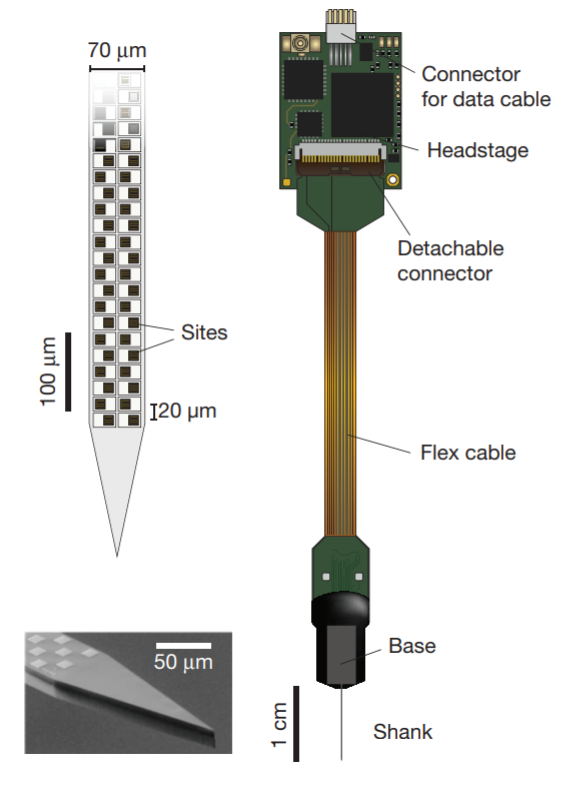
neuropixels

EEG-based facial image reconstruction

(Nemrodov, Niemeier, Patel, & Nestor, 2018)

  • EEG data associated with viewing images of faces was collected and used to determine the neural correlates of facial processing. In this way, the images were computationally reconstructed in a fashion resembling “mind reading.”
  • It should be noted that the images reconstructed using data taken from multiple people were more accurate than the images reconstructed using single individuals. Nonetheless, the single individual data still yielded statistically significant accuracy.
  • In addition to reconstructing the images themselves, the process gave insights on the cognitive steps involved in perceiving faces.

eeg reconstructions of faces

Near-infrared light and upconversion nanoparticles for optogenetic stimulation

(S. Chen et al., 2018)

  • Upconversion nanoparticles absorb two or more low-energy photons and emit a higher energy photon. For instance, multiple near-infrared photons can be converted into a single visible spectrum photon.
  • Shuo Chen and colleagues injected upconversion nanoparticles into the brains of mice and used them to convert externally applied near-infrared (NIR) light into visible light within the brain tissue. In this way, optogenetic stimulation was performed without the need for surgical implantation of fiber optics or similarly invasive procedures.
  • The authors demonstrated stimulation via upconversion of NIR to blue light (to activate ChR2) and inhibition via upconversion of NIR to green light (to activate a rhodopsin called Arch).
  • As a proof-of-concept, this technology was used to alter the behavior of the mice by activating hippocampally-encoded fear memories.

upconversion nanoparticles and nir

Map of all neuronal cell bodies within mouse brain

(Murakami et al., 2018)

  • Ueda, Murakami, and colleagues combined methods from expansion microscopy and CLARITY to develop a protocol called CUBIC-X which both expands and clears entire brains. Light-sheet fluorescence microscopy was used to image the treated brains and a novel algorithm was developed to detect individual nuclei.
  • Although expansion microscopy causes some increased tissue transparency on its own, CUBIC-X greatly improved this property in the enlarged tissues, facilitating more detailed whole-brain imaging.
  • Using CUBIC-X, the spatial locations of all the cell bodies (but not dendrites, axons, or synapses) within the mouse brain were mapped. This process was performed upon several adult mouse brains as well as several developing mouse brains to allow for comparative analysis.
  • The authors made the spatial atlas publicly available in order to facilitate global cooperation towards annotating connectivity among the neural cell bodies within the atlas.
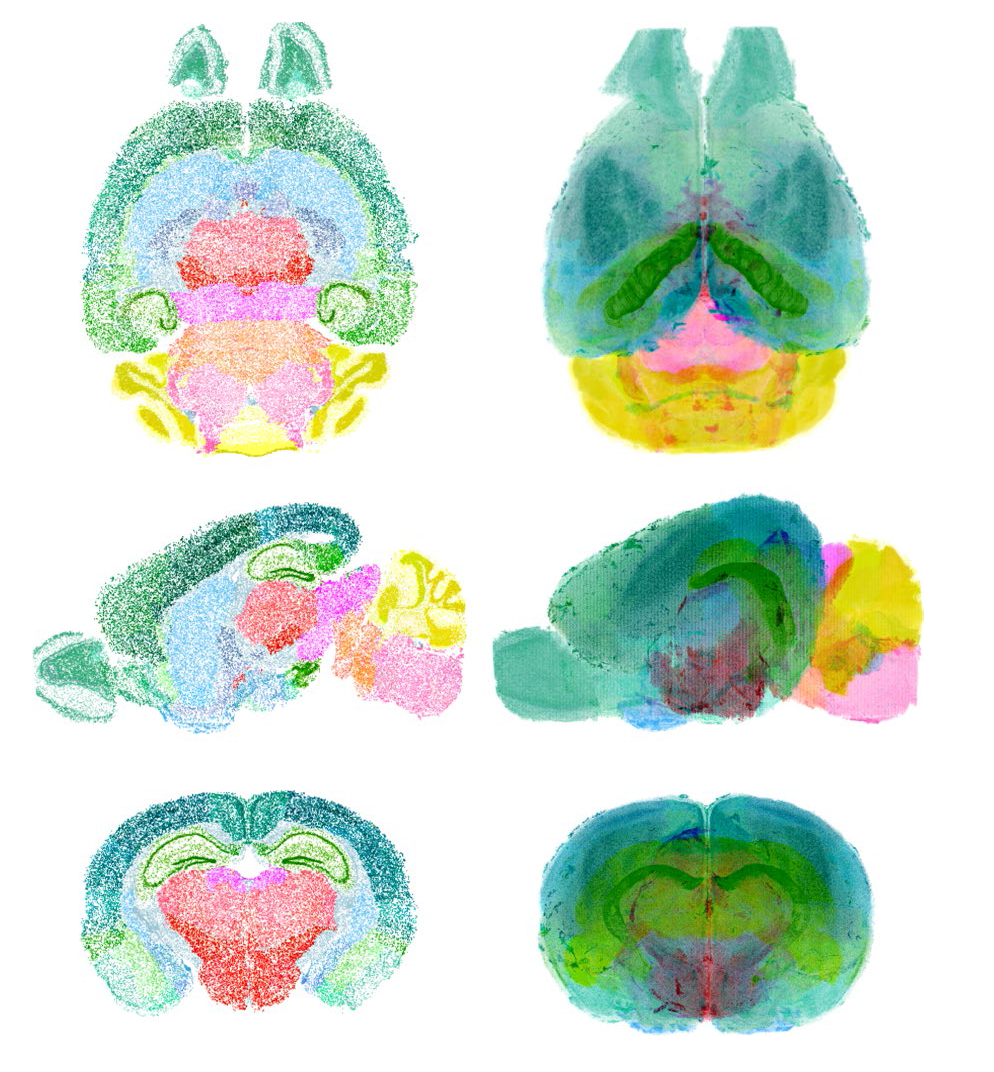
cubic-x

Clinical testing of hippocampal prosthesis algorithm in humans

(Hampson et al., 2018)

  • Further clinical tests of Berger’s hippocampal prosthesis were performed. Twenty-one patients took part in the experiments. Seventeen patients underwent CA3 recording so as to facilitate training and optimization of the MIMO model. Eight patients received CA1 stimulation so as to improve their memories.
  • Electrodes with the ability to record from single neurons (10-24 single-neuron recording sites) and via EEG (4-6 EEG recording sites) were implanted such that recording and stimulation could occur at CA3 and CA1 respectively.
  • Patients performed behavioral memory tasks. Both short-term and long-term memory showed an average improvement of 35% across the patients who underwent stimulation.

Precise optogenetic manipulation of fifty neurons

(Mardinly et al., 2018)

  • Mardinly and colleagues engineered a novel excitatory optogenetic ion channel called ST-ChroME and a novel inhibitory optogenetic ion channel called IRES-ST-eGtACR1. The channels were localized to the somas of host neurons and generated stronger photocurrents over shorter timescales than previously existing opsins, allowing for powerful and precise optogenetic stimulation and inhibition.
  • 3D-SHOT is an optical technique in which light is tuned by a device called a spatial light modulator along with several other optical components. Using 3D-SHOT, light was precisely projected upon targeted neurons within a volume of 550×550×100 μm3.
  • By combining novel optogenetic ion channels and the 3D-SHOT technique, complex patterns of neural activity were created in vivo with high spatial and temporal precision.
  • Simultaneously, calcium imaging allowed measurement of the induced neural activity. More custom optoelectronic components helped avoid optical crosstalk of the fluorescent calcium markers with the photostimulating laser.

optogenetic control of fifty neurons

Whole-brain Drosophila connectome data acquired via serial electron microscopy

(Zheng et al., 2018)

  • Zheng, Bock, and colleagues collected serial electron microscopy data on the entire adult Drosophila connectome, providing the data necessary to reconstruct a complete structural map of the fly’s brain at the resolution of individual synapses, dendritic spines, and axonal processes.
  • The data are in the form of 7050 transmission electron microscopy images (187500 x 87500 pixels and 16 GB per image), each representing a 40nm-thin slice of the fly’s brain. In total the dataset requires 106 TB of storage.
  • Although much of the the data still must be processed to reconstruct a 3-dimensional map of the Drosophila brain, the authors did create 3-dimensional reconstructions of selected areas in the olfactory pathway of the fly. In doing so, they discovered a new cell type as well as several other previously unrealized insights about the organization of Drosophila’s olfactory biology.
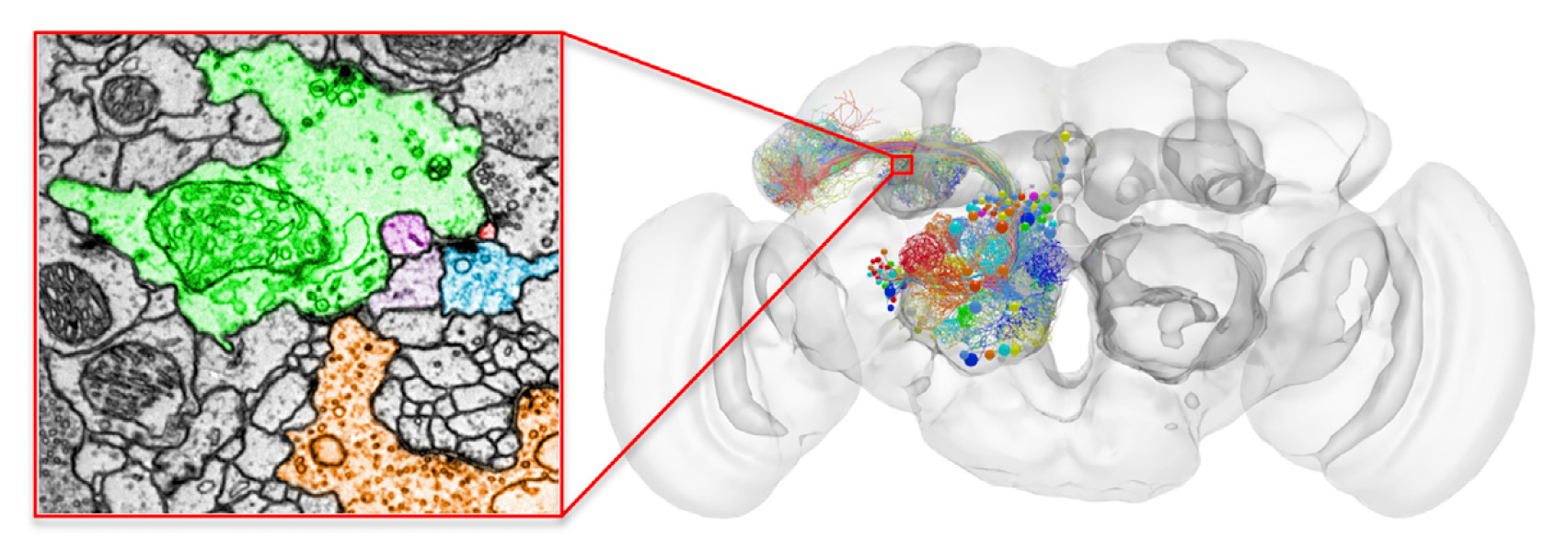
drosophila connectome with sem

Human telepathy using BrainNet

(Jiang et al., 2018)

  • EEG recordings were taken from two individuals (termed senders) while they played a Tetris-like game. Next, the recordings were converted into transcranial magnetic stimulation signals that acted to provide a third individual (called a receiver) with the necessary information to make decisions in the game without seeing the screen. The occipital cortex was stimulated. Fifteen people (five groups of three) took part in the study.
  • To convey their information, the senders were told to focus upon either a higher or a lower intensity light corresponding to commands within the game (the two lights were placed on different sides of the computer screen). In the receiver’s mind, this translated to perceiving a flash of light. The receiver was able to distinguish the intensities and implement the correct command within the game.
  • Using only the telepathically provided stimulation, the receiver made the correct game-playing decisions 81% of the time.

brainnet

Transcriptomic cell type classification across mouse neocortex

(Tasic et al., 2018)

  • Single-cell RNA sequencing was used to characterize gene expression across 23,822 cells from the primary visual cortex and the anterior lateral motor cortex of mice.
  • Using dimensionality reduction and clustering methods, the resulting data were used to classify the neurons into 133 transcriptomic cell types.
  • Injections of adeno associated viruses (engineered to express fluorescent markers) facilitated retrograde tracing of neuronal projections within a subset of the sequenced cells. In this way, correspondences between projection patterns and transcriptomic identities were established.


References

Ahrens, M. B., Orger, M. B., Robson, D. N., Li, J. M., & Keller, P. J. (2013). Whole-brain functional imaging at cellular resolution using light-sheet microscopy. Nature Methods, 10, 413. Retrieved from https://doi.org/10.1038/nmeth.2434

Akopyan, F., Sawada, J., Cassidy, A., Alvarez-Icaza, R., Arthur, J., Merolla, P., … Modha, D. S. (2015). TrueNorth: Design and Tool Flow of a 65 mW 1 Million Neuron Programmable Neurosynaptic Chip. IEEE Transactions on Computer-Aided Design of Integrated Circuits and Systems, 34(10), 1537–1557. https://doi.org/10.1109/TCAD.2015.2474396

Berger, T. W., Song, D., Chan, R. H. M., Marmarelis, V. Z., LaCoss, J., Wills, J., … Granacki, J. J. (2012). A Hippocampal Cognitive Prosthesis: Multi-Input, Multi-Output Nonlinear Modeling and VLSI Implementation. IEEE Transactions on Neural Systems and Rehabilitation Engineering, 20(2), 198–211. https://doi.org/10.1109/TNSRE.2012.2189133

Berning, S., Willig, K. I., Steffens, H., Dibaj, P., & Hell, S. W. (2012). Nanoscopy in a Living Mouse Brain. Science, 335(6068), 551 LP-551. Retrieved from http://science.sciencemag.org/content/335/6068/551.abstract

Bezaire, M. J., Raikov, I., Burk, K., Vyas, D., & Soltesz, I. (2016). Interneuronal mechanisms of hippocampal theta oscillations in a full-scale model of the rodent CA1 circuit. ELife, 5, e18566. https://doi.org/10.7554/eLife.18566

Boyden, E. S., Zhang, F., Bamberg, E., Nagel, G., & Deisseroth, K. (2005). Millisecond-timescale, genetically targeted optical control of neural activity. Nature Neuroscience, 8, 1263. Retrieved from http://dx.doi.org/10.1038/nn1525

Chen, F., Tillberg, P. W., & Boyden, E. S. (2015). Expansion microscopy. Science, 347(6221), 543 LP-548. Retrieved from http://science.sciencemag.org/content/347/6221/543.abstract

Chen, F., Wassie, A. T., Cote, A. J., Sinha, A., Alon, S., Asano, S., … Boyden, E. S. (2016). Nanoscale imaging of RNA with expansion microscopy. Nature Methods, 13, 679. Retrieved from http://dx.doi.org/10.1038/nmeth.3899

Chen, S., Weitemier, A. Z., Zeng, X., He, L., Wang, X., Tao, Y., … McHugh, T. J. (2018). Near-infrared deep brain stimulation via upconversion nanoparticle–mediated optogenetics. Science, 359(6376), 679 LP-684. Retrieved from http://science.sciencemag.org/content/359/6376/679.abstract

Chung, K., & Deisseroth, K. (2013). CLARITY for mapping the nervous system. Nature Methods, 10, 508. Retrieved from http://dx.doi.org/10.1038/nmeth.2481

Constine, J. (2017). Facebook is building brain-computer interfaces for typing and skin-hearing. TechCrunch. Retrieved from https://techcrunch.com/2017/04/19/facebook-brain-interface/

Cyranoski, D. (2017). China launches brain-imaging factory. Nature, 548(7667), 268–269. https://doi.org/10.1038/548268a

Deadwyler, S. A., Hampson, R. E., Song, D., Opris, I., Gerhardt, G. A., Marmarelis, V. Z., & Berger, T. W. (2017). A cognitive prosthesis for memory facilitation by closed-loop functional ensemble stimulation of hippocampal neurons in primate brain. Experimental Neurology, 287, 452–460. https://doi.org/https://doi.org/10.1016/j.expneurol.2016.05.031

Deadwyler, S., Hampson, R., Sweat, A., Song, D., Chan, R., Opris, I., … Berger, T. (2013). Donor/recipient enhancement of memory in rat hippocampus. Frontiers in Systems Neuroscience. Retrieved from https://www.frontiersin.org/article/10.3389/fnsys.2013.00120

Etherington, D. (2017). Elon Musk’s Neuralink wants to boost the brain to keep up with AI. TechCrunch. Retrieved from techcrunch.com/2017/03/27/elon-musks-neuralink-wants-to-boost-the-brain-to-keep-up-with-ai/

Fact Sheet: BRAIN Initiative. (2013). Retrieved from https://obamawhitehouse.archives.gov/the-press-office/2013/04/02/fact-sheet-brain-initiative

Flesher, S. N., Collinger, J. L., Foldes, S. T., Weiss, J. M., Downey, J. E., Tyler-Kabara, E. C., … Gaunt, R. A. (2016). Intracortical microstimulation of human somatosensory cortex. Science Translational Medicine. Retrieved from http://stm.sciencemag.org/content/early/2016/10/12/scitranslmed.aaf8083.abstract

Gunaydin, L. A., Yizhar, O., Berndt, A., Sohal, V. S., Deisseroth, K., & Hegemann, P. (2010). Ultrafast optogenetic control. Nature Neuroscience, 13, 387. Retrieved from http://dx.doi.org/10.1038/nn.2495

Hampson, R. E., Song, D., Robinson, B. S., Fetterhoff, D., Dakos, A. S., Roeder, B. M., … Deadwyler, S. A. (2018). Developing a hippocampal neural prosthetic to facilitate human memory encoding and recall. Journal of Neural Engineering, 15(3), 36014. https://doi.org/10.1088/1741-2552/aaaed7

Han, X., & Boyden, E. S. (2007). Multiple-Color Optical Activation, Silencing, and Desynchronization of Neural Activity, with Single-Spike Temporal Resolution. PLOS ONE, 2(3), e299. Retrieved from https://doi.org/10.1371/journal.pone.0000299

Hatmaker, T. (2017). DARPA awards $65 million to develop the perfect, tiny two-way brain-computer interface. TechCrunch. Retrieved from techcrunch.com/2017/07/10/darpa-nesd-grants-paradromics/

Hildebrand, D. G. C., Cicconet, M., Torres, R. M., Choi, W., Quan, T. M., Moon, J., … Engert, F. (2017). Whole-brain serial-section electron microscopy in larval zebrafish. Nature, 545, 345. Retrieved from https://doi.org/10.1038/nature22356

Horton, N. G., Wang, K., Kobat, D., Clark, C. G., Wise, F. W., Schaffer, C. B., & Xu, C. (2013). In vivo three-photon microscopy of subcortical structures within an intact mouse brain. Nature Photonics, 7, 205. Retrieved from https://doi.org/10.1038/nphoton.2012.336

Jiang, L., Stocco, A., Losey, D. M., Abernethy, J. A., Prat, C. S., & Rao, R. P. N. (2018). BrainNet: a multi-person brain-to-brain interface for direct collaboration between brains. ArXiv Preprint ArXiv:1809.08632.

Jun, J. J., Steinmetz, N. A., Siegle, J. H., Denman, D. J., Bauza, M., Barbarits, B., … Harris, T. D. (2017). Fully integrated silicon probes for high-density recording of neural activity. Nature, 551, 232. Retrieved from https://doi.org/10.1038/nature24636

Kato, S., Kaplan, H. S., Schrödel, T., Skora, S., Lindsay, T. H., Yemini, E., … Zimmer, M. (2015). Global Brain Dynamics Embed the Motor Command Sequence of Caenorhabditis elegans. Cell, 163(3), 656–669. https://doi.org/10.1016/j.cell.2015.09.034

Liu, J., Fu, T.-M., Cheng, Z., Hong, G., Zhou, T., Jin, L., … Lieber, C. M. (2015). Syringe-injectable electronics. Nature Nanotechnology, 10, 629. Retrieved from http://dx.doi.org/10.1038/nnano.2015.115

Livet, J., Weissman, T. A., Kang, H., Draft, R. W., Lu, J., Bennis, R. A., … Lichtman, J. W. (2007). Transgenic strategies for combinatorial expression of fluorescent proteins in the nervous system. Nature, 450, 56. Retrieved from http://dx.doi.org/10.1038/nature06293

Lomas, N. (2017). Superintelligent AI explains Softbank’s push to raise a $100BN Vision Fund. TechCrunch. Retrieved from https://techcrunch.com/2017/02/27/superintelligent-ai-explains-softbanks-push-to-raise-a-100bn-vision-fund/

Mardinly, A. R., Oldenburg, I. A., Pégard, N. C., Sridharan, S., Lyall, E. H., Chesnov, K., … Adesnik, H. (2018). Precise multimodal optical control of neural ensemble activity. Nature Neuroscience, 21(6), 881–893. https://doi.org/10.1038/s41593-018-0139-8

Markram, H. (2006). The Blue Brain Project. Nature Reviews Neuroscience, 7, 153. Retrieved from http://dx.doi.org/10.1038/nrn1848

Markram, H., Muller, E., Ramaswamy, S., Reimann, M. W., Abdellah, M., Sanchez, C. A., … Schürmann, F. (2015). Reconstruction and Simulation of Neocortical Microcircuitry. Cell, 163(2), 456–492. https://doi.org/10.1016/j.cell.2015.09.029

Marx, V. (2013). Neuroscience waves to the crowd. Nature Methods, 10, 1069. Retrieved from http://dx.doi.org/10.1038/nmeth.2695

Mizutani, R., Saiga, R., Takeuchi, A., Uesugi, K., & Suzuki, Y. (2013). Three-dimensional network of Drosophila brain hemisphere. Journal of Structural Biology, 184(2), 271–279. https://doi.org/https://doi.org/10.1016/j.jsb.2013.08.012

Murakami, T. C., Mano, T., Saikawa, S., Horiguchi, S. A., Shigeta, D., Baba, K., … Ueda, H. R. (2018). A three-dimensional single-cell-resolution whole-brain atlas using CUBIC-X expansion microscopy and tissue clearing. Nature Neuroscience, 21(4), 625–637. https://doi.org/10.1038/s41593-018-0109-1

Nemrodov, D., Niemeier, M., Patel, A., & Nestor, A. (2018). The Neural Dynamics of Facial Identity Processing: Insights from EEG-Based Pattern Analysis and Image Reconstruction. Eneuro, 5(1), ENEURO.0358-17.2018. https://doi.org/10.1523/ENEURO.0358-17.2018

Nishiyama, J., Mikuni, T., & Yasuda, R. (2017). Virus-Mediated Genome Editing via Homology-Directed Repair in Mitotic and Postmitotic Cells in Mammalian Brain. Neuron, 96(4), 755–768.e5. https://doi.org/10.1016/j.neuron.2017.10.004

Oizumi, M., Albantakis, L., & Tononi, G. (2014). From the Phenomenology to the Mechanisms of Consciousness: Integrated Information Theory 3.0. PLOS Computational Biology, 10(5), e1003588. Retrieved from https://doi.org/10.1371/journal.pcbi.1003588

Okano, H., Miyawaki, A., & Kasai, K. (2015). Brain/MINDS: brain-mapping project in Japan. Philosophical Transactions of the Royal Society of London. Series B, Biological Sciences, 370(1668). https://doi.org/10.1098/rstb.2014.0310

Peng, H., Hawrylycz, M., Roskams, J., Hill, S., Spruston, N., Meijering, E., & Ascoli, G. A. (2015). BigNeuron: Large-Scale 3D Neuron Reconstruction from Optical Microscopy Images. Neuron, 87(2), 252–256. https://doi.org/10.1016/j.neuron.2015.06.036

Peng, H., Zhou, Z., Meijering, E., Zhao, T., Ascoli, G. A., & Hawrylycz, M. (2017). Automatic tracing of ultra-volumes of neuronal images. Nature Methods, 14, 332. Retrieved from https://doi.org/10.1038/nmeth.4233

Poo, M., Du, J., Ip, N. Y., Xiong, Z.-Q., Xu, B., & Tan, T. (2016). China Brain Project: Basic Neuroscience, Brain Diseases, and Brain-Inspired Computing. Neuron, 92(3), 591–596. https://doi.org/10.1016/j.neuron.2016.10.050

Regalado, A. (2017). The Entrepreneur with the $100 Million Plan to Link Brains to Computers. MIT Technology Review. Retrieved from https://www.technologyreview.com/s/603771/the-entrepreneur-with-the-100-million-plan-to-link-brains-to-computers/

Reimann, M. W., Nolte, M., Scolamiero, M., Turner, K., Perin, R., Chindemi, G., … Markram, H. (2017). Cliques of Neurons Bound into Cavities Provide a Missing Link between Structure and Function. Frontiers in Computational Neuroscience. Retrieved from https://www.frontiersin.org/article/10.3389/fncom.2017.00048

Seo, D., Neely, R. M., Shen, K., Singhal, U., Alon, E., Rabaey, J. M., … Maharbiz, M. M. (2016). Wireless Recording in the Peripheral Nervous System with Ultrasonic Neural Dust. Neuron, 91(3), 529–539. https://doi.org/10.1016/j.neuron.2016.06.034

Song, D., She, X., Hampson, R. E., Deadwyler, S. A., & Berger, T. W. (2017). Multi-resolution multi-trial sparse classification model for decoding visual memories from hippocampal spikes in human. In 2017 39th Annual International Conference of the IEEE Engineering in Medicine and Biology Society (EMBC) (pp. 1046–1049). https://doi.org/10.1109/EMBC.2017.8037006

Stocco, A., Prat, C. S., Losey, D. M., Cronin, J. A., Wu, J., Abernethy, J. A., & Rao, R. P. N. (2015). Playing 20 Questions with the Mind: Collaborative Problem Solving by Humans Using a Brain-to-Brain Interface. PLOS ONE, 10(9), e0137303. Retrieved from https://doi.org/10.1371/journal.pone.0137303

Suk, H.-J., van Welie, I., Kodandaramaiah, S. B., Allen, B., Forest, C. R., & Boyden, E. S. (2017). Closed-Loop Real-Time Imaging Enables Fully Automated Cell-Targeted Patch-Clamp Neural Recording In Vivo. Neuron, 95(5), 1037–1047.e11. https://doi.org/https://doi.org/10.1016/j.neuron.2017.08.011

Szigeti, B., Gleeson, P., Vella, M., Khayrulin, S., Palyanov, A., Hokanson, J., … Larson, S. (2014). OpenWorm: an open-science approach to modeling Caenorhabditis elegans. Frontiers in Computational Neuroscience. Retrieved from https://www.frontiersin.org/article/10.3389/fncom.2014.00137

Tasic, B., Yao, Z., Graybuck, L. T., Smith, K. A., Nguyen, T. N., Bertagnolli, D., … Zeng, H. (2018). Shared and distinct transcriptomic cell types across neocortical areas. Nature, 563(7729), 72–78. https://doi.org/10.1038/s41586-018-0654-5

Zheng, Z., Lauritzen, J. S., Perlman, E., Robinson, C. G., Nichols, M., Milkie, D., … Bock, D. D. (2018). A Complete Electron Microscopy Volume of the Brain of Adult Drosophila melanogaster. Cell, 174(3), 730–743.e22. https://doi.org/10.1016/j.cell.2018.06.019



Notes on wave optics


No Comments

PDF version: Notes on wave optics – Logan Thrasher Collins

The wave equation

  • Because light exhibits wave-particle duality, wave-based descriptions of light are often appropriate in optical physics, allowing the establishment of an electromagnetic theory of light.
  • As electric fields can be generated by time-varying magnetic fields and magnetic fields can be generated time-varying electric fields, electromagnetic waves are perpendicular oscillating waves of electric and magnetic fields that propagate through space. For lossless media, the E and B field waves are in phase.
  • By manipulating Maxwell’s equations of electromagnetism, two relatively concise vector expressions that describe the propagation of electric and magnetic fields in free space are found. Recall that the constants ε0 and μ0 are the permittivity and permeability of free space respectively.

eq1

  • Since an electromagnetic wave consists of perpendicular electric and magnetic waves that are in phase, light can be described using the wave equation (which is equivalent to the expressions above). Note that the speed of light c = (ε0μ0)-1/2. Electromagnetic waves represent solutions to the wave equation.

eq2

  • Either the electric or the magnetic field can used to represent the electromagnetic wave since they propagate with the same phase and direction. With the exception of the wave equation above, the electric field E will instead be used to represent both waves. Note that either the electric or magnetic field can be employed to compute amplitudes.

Solutions to the wave equation

  • Plane waves represent an important class of solutions to the wave equation. The parameter k is the wavevector (which points in the direction of the wave’s propagation) with a magnitude equal to the wavenumber 2π/λ. In a 1-dimensional system, the dot product k•r is replaced by kx. The parameter ω is the angular frequency 2πf and φ is a phase shift.

eq3

  • To simplify calculations, Euler’s formula can be used to convert the equation above into complex exponential form. Only the real part describes the wave as the real part corresponds to the cosine term.

eq4

  • Spherical waves are another useful solution to the wave equation (though they are an approximation and truly spherical waves cannot exist). Because of their geometry, the electric field of a spherical wave is only dependent on distance from the origin. As such, the equation for a spherical wave can be written as seen below with origin r0.

eq5

  • Gaussian beams are a solution to the wave equation that can be used to model light from lasers or light propagating through lenses. If a Gaussian beam propagates in the z direction, then from the perspective of the xy plane, it shows a Gaussian Fig. 1intensity distribution. For a Gaussian beam, the amplitude decays over the direction of propagation according to some function A(z), R(z) represents the radius of curvature of the wavefront, and w(z) is the radius of the wave on the xy plane at distance z from the emitter. Often these functions can be approximated as constants.

eq6

Intensity and energy of electromagnetic waves

  • The Poynting vector S is oriented in the direction of a wave’s propagation (assuming that the wave’s energy flows in the direction of its propagation).

eq7

  • The magnitude of the Poynting vector represents the power per unit area (W/m2) or intensity crossing a surface with a normal parallel to S. Note that this is an approximation since, according to a quantum mechanical description of electromagnetic waves, the energy should be quantized.

eq8

  • Power per unit area (intensity) of plane waves, spherical waves, and Gaussian beams can also be calculated using the equations below. The formula for the Gaussian beam’s power represents the power at a plane perpendicular to the direction of light propagation z.

eq9

  • For electromagnetic waves, instantaneous energy per unit area is difficult to measure, so the average energy per unit area over a period of time Δt is often worked with instead. Since waves are continuous functions, taking their time-average requires an integral.

eq10

  • After using the above integral on the function eiωt and then taking the real and imaginary parts of the result, the time-averages of the functions cos(ωt) and sin(ωt) are found.

eq11

Superposition of waves

  • Let two waves E1 and E2 of the same frequency traveling in the same direction undergo superposition. E1 and E2 may or may not possess the same amplitude or phase. The substitution α = –(kx+φ) will be carried out.

eq12

  • If the phases of the waves are different, some special equations are necessary to find the amplitude E0 and the phase α of the resulting wave.

eq13

  • For the superposition of any number of waves, the equations above can be extended.

eq14

Polarization of light

  • The waves comprising linearly polarized light are all oriented at the same angle which is defined by the direction of the electric field of the light waves. For linearly polarized plane waves with electric fields oriented along the x or y axes that propagate in the z direction, the following equations describe their electric fields.

eq15

  • The superposition of two linearly polarized plane waves that are orthogonal to each other (and out of phase) is the vector sum of each electric field.

eq16

  • The superposition of two linearly polarized plane waves that are orthogonal to each other (and in phase) is computed via the following equation and has a tilt angle θ determined by the ratio of amplitudes of the original waves. This process can also be performed in reverse with a superposed polarized wave undergoing decomposition into two orthogonal waves.

eq18Fig. 2

  • When two constituent waves possess equal amplitudes and a phase shift of nπ/2, the superposed wave is circularly polarized (as it can be expressed using a sine and a cosine term). Equations for the constituent waves and the superposed wave are given below.

eq19

  • When circularly polarized light propagates, it takes a helical path and so rotates. As such, a full rotation occurs after one wavelength. If a circularly polarized wave rotates clockwise, it is called right-circularly polarized and has a positive sine term. If a circularly polarized wave rotates counterclockwise, it is called left-circularly polarized and has a negative sine term.

eq20

  • If a right-circularly polarized light wave and a left-circularly polarized light wave of equal amplitude are superposed, then they create a linearly polarized light wave with twice the amplitude of the individual waves.

eq21

  • Linearly polarized and circularly polarized light are special cases of elliptically polarized light. For elliptically polarized light, the amplitudes of the superposed waves may differ and the relative phase shift does not need to be nπ/2. As such, the electric field traces an elliptical helix as it propagates along the z direction.

eq22

  • For elliptically polarized light with a positive phase shift φ, it is called right-elliptically polarized if E0x > E0y and left-elliptically polarized if E0x < E0y.
  • Most light is unpolarized (or more appropriately, a mixture of randomly polarized waves). To obtain polarized light, polarizing filters are often used.


References

Boudoux, C. (2017). Fundamentals of Biomedical Optics. Blurb, Incorporated.

Degiorgio, V., & Cristiani, I. (2015). Photonics: A Short Course. Springer International Publishing.

Hecht, E. (2017). Optics. Pearson Education, Incorporated.