
Neuroecologies, cybernetic systems which combine biological and technological components, may streamline human interactions with their environment and counteract issues like pollution and climate change. Today, humans occupy too many ecological niches for long-term sustainability. If we continue to outcompete other species, we will observe deadly systemic bifurcations that lead to desertification, coastal submergence, and even more widespread extinctions. However, the interdependence of existing socioeconomic structures makes them difficult to uproot in order to avert catastrophe. To overcome this challenge, I propose that humans must integrate into their environments without sacrificing existing structures, instead metamorphosing those structures into more sustainable forms through improved technologies. In particular, the worlds of electronics, nanoscience, and synthetic biology must merge into the meadows, forests, and oceans. As written by Richard Brautigan in his 1967 poem, All Watched Over by Machines of Loving Grace, the “mammals and computers [will] live together in mutually programming harmony.”
Traditionally, environmentalist viewpoints have divorced technology and nature, framing human influence as corrupting and impure. However, this represents an incorrect and ultimately counterproductive approach. Humans and their creations are no more separate from nature than termites and their mounds, beavers and their dams, or bacteria and their metabolic byproducts. While human impact on the environment has occurred at a rapid pace, this does not mean that humans are inherently less ethical than other organisms. Framing the technological humans as evil is a mistake since this ideology “drives underground” many possible solutions to environmental challenges.
Many naturalists have supported anti-interference arguments with the fact that some technology has contributed to environmental damages. However, framing any particular technology as representative of all technology is misguided in an analogous way to cultural prejudice. Few would advocate judging the entire population of China based on an interaction with a single Chinese person. Likewise, it should be clear that the technologies which have contributed to climate change should not represent the philosophical concept of technology as a whole.
Unlike most other organisms, humans possess a potent ability to simulate possible future scenarios. This ability arises from internal biological cognition, social exchange of knowledge, and technological augmentations. On its own, the human brain can generate plans for behavior many years into the future. In societies, networks of human brains act as a form of distributed superintelligence, agglomerating and refining individual predictions (Lenartowicz, 2017). The outsourcing of cognitive tasks to computers, pencils, and other technologies provides an immense expansion to the human noosphere. This combined global cortex has the power to analyze, predict, and act to tackle today’s greatest challenges.
Biological and technological systems often share characteristics. From a network perspective, both usually possess a small-world structure (Sporns, 2009) (Newman, 2003). Small-world networks (supplementary Fig. S1C-D) have small mean path lengths and high clustering. For reference, mean path length is the average number of jumps taken to traverse between any pair of nodes in a network and clustering measures the connectivity among a given node’s nearest-neighbors (supplementary Fig. S1A-B). In addition, both biological and technological networks tend to exhibit resilience against random removal of nodes and vulnerability to targeted removal of highly interconnected nodes (Newman, 2003). Such network properties show remarkable universality across technology and biology.
From a control theory perspective, biological and technological systems share modules and protocols (Csete, 2002). Modules are subsystems that utilize interfaces to other modules and work with some degree of independence. Biological modules can be seen in macromolecular complexes, membrane-bound compartments, cells, oscillating neural circuits, organs, as well as in ecosocial structures like packs of wolves and coral reefs. Technological modules arise in circuit components like flip-flops, in microprocessors, in network-connected computational devices, stations on assembly lines, and in components of infrastructure like hospitals and schools.
Protocols are rules which manage the flow of ordered operations within systems (Csete, 2002). Biological protocols arise from information encoded in nucleic acids, epigenetic regulatory networks, neural ensembles, and ecological competition structures. Within such biological and technological protocols, feedback loops are universal. Feedback facilitates stable oscillations, system-scale or subsystem-scale adaptation to external stimuli, and discourse among modules.
Since biology and technology operate by common principles, the engineering techniques applied in technological systems can be adapted to engineering biological systems and engineering interfaces between systems. Of course, doing this will also require recognizing differences and working to optimize the characteristics of all the systems involved in order to more seamlessly merge our technology and environment.
For illustrative purposes, I will briefly outline a potential urban implementation of neuroecologies, a fictional city called Las Futuras. The skyscrapers of Las Futuras are wrapped in a silky, biocompatible polymer (Fig. 1B). Embedded in the polymeric matrix are nanomachines which recycle chemical waste products into nutrients, antioxidants, water, and molecules that chelate toxins and facilitate their traffic to more intensive treatment nodules. Cybernetic fireflies and bioluminescent trees illuminate the metropolis at night. There are no roads, the ground is overgrown with sensory flowers that monitor conditions and transmit data through conductive root networks, glistening metabolic blobs which assemble swarms of nanorobotic gardeners on command (Fig. 1C), and gossamer membranes for collecting solar energy.
Enhanced herbivores and insects wander freely, instinctively consuming the fruitlike globules growing out of the buildings. There is no predation as all predators have either been transformed into herbivores or their populations have been phased out by reproductive methods. Because of this and the fact that the animals may live for hundreds or even thousands of years, their fertility rates are modulated by AI savants who continuously oversee the organismic network and prevent catastrophic bifurcations from triggering issues like overpopulation and starvation.
The reason that few humanoid creatures are visible is that they exist elsewhere. Inside the skyscrapers, dense cores of computronium (Fig. 1A) simulate vast and beautiful worlds, kaleidoscopic utopias in which humanity’s billions and their AGI children may reside without overconsumption of resources. These people do have the option of entering android bodies and exploring realspace, but this exploration usually involves visiting locations other than Earth. As such, the neuroecologies remain sparsely populated by androids and their resource demands are minimal.
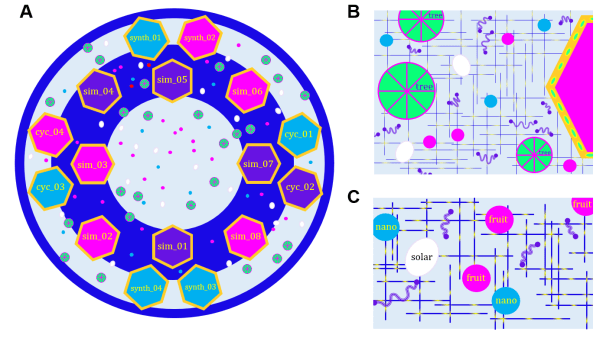
Figure 1 (A) Top view of the speculative urban neuroecology dubbed Las Futuras. Some skyscrapers (hexagonal structures) contain computronium for simulating uploaded minds and their virtual worlds, others manufacture materials and machines as needed by the system, still others recycle waste products. (B) Mesoscale view of a region within Las Futuras. Engineered trees exhibit bioluminescence. Nanomachines which recycle atmospheric pollutants are found in the walls of the skyscrapers. (C) Ground-level view of a region within Las Futuras. Fruitlike globules provide nutrients for cybernetic wildlife, including modified microorganisms and nanorobots. Solar membranes gather energy for local use, though more extensive solar farms exist outside the metropolitan area. Wriggling wormlike creatures tend to various macroscale tasks. Sensory flowers (not shown) monitor ambient conditions and route information into the conductive root network. This extensive system of roots provides a method of rapidly transporting data into the noosphere. Most organisms and devices are compatible with the roots and can easily link their nervous systems to the network.
Although this kind of world might seem distant, there is a real possibility that it will be achievable before the end of the 21st century. As a result of exponential trends in computer science and bioinformatics, many futurists argue that we are approaching a technological singularity. If this event occurs, it will be marked by an intelligence explosion which radically transforms life on Earth and beyond. The technological singularity may come from artificial superintelligence, self-aware computer networks, biological enhancement, or from the merging of humans and machines (Vinge, 1993). National Medal of Technology recipient Ray Kurzweil proposes that the technological singularity may occur as early as 2045, providing cognitive abilities up to a billion-fold more powerful than the entirety of today’s human race combined (122). This prediction may initially sound outrageous, but Kurzweil has shown a remarkable ability to accurately envision future events as evidenced by his numerous successful predictions; for instance, former world chess champion Garry Kasparov losing his games against IBM’s Deep Blue chess computer in 1997. If the singularity comes to pass, it will provide the intellectual and robotic resources necessary to merge technology and the environment.
For some, my vision of the future might initially sound unsettling as it is a very different world than the world to which we are accustomed. But throughout evolutionary history, the ecological scene has continuously metamorphosed. In the Precambrian, aquatic metazoans (multicellular organisms) were only just beginning to emerge and the land was populated only by cyanobacterial mats (Horodyski and Knauth, 1994). Today, a rich and beautiful biosphere thrives across the air, land, and sea. The prospect of transformation need not be frightening. Technology is a part of nature, facilitating the metamorphosis. We have the ability to carry out this transformation, guiding unstable human and nonhuman ecologies into unified, sustainable neuroecologies.
References
Brautigan. “All Watched Over by Machines of Loving Grace.” All Watched Over by Machines of Loving Grace, Communication Company, 1967.
Bullmore, Ed, and Olaf Sporns. “Complex brain networks: graph theoretical analysis of structural and functional systems.” Nature Reviews Neuroscience, vol. 10, no. 3, Apr. 2009, 186–198., doi:10.1038/nrn2575.
Csete, M. E. “Reverse Engineering of Biological Complexity.” Science, vol. 295, no. 5560, Jan. 2002, pp. 1664–1669., doi:10.1126/science.1069981.
Horodyski, R. J., and L. P. Knauth. “Life on Land in the Precambrian.” Science, vol. 263, no. 5146, 1994, pp. 494–498., doi:10.1126/science.263.5146.494.
Kurzweil, R. (2005). The Singularity is Near: When Humans Transcend Biology. New York: Viking.
Lenartowicz, Marta. “Creatures of the semiosphere: A problematic third party in the ‘humans plus technology’ cognitive architecture of the future global superintelligence.” Technological Forecasting and Social Change, vol. 114, 2017, pp. 35–42., doi:10.1016/j.techfore.2016.07.006.
Newman, Mark. “The Structure and Function of Complex Networks.” SIAM Review, vol. 45, no. 2, Mar. 2003, pp. 167–256., doi:10.1137/S003614450342480.
Vinge, Vernor. “The Coming Technological Singularity: How to Survive in the Post-human Era.” Interdisciplinary Science and Engineering in the Era of Cyberspace, Dec. 1993.

Supplementary Figure S1 (A) The clustering coefficient for a node is the number of links among its nearest neighbors divided by the maximum number of links among those neighbors. (B) The path length between two nodes is the minimum number of edges which must be traversed in order to reach one node from the other. (C) Small-world networks are extremely common in biological and technological systems. Here, a randomly generated small-world network is depicted. (D) Small-worldness is proportional to the mean clustering coefficient over the mean path length. Note that the N-1 terms cancel since they are the same in the numerator and the denominator for a given network with N nodes.













 LoganThrasherCollins.com