Notes on nanoparticle self-assembly


No Comments

PDF version: Notes on nanoparticle self-assembly – Logan Thrasher Collins

Preparation of nanoparticle superlattices

  • Nanoparticle superlattices can be prepared using solvent evaporation, solvent destabilization, or gravitational sedimentation methods.
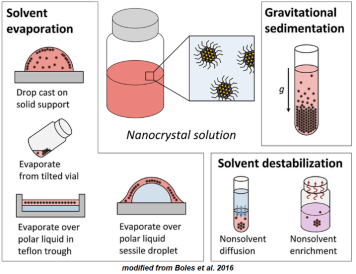
  • Solvent evaporation involves evaporating a nanoparticle-containing solvent to induce ordered aggregation of the particles. Note that many inorganic nanoparticles are insoluble in polar solvents and soluble in nonpolar solvents, though the presence of polar surface ligands can alter this behavior. Fig. 1
  • Solvent evaporation techniques include (i) placing a small droplet of nanoparticle-containing solvent on a solid substrate and allowing for evaporation to occur, (ii) evaporating a nanoparticle-containing solvent from a tilted vial so as to control the orientation of the meniscus, (iii) placing a small droplet of polar solvent on a solid substrate and then adding a nonpolar nanoparticle-containing solvent over the top to facilitate aggregation in the thin layer of nonpolar solvent, and (iv) filling a tray with a polar solvent and adding nonpolar nanoparticle-containing solvent over the top to facilitate aggregation in the thin layer of nonpolar solvent.
  • Solvent destabilization promotes gradual clustering of nanoparticle in solution via slowly changing the solvent conditions. Solvent destabilization techniques include (i) allowing for a polar and a nonpolar solvent to gradually intermingle and so facilitate a steady increase in the favorability of nanoparticle-nanoparticle interactions and (ii) heating a premixed solvent mixture that includes both polar and nonpolar components and so facilitating a controlled enrichment of the solvent with a higher boiling point. This increases the favorability of nanoparticle-nanoparticle interactions in a controlled fashion. Because many nonpolar liquids possess lower boiling points, the nanoparticle lattices prepared in this way may require nanoparticles equipped with polar surface ligands.
  • Gravitational sedimentation is less common than the other techniques since many nanoparticles are small enough to remain dissolved in spite of gravitational forces. But very large nanoparticles (100-1,000 nm) often do sediment, facilitating close-packing and the assembly of superlattices.

Characterization of nanoparticle superlattices

  • Transmission electron microscopy (TEM) is used to visualize nanoparticle superlattices directly. As TEM requires very thin slices, it makes 2-dimensional images of nanoparticle superlattices.
  • TEM operates best when there is a high contrast between the atomic number of the nanoparticles and the atomic number of the background support structure. For instance, PbS is easily imaged on a carbon support.
  • To circumvent issues that arise with atomic number contrast, ultrathin (i.e. graphene) supports or supports that possess numerous holes can be used. Ultrathin supports absorb less electrons while “holey” supports allow some nanoparticles to be positioned over the holes during imaging, preventing background absorption.
  • TEM often requires a vacuum chamber and so necessitates dry samples, meaning  that superlattice structure can be visualized after removal of the solvent, but snapshots of the self-assembly process cannot be taken. However, recent investigations into designing liquid-cell TEM may circumvent this problem.
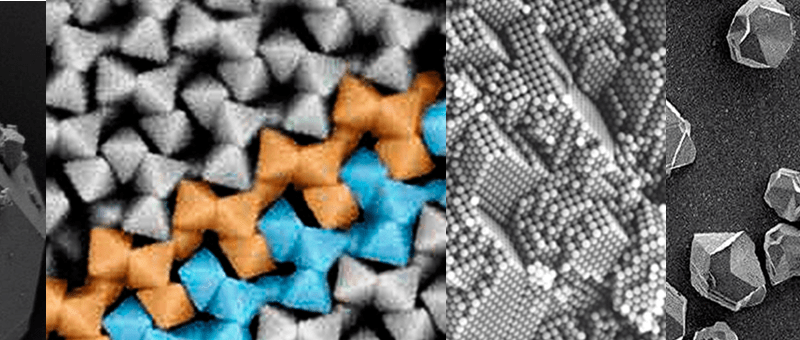
  • Scanning electron microscopy (SEM) generates 3-dimensional images via a scanning electron beam and so is useful for imaging nanoparticles and Fig. 2nanoparticle superlattices that exhibit some kinds of notable 3-dimensional geometric characteristics.
  • Atomic force microscopy, a technique in which a nanoscale probe is moved across a sample to reconstruct its shape via a “sense of touch,” has also been used for nanoparticle superlattice characterization.
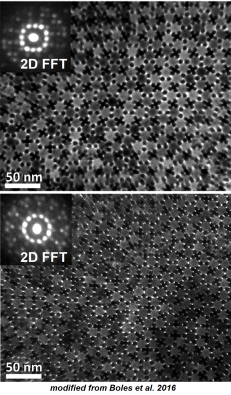
  • Images of repetitive superlattices are amenable to processing with two-dimensional fast Fourier transforms (FFTs) that can reveal insights about the lattice’s characteristics. Performing this form of FFT upon an image of a repetitive crystal structure creates a plot of spatial frequencies. This plot is said to display reciprocal space (or Fourier space).
  • Distinct points on the reciprocal space plot correspond to certain properties of the lattice that are sometimes not apparent from the image prior to the FFT. In this way, very similar lattices can be clearly distinguished.

Kinetics of nanoparticle superlattice formation

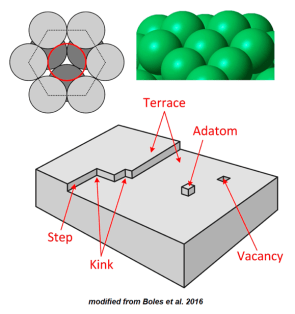
  • Homogenous nucleation occurs in solution and requires overcoming a nucleation barrier while heterogenous nucleation occurs as nanoparticles are added to a preexisting seed crystal. Homogenous nucleation typically leads to disordered solids and is typically much slower than heterogenous nucleation. Fig. 3
  • In heterogenous nucleation, crystal growth occurs at differing rates depending on how many new contacts are formed (assuming attractive interparticle interactions). If more new contacts occur upon the addition of a nanoparticle, the process will exhibit grater energetic favorability and occur at a faster rate.
  • This means that adding nanoparticles to kinks and vacancies happens more rapidly than the adsorption of nanoparticles to steps, terraces, and “adatoms” (see figure at right). As such, large scale structures that minimize surface energy tend to form.

Thermodynamics of nanoparticle superlattices

  • As mentioned, if superlattice assembly occurs rapidly, disordered aggregates can form. Allowing the process to occur more slowly facilitates sampling of many states as assembly proceeds. As such, the most thermodynamically stable structures can form when gradual assembly is performed.
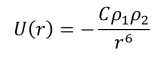
  • Van der Waals interactions between nanoparticles are often approximated using the following pair potential equation. U is the potential energy for the interparticle interaction, C represents a proportionality constant for the interparticle interaction, ρ1 and ρ2 are the number of atoms per unit volume in two interacting bodies, and r is the distance between the bodies.

Eq.1

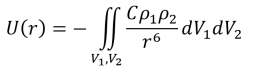
  • For nanoparticles with volumes V1 and V2, the total van der Waals energy of attraction is obtained by the following integral that performs a pairwise summation of all the atomic van der Waals interactions.

Eq.2

  • If two nanoparticles are spherical with radii R1 and R2, the integral can be solved analytically to give their interparticle potential energy.

Eq.3

  • When the distance d between two nanoparticles is much less than the radius of either nanoparticle, the above equation can be approximated using the following formula.

Eq.4

  • For many nanoparticles without chemical ligands, these van der Waals interactions would cause rapid aggregation in solution. However, the presence of certain surface ligands gives repulsion that maintains colloidal solutions of nanoparticles.
  • In order to convey repulsive effects between nanoparticles, the surface ligands require a proper solvent. Such solvents exhibit negative free energy upon ligand-solvent mixing. That is, interactions between the surface ligand and the solvent are energetically favorable.
  • Surface ligand repulsion includes an osmotic component and an elastic component. As the solvent molecules are sterically blocked by surface ligands, when the surface ligands of two nanoparticles start to interact, the volume that the solvent cannot enter increases. This situation is osmotically unfavorable, so osmotic repulsion occurs. When surface ligands are compressed because two nanoparticles are close to each other, elastic repulsion occurs.
  • When a solution of nanoparticles with surface ligands that are attracted to each other (i.e. hydrophobic chains) is dried, the ligands begin to freeze together rather than experiencing repulsion.
  • Equilibrium superlattice structures minimize the free energy G in terms of enthalpy U and entropy S according to Gibb’s equation ΔG = ΔU – TΔS.
  • The contributions of cores and ligands can be decomposed into the terms ΔUcores, ΔUligands, ΔScores, and ΔSligands. The energy terms can be further broken down into the components of van der Waals interactions (London dispersion forces, dipole-induced dipole interactions, and dipole-dipole interactions). The entropy terms can be further broken down into configurational, rotational, and translational components.


Reference: Boles, M. A., Engel, M., & Talapin, D. V. (2016). Self-Assembly of Colloidal Nanocrystals: From Intricate Structures to Functional Materials. Chemical Reviews, 116(18), 11220–11289. https://doi.org/10.1021/acs.chemrev.6b00196


Notes on Honeybee Sensory Neurobiology


1 Comment

PDF version: Notes on Honeybee Sensory Neurobiology – Logan Thrasher Collins

Olfaction

Antennal lobes

  • Honeybee antennal lobes (ALs) are composed of about 160 regions called glomeruli in which olfactory receptor neurons from the antennae make synapses on projection neuron cell bodies as well as inhibitory local neurons.
  • The projection neurons send cholinergic axons to the mushroom bodies and to the lateral horn (LH) while the GABAergic local neurons facilitate olfactory computations within the antennal lobes.

Mushroom bodies

  • The mushroom bodies are paired structures located on either side of the central brain (CB). They are known to facilitate higher sensory integration as well as associative learning processes.Fig. 1
  • In honeybees, the mushroom bodies use cup-shaped medial calyces (MCAs) and lateral calyces (LCAs) as their major sensory input regions while using the pedunculi (PEDs) as their major sensory output regions.
  • The calyces contain Kenyon cells which receive cholinergic axons from the projection neurons of the antennal lobes and the pedunculi contain the efferent axons of the Kenyon cells.

Associative olfactory learning

  • Honeybee associative olfactory learning can occur where the olfactory pathway converges with other pathways.Fig. 2
  • Specific odors can serve as conditioned stimuli when they are associated with unconditioned stimuli of appetitive or aversive character.
  • Experimental evidence shows that the VUMmx1 neuron is sufficient for olfactory reward learning in bees. Its cell body is located within a region called the subesophageal ganglion and it synapses upon cells in the calyces, the lateral horn, and the antennal lobe.

Vision

Honeybee eyes

  • Honeybees possess two frontal compound eyes and three ocelli (simple eyes) located on the top of the head.
  • The retinas of honeybee compound eyes are composed of ommatidia, each with nine photoreceptor cells. The types of bee photoreceptor cells include S, M, and L photoreceptors corresponding to UV, blue, and green wavelengths respectively.
  • Ocellar retinas are composed of rod cells (note that they do not have ommatidia) and are covered by a lens. However, the focal plane of this lens is behind the actual retina, leading to much lower resolving power than that of the compound eyes. Although the function of ocelli is not entirely understood, they may operate as widefield detectors of illumination changes. In addition, ocellar retinas can be subdivided into dorsal and ventral regions which view the horizon and the sky respectively. Distinct neuronal pathways are associated with these subdivisions.

Optic lobe

  • Honeybee vision (associated with the compound eyes) starts with the optic lobe’s three regions; the lamina (La), medulla (Me), and lobula (Lo).
  • The lamina is positioned directly under the compound eye’s photoreceptors. It receives inputs mainly from the L photoreceptors, which are involved in the achromatic pathway and exhibit fast response times. However, some very rough color processing may still occur in the lamina. Fig. 3
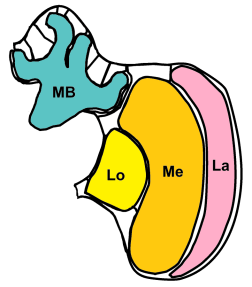
  • In the medulla, neurons are organized in a columnar retinotopic fashion with eight layers. The columns also possess horizontal connections (unlike the lamina) which likely facilitate color opponency. The medulla’s outer layers contain neurons that respond to specific wavelengths and neurons that respond to a broad range of wavelengths while the medulla’s inner layers contain color-opponent neurons that compare colors at center and surround regions of receptive fields.
  • The lobula consists of six layers. Its outer layers (1-4) are part of the achromatic pathway and exhibit motion sensitivity. Its inner layers (5-6) continue the color processing pathway. Some projections from the inner layers go to the mushroom bodies, possibly facilitating sensory crosstalk and learning.
  • Beyond the optic lobe, further visual processing of the achromatic and color pathways occurs in the protocerebrum and central brain.

Audition and antennal somatosensation

Johnston’s organ

  • Honeybees use Johnston’s organ as their sensory organ for audition. In bees, audition also acts as a form of somatosensation. Johnston’s organ is located on the antennae. It detects vibrations during the waggle dance and air currents during flight. Fig. 4
  • Johnston’s organ contains about 240 scolopidia, mechanosensory complexes which include bristles that deform and trigger action potentials along efferent axons.
  • The soma of neurons within Johnston’s organ are divided into dorsal (dJO), ventral (vJO), and anterior groups (aJO).

Projections from Johnston’s organ

  • The main axons from the soma within Johnston’s organ trifurcate into the fascicles called T6I, T6II, and T6III. The T6I axons terminate at the ventro-medial superior posterior slope (vmSPS), the T6II axons terminate at the antennal mechanosensory and motor center (AMMC), and the T6III axons terminate at the ventro-central superior posterior slope (vcSPS). Fig. 5
  • In the vmSPS, the axons show some degree of somatotopy arising from the dorsal, ventral, and anterior Johnston’s organ regions. Somatotopy is not observed in the AMMC or vcSPS.
  • All the sensory axons from Johnston’s organ also send small collateral branches to the bee’s dorsal lobe (DL).

The AMMC

  • The AMMC contains two classes of interneuron, AMMC-Int-1 and AMMC-Int-2. AMMC-Int-1 neurons have somas located in the honeybee’s primary auditory center, which is near the central brain. They densely arborize at the AMMC and thinly arborize in the ventral protocerebrum (the protocerebrum is a region of the insect brain that includes the mushroom bodies and central brain as well as several other structures). Their dense arborization in the AMMC runs close to the T6 collaterals at the dorsal lobe.
  • AMMC-Int-1 neurons demonstrate spontaneous spiking without sensory input.Fig. 6 During exposure to a vibratory stimulus, the spike rate slows slightly. After the stimulus is removed, the spike rate increases to a higher rate than that of the spontaneous spiking, but eventually returns to the basal rate. However, it should be noted that olfactory stimuli and other modulating factors can drastically alter the response properties of AMMC-Int-1 neurons.
  • AMMC-Int-2 neurons have somas located in the dorsal lobe. Their dendrites split into three main branches called x, y, and z. Branch y is the axon while branches x and z are dendritic. It sends a long process to the lateral protocerebrum (LP) and makes synapses. The x arborization represents the densest of the three branches and is located in the AMMC. Branch z passes through the dorsal lobe and into the lateral superior posterior slope (lateral SPS). Fig. 7
  • AMMC-Int-2 neurons respond to relatively high vibratory amplitudes, especially those which cause 30 μm (or greater) shifts in antennal position. Their sensitivity reaches a maximum at 265 Hz (a frequency that occurs during the waggle dance), though they also respond to other frequencies.

The SPS

  • The SPS contains an interneuron known as SPS-D-1 which projects to the ipsilateral and contralateral SPS.
  • SPS-D-1 does not respond to 265 Hz alone. However, it responds to long-lasting 265 Hz vibratory stimulation with simultaneous olfactory stimulation at the contralateral antenna.

Gustation

Gustatory sensilla

  • Gustatory receptor cells are found in sensilla, structures which resemble hairs or pegs. Sensilla are located on the glossa, antennae, labial palps, and several other parts of the bee’s body. Fig. 8
  • Each sensillum contains 3-5 gustatory receptor neurons that send dendrites up the shaft towards a pore at the sensillum’s tip. The somas of the receptor cells (along with a mechanoreceptor cell) are encapsulated by auxiliary cells and bathed in a receptor hemolymph. The gustatory receptor neurons likely use GPCRs to detect various food molecules while the mechanoreceptor facilitates evaluation of the food’s position and density.
  • Antennal sensilla respond in a dose-dependent and highly sensitive manner to sucrose solutions. In addition, antennal sensilla respond to aqueous NaCl. As the antennal sensilla do not respond to very low concentrations of KCl, they probably do not contain a receptor that responds to water alone (unlike in many other insects). Sensilla on the mouthparts respond to aqueous sucrose, glucose, fructose, LiCl, KCl, and NaCl. They do not respond to CaCl2 or MgCl2. Foreleg sensilla respond to sucrose as well as very low concentrations of KCl, suggesting that these sensilla may contain a receptor that responds to water alone (unlike the bee’s other sensilla).

Honeybee central gustatory processing

  • Honeybee central gustatory processing takes place primarily in their subesophageal ganglion (SEG). Axons of gustatory neurons and the mechanosensory neurons found in the sensilla project to the SEG’s mandibular, maxillary, and labial neuromeres via the mandibular, maxillary, and labial nerves respectively.
  • As mentioned, the SEG contains the VUMmx1 neuron, which facilitates pairing of olfactory and gustatory stimuli for reward learning. Other VUM neurons have been identified in the SEG, but their function remains unclear.
  • Beyond the SEG, other neurons might be involved in the honeybee’s gustatory processing. In the mushroom bodies, the PE1 neuron exhibits increased spiking in response to sucrose gustation. However, PE1 also responds to mechanical and olfactory inputs. Also located in the mushroom bodies are cells dubbed as “feedback neurons” which respond to odors and sucrose as well. In these cases, multisensory integration likely occurs.

With the exception of image created for the section “projections from Johnston’s organ,” images were modified from: (Steijven, Spaethe, Steffan-Dewenter, & Härtel, 2017), (R. Menzel, 2012), (Kiya & Kubo, 2011),  and (Galizia, Eisenhardt, & Giurfa, 2011).

References

Dyer, A. G., Paulk, A. C., & Reser, D. H. (2011). Colour processing in complex environments: insights from the visual system of bees. Proceedings of the Royal Society B: Biological Sciences, 278(1707), 952 LP-959. Retrieved from http://rspb.royalsocietypublishing.org/content/278/1707/952.abstract

Galizia, C. G., Eisenhardt, D., & Giurfa, M. (2011). Honeybee Neurobiology and Behavior: A Tribute to Randolf Menzel. Springer Netherlands.

Heisenberg, M. (2003). Mushroom body memoir: from maps to models. Nature Reviews Neuroscience, 4, 266. Retrieved from https://doi.org/10.1038/nrn1074

Hung, Y.-S., & Ibbotson, M. (2014). Ocellar structure and neural innervation in the honeybee. Frontiers in Neuroanatomy. Retrieved from https://www.frontiersin.org/article/10.3389/fnana.2014.00006

Kiya, T., & Kubo, T. (2011). Dance Type and Flight Parameters Are Associated with Different Mushroom Body Neural Activities in Worker Honeybee Brains. PLOS ONE, 6(4), e19301. Retrieved from https://doi.org/10.1371/journal.pone.0019301

Menzel, R. (2012). The honeybee as a model for understanding the basis of cognition. Nature Reviews Neuroscience, 13, 758. Retrieved from http://dx.doi.org/10.1038/nrn3357

Mota, T., Yamagata, N., Giurfa, M., Gronenberg, W., & Sandoz, J.-C. (2011). Neural Organization and Visual Processing in the Anterior Optic Tubercle of the Honeybee Brain. The Journal of Neuroscience, 31(32), 11443 LP-11456. Retrieved from http://www.jneurosci.org/content/31/32/11443.abstract

Sandoz, J.-C. (2013). Chapter 30 – Neural Correlates of Olfactory Learning in the Primary Olfactory Center of the Honeybee Brain: The Antennal Lobe. In R. Menzel & P. R. B. T.-H. of B. N. Benjamin (Eds.), Invertebrate Learning and Memory (Vol. 22, pp. 416–432). Elsevier. https://doi.org/https://doi.org/10.1016/B978-0-12-415823-8.00030-7

Steijven, K., Spaethe, J., Steffan-Dewenter, I., & Härtel, S. (2017). Learning performance and brain structure of artificially-reared honey bees fed with different quantities of food. PeerJ, 5, e3858. https://doi.org/10.7717/peerj.3858
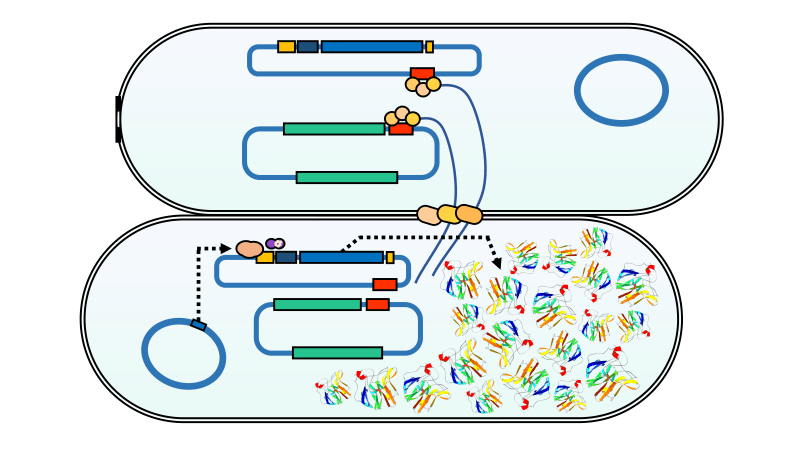
Design of a De Novo Aggregating Antimicrobial Peptide and a Bacterial Conjugation-Based Delivery System (journal article)


No Comments

My first scientific journal article (I am the lead author)! I came up with the idea for this project during middle school. In high school, I started working at a university laboratory. Over the course of this research, I competed in the International Science and Engineering Fair three times, gave a TEDx presentation, fought through countless obstacles, ignored the naysayers, witnessed the Nobel Prize ceremonies firsthand, and brought my idea to fruition.

ACS Biochemistry: Design of a De Novo Aggregating Antimicrobial Peptide and a Bacterial Conjugation-Based Delivery System

Local copy (full text): Design of a De Novo Aggregating Antimicrobial Peptide and a Bacterial Conjugation-Based Delivery System

Notes on computer architecture


No Comments

PDF version: Notes on computer architecture – Logan Thrasher Collins

Main memory

  • Some computers store data using flip-flop circuits. Each flip-flop circuit possesses a configuration of logic gates (including AND, OR, and NOT gates) that allows Fig.1switching between “on” and “off” states corresponding to 1 and 0.
  • More modern machines often use conceptually similar ways of storing data that involve using tiny electric charges to represent 1 and 0 states.
  • Each memory cell contains eight flip-flop circuits (or similar storage devices) that correspond to eight bits of memory. Together, eight bits are equal to one byte.
  • The memory cell’s eight bits are depicted as arranged in a line. The leftmost end is called the high-order end and the rightmost end is called the low-order end. The leftmost bit is called the most significant bit and the rightmost bit is called the least significant bit.
  • In order for the computer to find specific memory cells within main memory, every cell is assigned a unique numeric address. This can be visualized as a series of memory cells lined up and numbered starting with zero. In this way, individual cells are not only identifiable, but they are also ordered relative to other cells.
  • Since the computer can independently access any cell that is needed for a Fig.2computation (despite the cells possessing an ordered configuration), the main memory is called random access memory (RAM).
  • For computers that use tiny charges (rather than flip-flop circuits) to store data, the main memory is called dynamic RAM or DRAM because the charges are volatile, dissipate quickly, and must be restored many times per second using a refresh circuit.

Central processing unit

  • The central processing unit (CPU) includes an arithmetic unit that performs operations on data, a control unit that coordinates the machine’s activities, and a register unit that temporarily stores results from the arithmetic unit (and other data) in registers. Fig.3
  • The CPU is connected to the main memory (which is more permanent than the registers) via a collection of wires called a bus. To perform an operation on data from the main memory, the CPU uses an electronic address to find the desired data cell and send it to a set of registers. To write data into the proper location within main memory, the CPU uses a similar address system.

The stored program

  • Instructions for the CPU’s data manipulation can be stored in a computer’s main memory because programs and data are not fundamentally distinct entities.
  • The following steps summarize how stored programs operate.
    1. Retrieve a set of values from main memory and place each value within a register.
    2. Activate the circuitry that performs some operation upon the values (i.e. two values might be added together) and then store the result in another register.
    3. Transfer the result from its register to main memory for long-term storage. After this, stop the program.
  • CPUs also store cache memory in order to increase their speed. The cache memory is a temporary copy of the portion of the main memory that is undergoing processing at a given time. Using cache memory, the CPU can rapidly retrieve relevant data without needing to go all the way to the main memory as often.

Machine language

  • Data transfer group: instructions to “transfer” data from a memory cell to a register (or some similar process) are more accurately described as “copying” the data. Requests to copy data from are memory cell to a register are called LOAD instructions. Requests to copy data from a register and write it to a memory cell are called STORE instructions. Requests that control interaction of the CPU and main memory with external devices like printers and keyboards are referred to as I/O instructions.
  • Arithmetic/logic group: the arithmetic/logic unit can carry out instructions that run data through basic arithmetic operations and Boolean logic gate operations (AND, NOT, OR, XOR, etc.) The arithmetic/logic unit also uses the SHIFT and ROTATE instructions. SHIFT moves bits to the left or right within a register. ROTATE is another version of SHIFT which moves bits to the slots at the other end of the register (rather than allowing them to “fall off” as would happen if SHIFT were used).
  • Control group: contains instructions that direct program execution and termination. JUMP (also called BRANCH) commands cause a program to change the next action that it performs. JUMP commands can be unconditional or conditional (when conditional, they work like “if” statements). The STOP command also falls into this category.

Machine cycle

  • The machine cycle involves two special purpose registers, the instruction register and the program counter.
  • The instruction register contains the instruction that is undergoing execution.
  • The program counter contains the address of the next instruction that will be executed and so keeps track of the machine’s place within the program.
  • Using three steps, the CPU performs the machine cycle.
    1. Fetch: the CPU retrieves an instruction from the main memory at the address specified by its program counter. The program counter then increments to specify the next instruction.
    2. Decode: the CPU breaks the instruction into appropriate components based on its operational code.
    3. Execute: the CPU activates the necessary circuitry to perform the command that was requested.
  • The computer’s clock is a circuit that generates oscillating pulses which control the machine cycle’s rate. A faster clock speed results in a faster machine cycle. Clock speed is measured in Hertz. Typical laptop computers (as of 2018) run at clock speeds of several GHz.
  • To increase a computer’s performance, pipelining is often used. Pipelining involves allowing the steps of the machine cycle to overlap. Using pipelining, an instruction can be fetched while the previous operation is still underway, multiple instructions can be fetched simultaneously, and multiple operations can be executed simultaneously so long as they are independent of each other.

Multiprocessor machines

  • Some computers possess multiple CPUs that are linked to the same main memory. This is called a multiple-instruction stream multiple-data stream (MIMD) architecture. The CPUs operate independently while coordinating their efforts by writing instructions to each other on their shared memory cells. In this way, a CPU can request another CPU to perform a specified part of a large processing task.
  • Some computers use multiple CPUs that are linked together so as to perform the same sequence of instructions simultaneously upon distinct datasets. This is called a single-instruction stream multiple-data stream (SIMD) architecture. SIMD machines are useful when the application requires the same task to be performed upon a large amount of data.
  • Parallel processing can also be carried out using large computers that are composed of multiple smaller computers, each with its own CPU and main memory. In these cases, the smaller computers coordinate the partitioning of resources to handle a given task.


Reference and image source: Brookshear, J. G., Smith, D. T., & Brylow, D. (2012). Computer Science: An Overview. Addison-Wesley.