Author: logancollins

Interesting Lab Websites


1 Comment

Aksimentiev group: molecular dynamics, computational bionanotechnology, DNA origami simulations, nanopore simulations, design of synthetic molecular machines

Alexander-Katz group: lipid bilayer physics, biopolymer physics, self-assembly

Anikeeva lab: bioelectronics, flexible neural probes, optoelectronics, magnetic devices

*Arnold group: directed evolution techniques for protein engineering, biocatalysis, biochemical manufacturing, enzymes, machine learning for protein engineering and directed evolution 

*Baker lab: computational protein engineering, de novo protein design, the protein folding problem, homology modeling, ab initio modeling, crowdsourcing methods for protein folding

Barrett lab: insect welfare and suffering, empirical tools to understand insect sensory experiences, insect neurobiology, insect thermal physiology

Barron group: using the bee brain as a basis for understanding cognition, biomimetic artificial intelligence, insect neurobiology

Bathe lab: structural DNA and RNA nanotechnology, virus-like nanoparticles for vaccines and drug delivery, quantum computing hardware using DNA origami, DNA-based computing, multiplexed imaging of synapses for deciphering schizophrenia and autism, stabilizing RNAs for cryo-EM imaging and understanding their catalytic properties

Belcher group: biomaterials, nanotechnology, nanoengineering with M13 bacteriophages, biomaterials for batteries and solar cells, biomaterial catalysts, directed evolution, hybrid organic-inorganic nanomaterials

Berger group: hippocampal prosthesis, brain-brain interfacing, signal processing, implantable neuroelectronics

Bhatia group: nanotechnology and microtechnology for studying and perturbing tissue microenvironments, tissue engineering, understanding liver and cancer tissue microenvironments

Bintu lab: systems and synthetic biology tools for epigenetics, high-throughput assay technology for deciphering epigenetic regulation, nanobody-mediated control of epigenetic gene expression

Boahen lab: neuromorphic hardware engineering for computational neuroscience, software tools to integrate computational neuroscience with new neuromorphic hardware, neural prostheses, neuroscience of attention, computational modeling of neurobiological development towards creating brain emulations

*Boyden lab: synthetic neurobiology, expansion microscopy, optogenetic tools, connectomics, directed evolution, protein engineering, optical tools for neuroscience 

Bruns lab: nanomechanical devices, supramolecular chemistry, rotaxanes 

Chittka lab: honeybee neurobiology and ecology, sensory neurobiology of honeybees, computational neuroscience 

Chung lab: CLARITY, related tools for connectomics 

*Church lab: synthetic biology, DNA nanotechnology, tools for systems biology, evolutionary biology, genome engineering, CRISPR, aging research, tissue engineering, nanopore sequencing, gene drives and ecological engineering, growing human organs in pigs, next-generation gene therapies, human physiology in outer space, genomics, spatial transcriptomics tools, methods for deciphering 3D organization of chromosomes

Cohen lab: computational approaches to neural oscillations, experimental approaches to neural oscillations 

Collepardo lab: computational biophysics of chromatin organization, multiscale simulations of chromatin, atomistic molecular dynamics of chromatin components, coarse-graining techniques for chromatin models, computational modeling of epigenetic influences on chromatin, liquid-liquid phase separation of chromatin domains, designing chromatin-inspired nanotechnology for sustainable data storage

Covert lab: computational systems biology, whole-cell simulation, reporters for live-cell imaging, computational image analysis for live-cell imaging

Cramer lab: biomolecular chromatography and NMR, molecular dynamics simulations for studying chromatographic systems, chromatographic column modeling, smart biopolymer affinity precipitation systems, quantitative structure activity models for chromatography

*Cronin group: molecular computing, information theory in chemistry, automated synthetic chemistry, understanding the origin of life by exploring chemical processes

Danino lab: synthetic biology to engineer living medicines, programming bacteria to attack tumors, gene circuit design, data science approaches to optimizing synthetic biology systems

Dietz lab: DNA nanotechnology, RNA nanotechnology, molecular machines, fabricating and characterizing biomolecular nanotechnology

Dionne group: biophotonics, nanophotonics, upconversion nanoparticles, tools for visualizing chemical processes, surface plasmon resonance, nanoparticle-based reporters for mechanobiology and electrophysiology

*Doudna lab: structures and mechanisms of CRISPR systems,  new CRISPR-based gene editing tools, CRISPR-based diagnostics, developing CRISPR to treat human disease, developing CRISPR for better engineering of crops

Doyle group: microparticles for biomedicine, microfluidics, DNA polymer physics

*Feringa group: molecular nanotechnology, supramolecular chemistry, biohybrid systems, nanotechnology for synthesis and catalysis, molecular manufacturing

Frangakis group: structural biology, cryo-electron tomography for imaging cellular organization, integrating data from atomic resolution reconstruction techniques with cryo-electron tomography, pattern recognition methods to find spatial locations of biomolecules in 3D cryo-electron tomograms 

Franklin group: novel nanomaterials for electronics, methods for fabricating nanoelectronics, nanoelectronic biosensors

Fussenegger group: synthetic protein receptors, immuno-mimmetic cells, synthetic gene switches, programmable biocomputers, prosthetic cells for sensing and responding to disease, engineered cells as diagnostic tools, programming of stem cell lineages, drug discovery, non-neural optogenetics, using synthetic biology for drug manufacturing, synthetic gene regulatory networks

Göpfrich lab: DNA nanotechnology and synthetic cell engineering, biophysics, 3D printing inside of synthetic cells, mechanics of membrane-enclosed compartments, information encoding and processing in biological systems, microfluidics, molecular dynamics, nanopores

Gore lab: physics-based approaches to understanding microbial ecology, evolution of microbial cooperative behaviors, evolution of antibiotic resistance, determining factors for diversity of microbial communities, dynamics of microbial population collapses

Häusser group: neural computations in the cerebellum and neocortex, recording neural activity with Neuropixels, focused ion beam scanning electron microscopy for connectomics, simultaneous two-photon imaging and optogenetic manipulation, patch-clamp tools

Heiman lab: molecular mechanisms of neurodegenerative and psychiatric diseases, molecular profiling of specific cell types, in vivo genetic screening within brain tissue, Translating Ribosome Affinity Purification (TRAP) methodology

Holten group: bio-inspired interfaces, materials science, polymers 

Horiuchi group: computational sensorimotor neuroscience, neuromorphic VSLI design, neural computation in bats, mobile robotics inspired by neural computations in bats

Issacs lab: RNA riboregulator engineering, building new genetic code using MAGE and CAGE, drug discovery from biological diversity and design, high-throughput biology

Jeong lab: flexible electronics, brain-machine interfaces, biophotonics, wearable electronic “tattoos” 

Ji lab: optical microscopy tools for neuroscience, neural circuits, computation in visual pathways

Johnson group: branched polymer nanomaterials, hydrogel networks, semiconducting organometallic polymers

Kamm lab: mechanobiology, tissue engineering to make model systems for studying diseases, cancer model systems, vascular model systems, neurodegenerative disease model systems, microfluidic models, vascularized organoids, tissue imaging

Karr lab: computational systems biology, whole-cell simulation, data analysis tools for large-scale modeling of cells, integrating information from biological databases into computational models

Kleinfeld lab: brain microcirculation, imaging with two-photon microscopy and adaptive optics, orofacial motor actions and sensory processing, engineered cell-based reporters for detecting neurotransmitters

*Knight lab: the microbiome, environmental microbiota, animal and human microbiota, bioinformatic tool development, experimental tool development, microbiome research for forensic science

*Langer lab: polymeric drug delivery systems, controlled release drug delivery systems, nanotechnology for drug delivery, biomaterials, angiogenesis inhibition, polymer systems for tissue engineering, mathematical modeling of biomaterials

Lee lab: connectomics, electron microscopy of brain tissue, two-photon calcium imaging, neurobiology of motor circuits and association cortex, correlative microscopy, x-ray holographic nanotomography

Leifer lab: C. elegans neurobiology, optogenetics, calcium indicators, whole-organism optical neurophysiology, computational neuroscience

Leigh group: nanotechnology, supramolecular chemistry, molecular motors, molecular robotics, walking molecules, molecular weaving, molecular machines for chemical synthesis

Lieber lab: injectable electronics, biomaterials, brain-machine interfaces, flexible electronics, immunological responses to implanted electronics 

Lipson group: robotics, autonomous self-replication, self-aware machines, food printing, computational evolution of soft robots, robots which show creativity, biomimetic machines, particle robotics. 

Liu group: custom light-sheet and confocal microscopes for clinical applications, custom endoscopes, nanoparticle contrast agents, disease biomarker imaging. 

Lytton group: computational neuroscience, multiscale modeling of neurobiological systems, software development for biophysical modeling, dendritic processing models, network models, molecular models 

Maharbiz lab: neural dust, implantable microelectronics, brain-computer interfaces, bioelectronics, electrical engineering

Mehmet lab: neurotechnology, neural circuits, brain-computer interfaces, computational and experimental tools for neuroscience, robotics and AI applications to neuroscience

Metscher lab: x-ray microscopy for developmental morphology, x-ray microscopy of arthropod specimens, contrast agents for x-ray microscopy, dual energy x-ray microscopy, molecular probes for x-ray microscopy 

Mizutani lab: x-ray microtomography and nanotomography for imaging brain tissue, comparison of neuronal microarchitecture between healthy and diseased states, synchrotron x-ray microscopy 

Olsen lab: polymers, protein engineering, network chemistry, nanotechnology 

Oron lab: far-field super-resolution imaging techniques, optics of biogenic crystals, nanoparticle optics, multiphoton microscopy 

Pessoa lab: emotion and cognition, computational neuroscience, affective brain networks

Plückthun lab: protein engineering applied to tumor targeting, shielded and retargeted adenoviral gene therapy, directed evolution to make more stable GPCRs for high-throughput studies, structural biology, antibody engineering, directed evolution tools, designed ankyrin repeat proteins as scaffolds, designed armadillo repeat proteins for binding many epitopes, GPCR structural biology

Qi lab: new CRISPR-based tools for engineering the human genome, mammalian synthetic biology, synthetic biology for epigenetics, gene and cell therapy technologies, CRISPR-based gene therapy to provide pan-coronavirus protection

Ramirez group: neurobiology of learning and memory, engineering memories using optogenetics and other techniques in order to treat psychiatric disorders 

Rodriguez group: micro-electron diffraction for solving molecular structures, new methods for x-ray crystallography, protein engineering, imaging cells using lens-less x-ray diffraction techniques 

Sarkar group: nanobioelectronics, novel nanoelectronic devices, nanomachine interfaces with biological systems, neuromorphic computing, wireless nanoimplants, expansion microscopy, energy-efficient nanoelectronics

Schiller lab: cortical computation, single neuron computation, plasticity mechanisms in cortex, sensorimotor learning mechanisms 

Schulaker group: new nanomaterials and nanodevices for electronics, complex electronic nanosystems, useful applications for nanoelectronic systems, assembling large-scale electronics from nanoscale components, 3D chips, implantable nanoelectronics, carbon nanotube computing

Sestan lab: spatial transcriptomics in the brain, computational neuroscience, systems neuroscience, RNA sequencing

Shawn Douglas lab: DNA nanotechnology, protein engineering, nanorobotics

Shih lab: DNA origami, single-molecule analysis tools via DNA nanotechnology, novel DNA nanotechnology architectures, nanorobotic devices using DNA nanotechnology, therapeutic delivery systems using DNA nanotechnology

*Sinclair lab: epigenetic noise and aging, epigenetic gene therapy treat aging, drugs to treat aging, mitochondria in aging, delaying menopause and reversing infertility, slowing and reversing neurodegenerative diseases, the human secretome

So lab: mechanobiological imaging, biological spectroscopy, nonlinear microscopy, endoscopy, multi-photon imaging, engineering new ways to perform cellular and tissue imaging 

Smolke lab: RNA nanodevices, high-throughput measurement platforms for molecular activities, engineering more efficient plant natural product biosynthesis, synthetic biology for natural product discovery and manufacturing, mammalian synthetic biology

Stavrinidou group: electronic plants, organic electronics, bioelectronics

Stoddart group: supramolecular chemistry, supramolecular machines, supramolecular photochemistry, supramolecular electronics, supramolecular energy storage, porous materials, supramolecular boxes and cages, supramolecular factories, mechanostereochemistry, catenanes and rotaxanes, supramolecular topology

Trevor Douglas lab: virus capsids as useful biomaterials, P22 phage capsid to encapsulate enzymes and make nanoreactors, P22 phage capsid as a template for constrained polymer synthesis, nanobiotechnology for targeted MRI contrast agents

*Voigt lab: synthetic biology, programming cells, genetic parts and devices, agricultural synthetic biology, biosynthesis of novel materials and therapeutics

Wang lab (Harris Wang): microbiome engineering, MAGE and CAGE and other tools for genome-scale engineering, dynamics of microbiomes, metagenomics, spatial metagenomics, horizontal gene transfer, synthetic biology, DNA-based cellular recording, microbiomes and metabolism, alternative genetic codes

Wang lab (Joeseph Wang): nanobioelectronics, nanorobotics, nanobiosensors, flexible materials

Wang lab (Xiao Wang): in situ 3D nucleic acid sequencing, molecular basis of cell identity, impact of RNA dynamics on neural function, molecular cues guiding the formation of neural circuits

*Weiss lab: synthetic biology, synthetic gene networks using digital logic principles, analog genetic circuits, protein engineering

White lab: computational biology and computational chemistry, machine learning in molecular simulations, ab initio molecular dynamics, coarse-graining tools for molecular simulations, computational tools for education 

Wu lab: synthetic immunobiology, immunotherapy, cancer-targeting genetic circuits, light-inducible immunotherapies, CAR-T cells which respond to their environments using genetic circuits, foundational synthetic biology design methods, machine learning tools for synthetic biology

*Zhang lab: developing CRISPR-based tools, genetic delivery with viral vectors and exosomes, platforms for gene therapy, discovering new genetic tools from biological diversity, transcriptomics, spatial DNA sequencing, precision gene editing

*groups led by superstar professors who have risen to celebrity status [a highly subjective metric arising from my biased observations].

Cover image source: Aksimentiev group

Notes on neural mass models


No Comments

PDF version: Notes on neural mass models – Logan Thrasher Collins      

Homogenous and heterogenous populations of neurons

  • The simplest type of neural mass model involves assuming a homogenous population of neurons. This means that all neurons are coupled to each other and to themselves with an equal interaction strength wij=w0. In graph theoretic terms, this is a complete graph with self-edges at every vertex. Furthermore, all neurons receive the same amount of externally applied current Iext(t). As a consequence of these approximations, this type of model can only be used for large populations of neurons.
  • Neural coupling strengths that are less than zero are inhibitory. Neural coupling strengths that are greater than zero are excitatory.
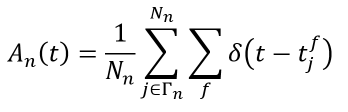
  • Population activity is defined by the equation below. Note that this equation is not specific to homogenous populations, it can be used for many other types of models as well. N refers to the total number of neurons in the population while nspikes counts the number of spikes between time t and a subsequent time t+Δt. The δ is the Dirac delta function and tjf is the time at which neuron j fires.

Eq1

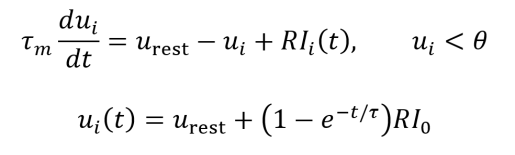
  • The electrophysiological activities of integrate-and-fire neurons are defined by the following differential equation and its solutions where τm is the membrane time constant (which equals the membrane resistance R times the membrane capacitance C), I(t) is the input current, and u is the membrane voltage. If the value of u passes a threshold ϴ, then a spike occurs and u is reset to the resting potential urest.

Eq2

  • One of the tools necessary for describing the activity of a homogenous population of integrate-and-fire neurons is a function α(t – tif) which represents the postsynaptic current generated by an input spike. Depending on the shape of the curve used to model the postsynaptic current, α(t – tif) might take on different forms.
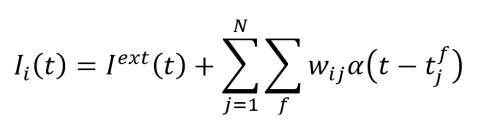
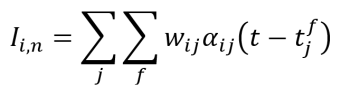
  • With all neurons are coupled to each other (and to themselves) in a homogenous population, the total current in any given neuron is the externally applied current plus the sum of all postsynaptic currents from input spikes multiplied by each interaction weight wij.

Eq3

  • For homogenous populations with homogenous all-to-all coupling and a constant interaction strength w0, the total current is the same in every neuron. This current is given by the following equation (since we can assume a continuum for a large population of neurons). The reason that the integral is multiplied by w0N is that every neuron is connected to the given neuron. Here, s represents the time at which a spike occurs.

Eq4

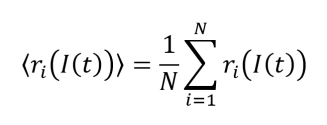
  • Consider a population in which each neuron has slightly different parameters from the others such that the firing rates ri(I(t)) vary over the population despite each neuron receiving the same input current. If the population is large, then the function which describes the variation in firing rate can be linearized around the average firing rate (and neglecting the higher-order terms of the Taylor series). As such, this simplification (the linearized model) can still be useful for some applications.

Eq5

  • The above expression can also be thought of as indicating that the mean firing rate of the population is equal to the firing rate of a “typical” neuron (with “typical” parameters) in the population.
  • In cases that involve more dramatic variations within populations of neurons, the averaging technique described above is insufficient. For instance, consider a population in which half the neurons are described by a set of parameters p1 and the other half by a set of significantly different parameters p2. This population should be split and regarded as two homogenous populations.
  • Indeed, any population composed of subsets which differ significantly from each other should be decomposed into the homogenous subsets. The same applies to populations composed of neurons with identical parameters, but with subsets that receive significantly different input currents.

Connectivity schemes and scaling

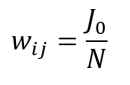
  • Using these techniques, populations of different sizes can give similar results if a scaling law is applied to the connection weights. For a homogenous population with all-to-all connectivity, the appropriate scaling law is as follows. J0 is the number of neurons before scaling and N is the number of neurons after scaling.

Eq6

  • Increasing the size of a population while keeping its connectivity the same allows for noise reduction. This is especially useful since some populations are quite small. For instance, a single layer within a cortical column might have only a few hundred neurons.
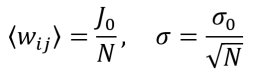
  • Another all-to-all coupling model involves using a Gaussian distribution of weights with the following mean and standard deviation (σ0 is the standard deviation of weights prior to scaling).

Eq7

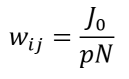
  • Populations can also be modeled by setting a fixed coupling probability p (among N2 possible connections). In this type of model, the mean number of connections to a neuron j is then given by pN and the variance is p(1 – p)N. Alternatively, each neuron j can send outputs to pN partners. To scale a population with a fixed coupling probability, the equation below is used so that the average number of inputs to each neuron does not change as the population size changes.

Eq8

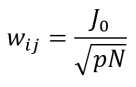
  • Some simulations can assume a balanced population of excitatory and inhibitory neurons. In such cases, the mean input current is zero, so scaling the connection weights does not influence the mean. Instead, the weights should be scaled with respect to how they affect fluctuations about zero. This can be achieved using the following scaling equation.

Eq9

Interacting populations

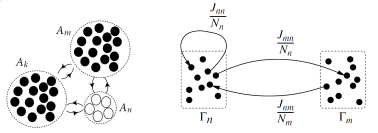
  • In the previous sections, balanced populations of excitatory and inhibitory neurons were used. Now, consider homogenous populations each consisting of either excitatory or inhibitory neurons, but not both. Fig.1
  • These populations can be visualized as spatially separated from each other, but this is not necessary for the model to work (and it is not biologically realistic). The populations could just as easily be spatially mixed.
  • The activity of neurons in homogenous population n is given by the equation below. The parameter Γn represents the set of neurons belonging to population n.

Eq10

  • With all-to-all coupling, each neuron i within pool n is assumed to receive inputs from every neuron j within pool m. The connection strength is wij=JnmNm where Jnm is the strength of an individual coupling from a neuron in pool m to a neuron in pool n and Nm is the number of neurons in pool m. As such, the input current to a neuron i will come from all the spikes in the network. Once again, α represents some given type of postsynaptic voltage-time function after an input current.

Eq11

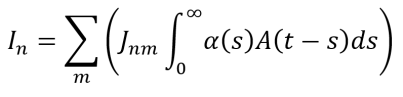
  • The input current can also be formulated by the equation below. Since the model provides identical input current to all neurons, the index i can be removed. Once again, s represents the time at which a spike occurs.

Eq12

Distance-dependent connectivity

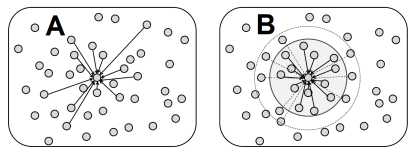
  • To better model neural populations, distance can provide an approximate measure for coupling probability (with more distant neurons having a lower probability of coupling). It should be noted that this is still a very rough model. Fig.2
  • In order to create a model with distance-dependent connectivity, each neuron i must be assigned a location x(i) on a two-dimensional cortical sheet.
  • For this type of model, all connections are assigned the same weight and the connection probability depends on distance (see part A of the diagram). P is a function which maps any vector to a real number on the interval [0,1].

Eq13

  • Alternatively, all-to-all coupling can be assumed with a strength wij that decreases with distance (see part B of the diagram). This is modeled by the following equation where g is a function that maps any vector to a real number. (For example, a Euclidean length metric inside of a decaying exponential).

Eq14

Spatial continuum models

  • Many neural populations in the brain exhibit properties which continuously vary across space (i.e. tonotopy and retinotopy). Of course, this kind of variation is not actually continuous at the level of individual neurons, but it is effectively continuous from the perspective of population modeling. Sets of homogenous populations cannot account for such continuous variation, so spatial continuum Fig.3models must be used when considering this kind of functional organization.
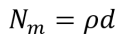
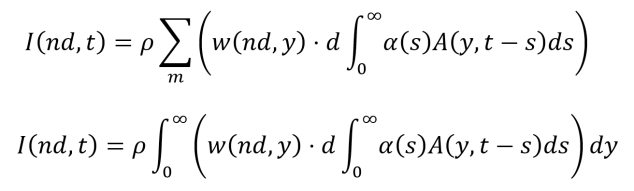
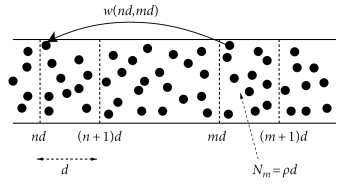
  • Consider a continuum of neurons along a one-dimensional axis and assume all-to-all coupling with connection strength dependent upon distance. This model uses the equation wij = g(|x(i) – x(j)|) as described in the previous section. Then discretize space into segments of length d. The number of neurons in a segment n is given by the following equation where ρ represents the density of neurons. Neurons within this interval belong to the set Γm.

 Eq15

  • For continuum models, the population activity of population m is described as a function of time and of the spatial position of the neurons belonging to population m. The latter is given by md since the distance along the axis is equal to the segment length times the index m.
  • The coupling strength between a neuron x(i) at location nd and a neuron x(j) at location md is a function w(nd,md) that defines a weighting measure depending on the distance between the two locations nd and md.
  • As such, the input current to a neuron in population m is computed using the following equation (top). The product of an input current from population n with the population activity induced in population m is found inside of the summation. All input currents to population m from the rest of the populations are then summed. For a large number of populations, this equation can be replaced by an equation with a second integral. For convenience, md has been replaced with y in these equations.

Eq16


Reference: Gerstner, W., Kistler, W. M., Naud, R., & Paninski, L. (2014). Neuronal Dynamics: From Single Neurons to Networks and Models of Cognition. New York, NY, USA: Cambridge University Press.


Notes on – Observing the cell in its native state: imaging subcellular dynamics in multicellular organisms (Betzig et al.)


No Comments

PDF Version: Notes on – Observing the cell in its native state imaging subcellular dynamics in multicellular organisms (Betzig et al.) – Logan Thrasher Collins

Overview

  • Eric Betzig, a 2014 Nobel laureate in chemistry (for playing a key role in developing super-resolution fluorescence microscopy), has continued to advance biological imaging technologies.
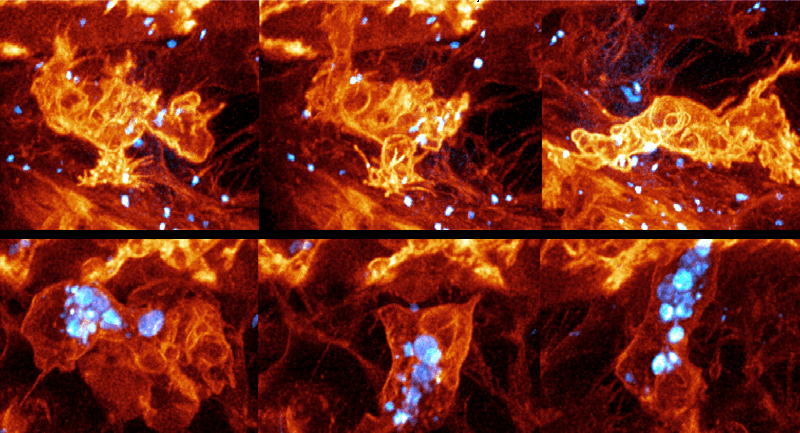
  • In their 2018 paper, “Observing the cell in its native state: imaging subcellular dynamics in multicellular organisms,” Betzig’s group combined lattice light sheet microscopy and adaptive optics to acquire 3-dimensional images and videos of physiological processes in vivo with subcellular resolution, achieving unprecedented detail and clarity.

Fig.0

Image source: (Liu et al., 2018)

Light sheet microscopy

  • Light sheet microscopy uses a laser and a cylindrical lens to project a plane of illumination through a sample.
  • As the sheet only illuminates a single plane of the sample at a time, this technique decreases photodamage relative to other methods which pass light through the entire sample at once. In addition, the single plane illumination decreases Fig.1background noise and so generates images with high contrast.
  • Light sheet microscopy operates rapidly since it scans entire layers of the sample all at once rather than scanning one point of light at a time (the latter is common with other types of microscopy).
  • Each layer of the sample is imaged in this way before the layers are stacked to reconstruct a 3-dimensional image. Betzig’s group used a mathematical algorithm called deconvolution to remove out-of-focus light and enhance more focused light within the Z-stacks generated by his lattice light sheet microscopy technique.

Image source: Jan Krieger, CC BY-SA 3.0, commons.wikimedia.org

Lattice light sheet microscopy

  • In lattice light sheet microscopy, the input laser is first stretched (in the x direction) by a pair of cylindrical lenses and then compressed (in the z direction) into a sheet by another pair of cylindrical lenses oriented perpendicularly to the first pair.
  • Lattice light sheet microscopes combine Bessel beams with 2D optical lattices using an optical element called a spatial light modulator. The spatial light modulator uses a ferroelectric liquid crystal display to create programmable gratings that diffract incoming light into a customized pattern. This is displayed in the figure from Förster et al., where a spatial light modulator displays a customized grid of white squares (light can pass through) and black squares (light is blocked) which forms a diffraction grating.Fig.2
    • Bessel beams are fields of electromagnetic radiation which can be mathematically described by Bessel functions of the first kind. Unlike most electromagnetic radiation, Bessel beams do not spread out as they propagate. As such, they do not form diffraction patterns. Although ideal Bessel beams are physically impossible, approximate forms of the phenomenon can be created.
    • 2D optical lattices arise from the interference of beams of light that exhibit periodic behavior in two dimensions. They can form the same set of patterns found in 2D Bravais lattices (which are a mathematical formulation for crystal structures).
  • On their own, neither Bessel beams nor 2D optical lattices are useful for light sheet microscopy, but they achieve superior properties for imaging when properly implemented together.
    • Bessel beams contain the same amount of energy in their “side lobes” as they do in their central peaks. For this region, they cause excessive illumination outside of the targeted plane. This is problematic for light sheet microscopy since the technique depends on having a focused plane of light.
    • Despite their name, 2D optical lattices extend into 3D space (since many “copies” of the planar lattice occur along the z direction). This is similarly problematic for light sheet microscopy since the technique depends on the light exhibiting confinement to the xy plane of focus.
    • These issues can be overcome by combining Bessel beams and 2D optical lattices. To achieve this, a ring (or annulus) of illumination is used to destructively interfere with the side lobes of the Bessel beams, creating Bessel-Gauss beams. Then an array of coherent Bessel-Gauss beams is generated (two waves with a constant phase difference, the same frequency, and the same waveform are coherent). This array of Bessel-Gauss beams is suitable as a light sheet for lattice light sheet microscopy.

Image source: (Förster et al., 2014)

Adaptive optics

  • The light used for excitation in lattice light sheet microscopy traverses different regions of the sample relative to the detected light. As such, the light involved in excitation and the light involved in detection are subject to different aberrations.
  • To adjust for such aberrations, Betzig’s group used a two-photon excitation beam from an ultrafast Ti:Sapphire laser. This beam creates a “guide star” (this term comes from a similar technique used in astronomy) which acts as a reference. The guide star is scanned over the entire focal plane so as to compute an average correction since average correction has more accuracy than a correction from a single point in the sample.
  • Next, a switching galvanometer SG1 (a device which rotates a mirror back and forth) facilitates transfer of the two-photon excitation beam to either the excitation or detection arms of the microscope as needed. Fig.3
  • For the detection beam, the light generated from the scanned guide star is collected and sent to a device called a Shack-Hartmann wavefront sensor using another switching galvanometer SG2.
    • The Shack-Hartmann wavefront sensor contains an array of small sensors which measure the “tilts” of the incoming plane waves. By measuring the local tilt of each small wavefront composing the detected light beam, the overall shape of any optical aberration can be approximated.
    • Then a deformable mirror is modified to precisely compensate for the aberration measured by the Shack-Hartmann wavefront sensor. The second switching galvanometer SG2 transfers the light to this deformable mirror. After reflecting from the deformable mirror, the aberration is corrected and the detection objective collects the light to create an image.
  • For the excitation beam, the light from the two-photon excitation laser is scanned over the sample as a guide star and then collected by the excitation objective.
    • The collected light is transferred to another Shack-Hartmann wavefront sensor. Once again, the sensor measures an approximate representation of any optical aberration which occurs.
    • Next, the spatial light modulator used in creating the light sheet itself applies the appropriate correction to the excitation beam. This is highly effective since the spatial light modulator provides exquisite control over the output light sheet. 

Image source: (Liu et al., 2018)

References

Chen, B.-C., Legant, W. R., Wang, K., Shao, L., Milkie, D. E., Davidson, M. W., … Betzig, E. (2014). Lattice light-sheet microscopy: Imaging molecules to embryos at high spatiotemporal resolution. Science, 346(6208). Retrieved from http://science.sciencemag.org/content/346/6208/1257998.abstract

Förster, R., Lu-Walther, H.-W., Jost, A., Kielhorn, M., Wicker, K., & Heintzmann, R. (2014). Simple structured illumination microscope setup with high acquisition speed by using a spatial light modulator. Optics Express, 22(17), 20663–20677. http://doi.org/10.1364/OE.22.020663

Liu, T.-L., Upadhyayula, S., Milkie, D. E., Singh, V., Wang, K., Swinburne, I. A., … Betzig, E. (2018). Observing the cell in its native state: Imaging subcellular dynamics in multicellular organisms. Science, 360(6386). Retrieved from http://science.sciencemag.org/content/360/6386/eaaq1392.abstract