Notes on – Observing the cell in its native state: imaging subcellular dynamics in multicellular organisms (Betzig et al.)


No Comments

PDF Version: Notes on – Observing the cell in its native state imaging subcellular dynamics in multicellular organisms (Betzig et al.) – Logan Thrasher Collins

Overview

  • Eric Betzig, a 2014 Nobel laureate in chemistry (for playing a key role in developing super-resolution fluorescence microscopy), has continued to advance biological imaging technologies.
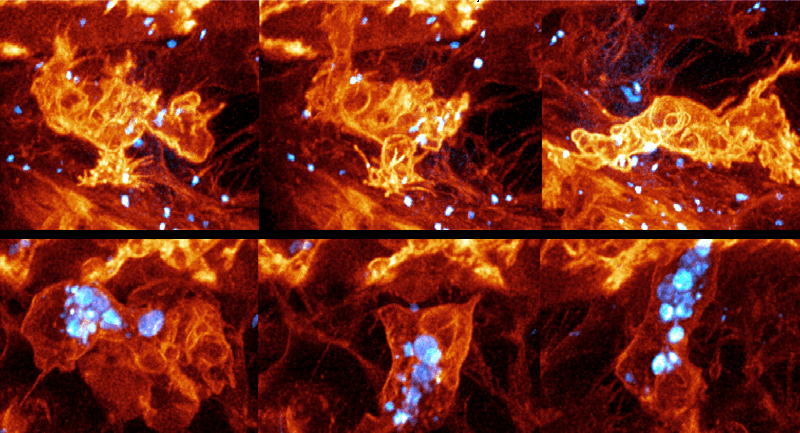
  • In their 2018 paper, “Observing the cell in its native state: imaging subcellular dynamics in multicellular organisms,” Betzig’s group combined lattice light sheet microscopy and adaptive optics to acquire 3-dimensional images and videos of physiological processes in vivo with subcellular resolution, achieving unprecedented detail and clarity.

Fig.0

Image source: (Liu et al., 2018)

Light sheet microscopy

  • Light sheet microscopy uses a laser and a cylindrical lens to project a plane of illumination through a sample.
  • As the sheet only illuminates a single plane of the sample at a time, this technique decreases photodamage relative to other methods which pass light through the entire sample at once. In addition, the single plane illumination decreases Fig.1background noise and so generates images with high contrast.
  • Light sheet microscopy operates rapidly since it scans entire layers of the sample all at once rather than scanning one point of light at a time (the latter is common with other types of microscopy).
  • Each layer of the sample is imaged in this way before the layers are stacked to reconstruct a 3-dimensional image. Betzig’s group used a mathematical algorithm called deconvolution to remove out-of-focus light and enhance more focused light within the Z-stacks generated by his lattice light sheet microscopy technique.

Image source: Jan Krieger, CC BY-SA 3.0, commons.wikimedia.org

Lattice light sheet microscopy

  • In lattice light sheet microscopy, the input laser is first stretched (in the x direction) by a pair of cylindrical lenses and then compressed (in the z direction) into a sheet by another pair of cylindrical lenses oriented perpendicularly to the first pair.
  • Lattice light sheet microscopes combine Bessel beams with 2D optical lattices using an optical element called a spatial light modulator. The spatial light modulator uses a ferroelectric liquid crystal display to create programmable gratings that diffract incoming light into a customized pattern. This is displayed in the figure from Förster et al., where a spatial light modulator displays a customized grid of white squares (light can pass through) and black squares (light is blocked) which forms a diffraction grating.Fig.2
    • Bessel beams are fields of electromagnetic radiation which can be mathematically described by Bessel functions of the first kind. Unlike most electromagnetic radiation, Bessel beams do not spread out as they propagate. As such, they do not form diffraction patterns. Although ideal Bessel beams are physically impossible, approximate forms of the phenomenon can be created.
    • 2D optical lattices arise from the interference of beams of light that exhibit periodic behavior in two dimensions. They can form the same set of patterns found in 2D Bravais lattices (which are a mathematical formulation for crystal structures).
  • On their own, neither Bessel beams nor 2D optical lattices are useful for light sheet microscopy, but they achieve superior properties for imaging when properly implemented together.
    • Bessel beams contain the same amount of energy in their “side lobes” as they do in their central peaks. For this region, they cause excessive illumination outside of the targeted plane. This is problematic for light sheet microscopy since the technique depends on having a focused plane of light.
    • Despite their name, 2D optical lattices extend into 3D space (since many “copies” of the planar lattice occur along the z direction). This is similarly problematic for light sheet microscopy since the technique depends on the light exhibiting confinement to the xy plane of focus.
    • These issues can be overcome by combining Bessel beams and 2D optical lattices. To achieve this, a ring (or annulus) of illumination is used to destructively interfere with the side lobes of the Bessel beams, creating Bessel-Gauss beams. Then an array of coherent Bessel-Gauss beams is generated (two waves with a constant phase difference, the same frequency, and the same waveform are coherent). This array of Bessel-Gauss beams is suitable as a light sheet for lattice light sheet microscopy.

Image source: (Förster et al., 2014)

Adaptive optics

  • The light used for excitation in lattice light sheet microscopy traverses different regions of the sample relative to the detected light. As such, the light involved in excitation and the light involved in detection are subject to different aberrations.
  • To adjust for such aberrations, Betzig’s group used a two-photon excitation beam from an ultrafast Ti:Sapphire laser. This beam creates a “guide star” (this term comes from a similar technique used in astronomy) which acts as a reference. The guide star is scanned over the entire focal plane so as to compute an average correction since average correction has more accuracy than a correction from a single point in the sample.
  • Next, a switching galvanometer SG1 (a device which rotates a mirror back and forth) facilitates transfer of the two-photon excitation beam to either the excitation or detection arms of the microscope as needed. Fig.3
  • For the detection beam, the light generated from the scanned guide star is collected and sent to a device called a Shack-Hartmann wavefront sensor using another switching galvanometer SG2.
    • The Shack-Hartmann wavefront sensor contains an array of small sensors which measure the “tilts” of the incoming plane waves. By measuring the local tilt of each small wavefront composing the detected light beam, the overall shape of any optical aberration can be approximated.
    • Then a deformable mirror is modified to precisely compensate for the aberration measured by the Shack-Hartmann wavefront sensor. The second switching galvanometer SG2 transfers the light to this deformable mirror. After reflecting from the deformable mirror, the aberration is corrected and the detection objective collects the light to create an image.
  • For the excitation beam, the light from the two-photon excitation laser is scanned over the sample as a guide star and then collected by the excitation objective.
    • The collected light is transferred to another Shack-Hartmann wavefront sensor. Once again, the sensor measures an approximate representation of any optical aberration which occurs.
    • Next, the spatial light modulator used in creating the light sheet itself applies the appropriate correction to the excitation beam. This is highly effective since the spatial light modulator provides exquisite control over the output light sheet. 

Image source: (Liu et al., 2018)

References

Chen, B.-C., Legant, W. R., Wang, K., Shao, L., Milkie, D. E., Davidson, M. W., … Betzig, E. (2014). Lattice light-sheet microscopy: Imaging molecules to embryos at high spatiotemporal resolution. Science, 346(6208). Retrieved from http://science.sciencemag.org/content/346/6208/1257998.abstract

Förster, R., Lu-Walther, H.-W., Jost, A., Kielhorn, M., Wicker, K., & Heintzmann, R. (2014). Simple structured illumination microscope setup with high acquisition speed by using a spatial light modulator. Optics Express, 22(17), 20663–20677. http://doi.org/10.1364/OE.22.020663

Liu, T.-L., Upadhyayula, S., Milkie, D. E., Singh, V., Wang, K., Swinburne, I. A., … Betzig, E. (2018). Observing the cell in its native state: Imaging subcellular dynamics in multicellular organisms. Science, 360(6386). Retrieved from http://science.sciencemag.org/content/360/6386/eaaq1392.abstract


Notes on two-photon microscopy


No Comments

PDF version: Notes on two-photon microscopy – Logan Thrasher Collins

Hardware for two-photon microscopy

(Svoboda & Yasuda, 2006)

  • In two-photon microscopy, a rapidly pulsed laser excites a fluorophore via two lower energy photons (which are typically red to infrared range). The fluorophore then emits a higher energy photon which is detected by the microscope.
  • Two-photon microscopy is usually implemented using a laser scanning microscope. The laser is tightly focused on a small focal volume, then scanned over the sample’s area to acquire information from each point within the sample. When the laser overlaps with fluorophores, photons are emitted from the given focal volume. All of these points are mapped to pixels and the full image is reconstructed computationally.
  • Since the focal volumes used in two-photon microscopy are small, high excitation intensities are needed to generate enough emitted signal. This necessitates rapid trains of short pulses from the excitation laser. Mode-locked Ti:sapphire lasers have a frequency of about 100 MHz, a pulse duration of about 100 femtoseconds, and their wavelength can be tuned from about 700-1,000 nm. These properties are nearly ideal for most fluorophores. If the required wavelengths are over 1,000 nm, other types of lasers are available as well.
  • Some examples of fluorophores used with two-photon microscopy include transgenic fluorescent proteins (i.e. XFPs), organic calcium indicator dyes, and other types of fluorescent dye molecules.

Advantages of two-photon microscopy

(Svoboda & Yasuda, 2006)

  • The absorption rate of the fluorophore is given by the intensity of the laser squared. This nonlinear process allows excitation to occur only within the described small focal volumes. When using a high numerical aperture objective, the diameter of an individual focal volume can reach down to just 100 nm. Fig.1
  • Since two-photon microscopy uses long wavelengths, the light penetrates tissue more deeply than with most other techniques.
  • As a result of the nonlinear excitation process which requires two photons in order to excite a fluorophore, single photons scattered by the tissue are too dilute to cause much off-target fluorescence.
  • The only photons which do experience scattering are those which come from the localized focal volume. As such, they still provide useful signal if detected. In traditional fluorescence microscopy, scattered photons are typically lost or they contribute to background fluorescence.
  • It is relatively easy to modify confocal fluorescence microscopes to create two-photon microscopes. Academic laboratories sometimes perform such modifications in-house.

Selected applications of two-photon microscopy

(Ellis-Davies, 2011)

  • Cortical neurons within transgenic mice expressing GFP and transgenic mice expressing YFP were imaged in vivo using two-photon microscopy by the Gan and Svoboda groups respectively. The fluorescent proteins were expressed only by a subset of neurons, allowing for higher contrast against the background. In this way, entire dendritic trees of pyramidal neurons were imaged at depths of up to 500-600 Fig.2 μm. The method established that, under the conditions used, most of the dendritic spines in the mouse neocortex remain fairly stable over a period of one month.
  • Later studies using similar techniques but with deliberate ablations to various sensory systems showed greater destabilization of dendritic spines, indicating that sensory memories might be partly encoded in spine patterns.
  • Two-photon microscopy also helped reveal that spines in the motor cortex show significantly greater stabilization during motor learning tasks than spines elsewhere in the cortex. This was demonstrated in both mice and songbirds.

Two-photon photolysis of caged neurotransmitters

(Matsuzaki, Hayama, Kasai, & Ellis-Davies, 2010)

  • The Ellis-Davies group developed modified glutamate and GABA molecules that include moieties which block their biological function. Such caged neurotransmitters are initially inactive, but can undergo photolysis when exposed to the excitation lasers used in two-photon microscopy, releasing the active molecules. Fig.3
  • Two-photon photolysis was used on caged glutamate within neural tissue samples, causing localized release of glutamate and the induction of action potentials.
  • Similarly, caged GABA was photolyzed by two-photon excitation. By combining this technique with patch-clamp recording, electrical activity was mapped on neural membranes, allowing GABA receptor distributions over the membranes to be estimated.


References

Ellis-Davies, G. C. R. (2011). Two-Photon Microscopy for Chemical Neuroscience. ACS Chemical Neuroscience, 2(4), 185–197. http://doi.org/10.1021/cn100111a

Matsuzaki, M., Hayama, T., Kasai, H., & Ellis-Davies, G. C. R. (2010). Two-photon uncaging of γ-aminobutyric acid in intact brain tissue. Nature Chemical Biology, 6, 255. Retrieved from http://dx.doi.org/10.1038/nchembio.321

Svoboda, K., & Yasuda, R. (2006). Principles of Two-Photon Excitation Microscopy and Its Applications to Neuroscience. Neuron, 50(6), 823–839. http://doi.org/10.1016/j.neuron.2006.05.019


Notes on Banach and Hilbert Spaces


No Comments

PDF Version: Notes on Banach and Hilbert Spaces – Logan Thrasher Collins

  • Banach spaces are normed vector spaces with the property of completeness.
  • Hilbert spaces are normed vector spaces with the property of completeness for which the norm is determined via an inner product.
  • Hilbert spaces are always Banach spaces, but Banach spaces are not always Hilbert spaces.
  • A vector space is a set equipped with vector addition and scalar multiplication which also satisfies the following axioms for all scalars a,b and all vectors u,v,w.

Equ1

  • The norm of a vector space V is a function p on a field F (often the real or complex numbers) defined below. The conditions which must be satisfied include (i) the triangle inequality, (ii) absolute scalability, and (iii) positive definiteness.

Equ2

  • Norms are often denoted by double brackets as |||| with the dot indicating an arbitrary norm. Vectors and functions of vectors can also be placed between the brackets to indicate the norm on said vector or vector-valued function.
  • The inner product of a vector space V is a function <,> which takes two elements of the vector space and maps them to the field F which the vector space is defined over. An inner product must satisfy the axioms of (i) conjugate symmetry, (ii) linearity in the first argument, and (iii) positive definiteness.

Equ3

  • Note that the linearity axiom of an inner product is sometimes defined with respect to the second argument (rather than the first), particularly in physics disciplines.
  • When an inner product is defined, the norm and the inner product are related by the following formula.

Equ4

  • Completeness is a mathematical property of metric spaces. Normed vector spaces are a type of metric space, though vector spaces in general are not necessarily metric spaces. A metric space M is called complete if every Cauchy sequence of points in M converges to a limit L which is also in M.
  • Cauchy sequences are sequences (xn)n∈ℕ within normed vector spaces for which distinct terms can be made arbitrarily close to each other if one goes far enough into the sequence. This is expressed by the following relation where ε denotes a distance.

Equ5

  • Convergent sequences are sequences (xn)n∈ℕ within normed vector spaces for which the following holds. For every distance ε, there exists an index N∈ℕ such that all terms beyond N have a distance to L less than ε. This is expressed below in symbolic form.

Equ6

  • Every convergent sequence is a Cauchy sequence and every convergent sequence has a unique limit.
  • Some examples of Banach spaces include (ℝ, ||||), (ℂ, ||||), and (ℝd, ||||2). For the first two cases, the norms are given by the absolute value |a – b| where a and b are real or complex numbers. The third case uses the Euclidean norm (x12+x22+x32+…+xd2)1/2 where xi are components of a d-dimensional vector x.
  • Some examples of Hilbert spaces include ℝn with the vector dot product <u,v>, ℂn with the vector dot product <u,v*> (in which the complex conjugate of the second argument is taken), and the infinite dimensional Hilbert space L2 which is the set of all real-valued functions such that the inner product given below does not diverge.

Equ7